

What Time Was It 5 Hours Ago? Calculate the Exact Time
If you want to know what time was it 5 hours ago, subtract 5 hours from the current time. For example, if it is 2:00 PM now, 5 hours ago it was 9:00 AM. If it is 3:00 AM now, 5 hours ago it was 10:00 PM on the previous day.
The calculation is simple, but the answer can become confusing when you cross midnight, switch between AM and PM, or compare different time zones. This guide explains how to calculate five hours ago manually, use a time calculator, handle the 12-hour and 24-hour clocks, and avoid common mistakes.
Understanding What Time Was It 5 Hours Ago
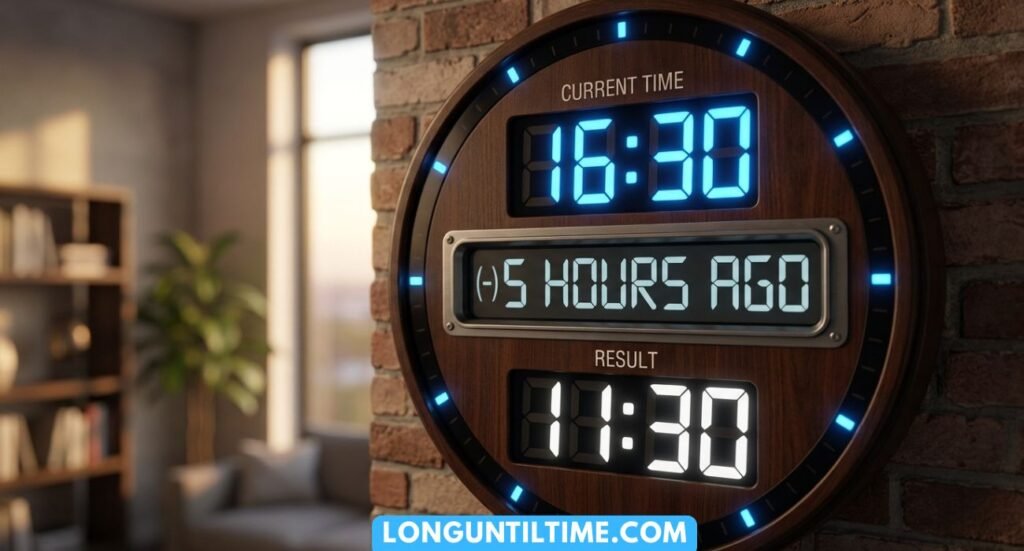
The phrase “5 hours ago” means a point in time exactly five hours before the current or reference time. To find it, you move backward on the clock by five complete hours.
The basic formula is:
Time 5 hours ago = Current time − 5 hours
For example, if the current time is 10:00 AM, subtracting five hours gives 5:00 AM. If the current time is 8:30 PM, the result is 3:30 PM.
The minutes and seconds normally stay the same when you subtract exactly five hours. So, if the current time is 11:42 AM, five hours earlier was 6:42 AM. Likewise, if the current time is 7:18:30 PM, five hours earlier was 2:18:30 PM.
The main exception is when the calculation moves backward past midnight. In that case, the time belongs to the previous calendar date.
Because there is no single answer to “what time was it 5 hours ago” without knowing the starting time, you should always identify the current time, the reference date, and, when locations are involved, the relevant local time.
How Time Subtraction Actually Works
Time subtraction works much like ordinary subtraction, but a clock repeats after reaching midnight. A normal day contains 24 hours, so moving five hours backward simply means moving five positions around a 24-hour cycle.
Suppose the current time is 4:00 PM. Moving backward one hour gives 3:00 PM, two hours gives 2:00 PM, and continuing for five hours gives 11:00 AM.
The calculation is:
4:00 PM − 5 hours = 11:00 AM
For a time with minutes, the minutes remain unchanged when the amount being subtracted is a whole number of hours.
For example:
| Current Time | Subtract 5 Hours | Time 5 Hours Ago |
|---|---|---|
| 9:00 AM | 5 hours | 4:00 AM |
| 11:30 AM | 5 hours | 6:30 AM |
| 2:15 PM | 5 hours | 9:15 AM |
| 6:45 PM | 5 hours | 1:45 PM |
| 10:20 PM | 5 hours | 5:20 PM |
This works because one hour contains 60 minutes. Subtracting five hours means subtracting 300 minutes:
5 × 60 = 300 minutes
You can therefore think of the calculation as moving backward 300 minutes from the reference time.
Seconds work in the same way. If it is 9:25:40 AM now, five hours earlier was 4:25:40 AM.
Why Reverse Time Calculation Matters in Everyday Life
Knowing how to calculate a previous time can be useful whenever you need to reconstruct a schedule or determine when something happened.
Someone might ask what was 5 hours ago from now after noticing an old message, checking a work record, reviewing an appointment, or trying to remember when an event occurred. The same calculation can also help when looking backward from a flight time, work shift, scheduled event, or digital timestamp.
Reverse time calculation is especially useful because clocks tell you where you are in the present, while many everyday questions require you to look backward.
For example, imagine that a meeting starts at 6:00 PM and you want to know when a five-hour preparation period began. You can subtract five hours:
6:00 PM − 5 hours = 1:00 PM
The calculation does not require a special tool. You only need to understand how the clock changes as you move backward.
The important part is to distinguish between elapsed time and a clock’s displayed time. Five hours is always 300 minutes, but the displayed hour can change from AM to PM or move to the previous date.
What Time Was It 5 Hours Ago Using the 12-Hour Clock
The 12-hour clock divides the day into two periods: AM and PM. This is the clock system most people commonly see in everyday life in the United States.
When using this system, subtract five hours from the displayed hour and make sure the AM or PM designation remains correct.
For example:
9:00 AM − 5 hours = 4:00 AM
Here, both times are in the morning.
Another example is:
1:00 PM − 5 hours = 8:00 AM
This calculation crosses from PM into AM, so the AM/PM label changes.
Here are several examples:
| Current Time | 5 Hours Ago |
|---|---|
| 7:00 AM | 2:00 AM |
| 10:30 AM | 5:30 AM |
| 12:00 PM | 7:00 AM |
| 2:30 PM | 9:30 AM |
| 5:15 PM | 12:15 PM |
| 8:45 PM | 3:45 PM |
| 11:00 PM | 6:00 PM |
The most important point is that 12:00 PM is noon, while 12:00 AM is midnight. Confusing these two times can produce an incorrect answer.
For instance, five hours before 12:00 PM is 7:00 AM, while five hours before 12:00 AM is 7:00 PM on the previous day.
What Time Was It 5 Hours Ago Using the 24-Hour Clock
The 24-hour clock represents midnight as 00:00 and continues through 23:59. It removes the need for AM and PM labels and can make reverse calculations easier.
For example:
14:00 − 5 hours = 09:00
That corresponds to 2:00 PM and 9:00 AM in the 12-hour system.
More examples include:
| 24-Hour Current Time | 5 Hours Earlier | 12-Hour Equivalent |
|---|---|---|
| 08:00 | 03:00 | 3:00 AM |
| 12:30 | 07:30 | 7:30 AM |
| 15:45 | 10:45 | 10:45 AM |
| 18:20 | 13:20 | 1:20 PM |
| 22:15 | 17:15 | 5:15 PM |
The 24-hour clock becomes particularly useful around midnight.
Suppose the current time is 03:00. Simply subtracting five from 3 produces −2, which is not a valid hour on a standard clock. Instead, move backward through midnight:
03:00 − 5 hours = 22:00 on the previous day
In the 12-hour system, that is 10:00 PM on the previous day.
Crossing Midnight: The Most Common Mistake
Crossing midnight is one of the easiest ways to make a mistake when calculating 5 hours ago.
If the current time is later than 5:00 AM, subtracting five hours usually stays on the same calendar date. If the current time is between midnight and 5:00 AM, subtracting five hours takes you into the previous day.
For example:
2:00 AM − 5 hours = 9:00 PM the previous day
You can see the movement by counting backward:
2:00 AM → 1:00 AM → 12:00 AM → 11:00 PM → 10:00 PM → 9:00 PM
That is five hours.
Another example:
4:30 AM − 5 hours = 11:30 PM the previous day
The clock time is 11:30 PM, but the date has also changed.
This matters whenever the exact date is important. Saying “5 hours ago it was 11:30 PM” without mentioning the previous date could cause confusion if you are recording an event, checking a schedule, or comparing timestamps.
A useful way to avoid the mistake is to ask yourself whether the backward calculation passes through midnight. If it does, move the date back by one day.
Manual Time Arithmetic Without a Calculator
You can calculate five hours ago without an online tool. The easiest approach is to move backward one hour at a time or subtract five from the hour when the result remains within the same day.
Start with the exact reference time. Then subtract five hours. Finally, check the AM/PM designation and determine whether the date changed.
For example, if it is 4:15 PM:
4:15 PM − 5 hours = 11:15 AM
The minutes remain 15 because you are subtracting complete hours.
For an early-morning time, the process is slightly different. If it is 2:15 AM, moving backward five hours takes you across midnight:
2:15 AM − 5 hours = 9:15 PM on the previous day
Another way to verify your result is to add five hours back. If you calculate 9:15 PM as the answer, then:
9:15 PM + 5 hours = 2:15 AM
That confirms the calculation.
Example 1
Suppose the current time is 10:30 AM.
Subtract five hours:
10:30 AM − 5 hours = 5:30 AM
No midnight crossing occurs, so the answer remains on the same date.
The answer is 5:30 AM.
Example 2
Suppose the current time is 7:45 PM.
Subtract five hours:
7:45 PM − 5 hours = 2:45 PM
The calculation stays within the afternoon and evening portion of the same date.
The answer is 2:45 PM.
Example 3
Suppose the current time is 3:20 AM.
Start moving backward five hours:
3:20 AM → 2:20 AM → 1:20 AM → 12:20 AM → 11:20 PM → 10:20 PM
Therefore:
3:20 AM − 5 hours = 10:20 PM on the previous day
The important detail is not only the clock time but also the date. The answer belongs to the previous calendar day.
Using Online Time Calculators
An online time calculator can perform the subtraction automatically when you provide the correct starting time. This is useful when you are working with exact timestamps, dates, or several time calculations.
For a simple five-hour calculation, you may not need a calculator at all. Manual subtraction is usually faster. An online calculator becomes more helpful when the calculation involves minutes, seconds, dates, or different locations.
For example, calculating five hours backward from 2:37:45 AM requires you to cross midnight and preserve the minutes and seconds. The result is:
9:37:45 PM on the previous day
A calculator can reduce the chance of accidentally changing the minutes or forgetting the date change.
When using an online tool, make sure you enter the correct reference time. If the calculator asks for a date or time zone, select the appropriate one. Otherwise, the displayed result may not match the local time you expected.
A countdown timer serves a different purpose. It normally counts forward or backward toward a duration or event, while a time calculator can help determine a specific clock time.
Time Zones Make Everything More Interesting
A five-hour subtraction is mathematically straightforward, but time zones can make the surrounding situation more complicated.
The phrase “5 hours ago” should normally be calculated from a particular reference clock. If two people are in different locations, they may see different local clock times even though they are referring to the same moment.
For example, suppose an event occurs at a specific instant and one person records it using Eastern Time while another uses Pacific Time. Their displayed clock times will differ because the locations use different local times.
The major U.S. time zones include Eastern, Central, Mountain, and Pacific Time, along with Alaska and Hawaii-Aleutian time zones. Their local clocks do not always show the same hour.
This distinction becomes important when calculating the time of a scheduled event. If someone asks, “What time was this event five hours ago?” first determine which clock or local time the question refers to.
Daylight saving time adds another layer. The relationship between local clocks can change when daylight saving time begins or ends. For simple “five hours ago” calculations, however, the key principle remains the same: subtract five elapsed hours from the reference instant.
It is also useful to distinguish between a time calculation and a time-zone conversion. Subtracting five hours answers how far back a moment occurred. Converting between time zones answers how the same moment appears on another local clock.
See Also : How Long Until 11pm? Calculate the Time, Use a Live Countdown
Real-Life Examples of Five-Hour Calculations
The question what time was it 5 hours ago appears in many ordinary situations. The arithmetic stays the same, but the reason for calculating it can change.
Imagine that a person received a message at 6:40 PM and wants to know when a five-hour period before that message began. The calculation is:
6:40 PM − 5 hours = 1:40 PM
For an overnight situation, suppose a digital record shows an activity at 2:10 AM. Five hours earlier was:
9:10 PM on the previous day
These examples show why the date can be just as important as the clock time.
The following reference table covers common situations:
| Reference Time | Five Hours Earlier |
|---|---|
| 5:00 AM | 12:00 AM |
| 7:30 AM | 2:30 AM |
| 10:00 AM | 5:00 AM |
| 1:00 PM | 8:00 AM |
| 3:30 PM | 10:30 AM |
| 6:00 PM | 1:00 PM |
| 9:15 PM | 4:15 PM |
| 11:45 PM | 6:45 PM |
| 2:00 AM | 9:00 PM previous day |
| 4:30 AM | 11:30 PM previous day |
Medication Timing
Time subtraction can help someone understand a medication timeline, such as determining when a previous recorded dose occurred if a timestamp is known.
For example, if a record shows a time of 8:00 PM and you need to identify a point five hours earlier, the mathematical calculation is:
8:00 PM − 5 hours = 3:00 PM
However, a time calculation does not determine when a medication should actually be taken. Medication instructions can depend on the specific medicine, dose, interval, and individual circumstances. Use the medication label or instructions from a qualified healthcare professional for dosing decisions.
The useful role of reverse time calculation here is simply to understand an existing timestamp accurately.
Flight Timing
Flight schedules can involve several different clocks, so calculating a previous time requires attention to the reference location.
Suppose a local flight-related event is scheduled for 6:00 PM, and you want to find the time five hours before that event according to the same local clock:
6:00 PM − 5 hours = 1:00 PM
Travel becomes more complicated when a flight crosses a time zone. The elapsed duration and the displayed local arrival time are not necessarily the same thing.
For example, a journey can take several hours while the destination clock shows a different local time because the destination uses another time zone. When working with flight information, identify whether you are calculating elapsed time or converting a scheduled time to another location.
Shift Calculation
Workers may need to look backward from a known time to determine when an earlier part of a shift occurred.
Suppose a shift-related record shows 5:30 PM, and you want to know what time was five hours earlier:
5:30 PM − 5 hours = 12:30 PM
Overnight shifts require additional care. If a worker’s record shows 3:00 AM, five hours earlier was 10:00 PM on the previous date.
This is why workplace records that cross midnight should include both the time and date. A clock time by itself can be ambiguous.
Memory Reconstruction
People sometimes use reverse time calculations to reconstruct a sequence of events. You might remember that something happened around 9:00 PM and want to determine what occurred five hours before it.
If the reference point is exactly 9:00 PM:
9:00 PM − 5 hours = 4:00 PM
The mathematics is exact, but the underlying memory may not be. If the original time was only an estimate, the calculated result is also based on that estimate.
For example, if someone remembers an event as “around 9 PM,” saying that it happened exactly at 4 PM five hours earlier would create more precision than the original information supports. The calculation can be exact while the input remains approximate.
Gaming
Gamers may encounter reverse time calculations when checking event schedules, tournament times, server events, livestreams, or scheduled resets.
Suppose an online event is scheduled for 8:00 PM in the relevant server’s time. Five hours before that time is:
8:00 PM − 5 hours = 3:00 PM
The important detail is the reference clock. A game server may use a different time zone from the player’s device. Your computer or phone can show your local time, while the game displays an event according to server time.
For that reason, always identify which clock the scheduled event uses before converting it.
Human Perception Versus Digital Precision
Five hours is a fixed amount of elapsed time, but people do not always experience five hours as feeling equally long.
An active afternoon can seem to pass quickly, while waiting for an appointment can make the same period feel much longer. This difference in perception does not change the mathematical duration.
Digital devices provide a more precise reference. A phone, computer, or other device can display hours, minutes, and sometimes seconds. If you have an exact timestamp, subtracting five hours gives an exact earlier timestamp.
For example:
11:18:42 AM − 5 hours = 6:18:42 AM
The five-hour interval is precise because five hours equals exactly 18,000 seconds:
5 × 60 × 60 = 18,000 seconds
Human memory may provide only an approximate starting point, but digital timestamps can provide a more precise reference for reverse calculations.
Tips for Accurate Reverse Time Calculation
Accurate reverse time calculation starts with a reliable reference time. If the starting time is wrong, the final answer will also be wrong.
A simple method is to first write down the exact hour and minutes. Then subtract five hours. After that, check whether you crossed midnight and whether the AM/PM designation changed.
When using a 12-hour clock, pay special attention to 12:00 AM and 12:00 PM. Midnight is 12:00 AM, while noon is 12:00 PM.
When using a 24-hour clock, remember that midnight is represented as 00:00. If subtracting five hours takes the result below 00:00, continue backward from the previous day’s 24-hour cycle.
If you are working with an event in another location, confirm the relevant time zone before doing the calculation. A five-hour difference from one local clock should not automatically be treated as a five-hour time-zone difference.
Finally, verify your answer by adding five hours to it. If the original time comes back, your subtraction is consistent.
For example:
3:20 AM − 5 hours = 10:20 PM previous day
Verification:
10:20 PM + 5 hours = 3:20 AM
This simple check is especially helpful when the calculation crosses midnight.
See Also : How Long Until 2:30? Calculate the Exact Time Left
How to Calculate 5 Hours Ago From Any Exact Time
Calculating five hours ago from any exact time only requires you to move backward by five hours. For example, if the reference time is 9:25 AM, five hours earlier was 4:25 AM. The minutes stay the same because you are subtracting complete hours.
If the calculation moves past midnight, remember to change the date as well. For example, five hours before 2:15 AM was 9:15 PM on the previous day. This simple check helps keep both the time and date accurate.
What Time Was It 5 Hours Ago in Minutes?
Five hours equals 300 minutes, so you can also calculate the answer by subtracting 300 minutes from the current time. This method can be useful when working with detailed timestamps or when a calculation includes both hours and minutes.
For example, if the current time is 4:30 PM, subtracting 300 minutes gives 11:30 AM. Thinking in minutes can make reverse time calculations easier when the starting time does not fall on an exact hour.
How to Check Your 5-Hour Time Calculation
After calculating what time was 5 hours ago, you can verify the answer by adding five hours back to it. If you reach the original time, your calculation is correct. For example, 2:45 PM plus five hours equals 7:45 PM.
This verification method is especially helpful when the calculation crosses midnight. If your answer is 10:20 PM on the previous day, adding five hours brings you back to 3:20 AM on the current day. Checking both the time and date helps prevent common errors.
When Should You Use a Time Calculator?
A simple five-hour calculation can usually be done mentally, but an online time calculator can be useful when you need to work with exact minutes, seconds, dates, or multiple time zones. It can reduce mistakes when several time calculations are involved.
A calculator is also helpful when you are checking schedules, timestamps, travel information, or events across different locations. Even when using a tool, confirm the reference time and time zone first so the result matches the situation you are trying to calculate.
Quick Reference: What Time Was It 5 Hours Ago?
If you need a fast answer, use the reference table below. These examples assume the starting time and the earlier time are based on the same local clock.
| If It Is Now | 5 Hours Ago Was |
|---|---|
| 6:00 AM | 1:00 AM |
| 8:00 AM | 3:00 AM |
| 10:00 AM | 5:00 AM |
| 12:00 PM | 7:00 AM |
| 2:00 PM | 9:00 AM |
| 4:00 PM | 11:00 AM |
| 6:00 PM | 1:00 PM |
| 8:00 PM | 3:00 PM |
| 10:00 PM | 5:00 PM |
| 12:00 AM | 7:00 PM previous day |
| 2:00 AM | 9:00 PM previous day |
| 4:00 AM | 11:00 PM previous day |
The pattern is simple: move the clock backward five hours and adjust the date if you pass midnight.
Frequently Asked Questions About What Time Was It 5 Hours Ago?
What time was it 5 hours ago?
Five hours ago is the current time minus five hours. For example, if it is 4:00 PM now, five hours ago it was 11:00 AM.
What was 5 hours ago from now?
To find what was 5 hours ago from now, subtract five hours from your current clock time. If the calculation crosses midnight, the answer falls on the previous calendar day.
What time was 5 hours before now?
“Five hours before now” means the same thing as “five hours ago.” Take the reference time and move backward by exactly five hours.
How do I calculate 5 hours ago manually?
Write down the current time, subtract five hours, and then check the AM/PM label and date. If you cross midnight, move the date back by one day.
What time was it 5 hours ago if it is 3 AM now?
If it is 3:00 AM now, five hours ago was 10:00 PM on the previous day.
What time was it 5 hours ago if it is 12 PM now?
If it is 12:00 PM, which is noon, five hours earlier was 7:00 AM on the same day.
Does 5 hours ago always mean the previous day?
No. The date only changes when subtracting five hours takes you before midnight. For example, five hours before 8:00 PM is 3:00 PM on the same day, while five hours before 2:00 AM is 9:00 PM on the previous day.
How many minutes are 5 hours?
Five hours equals 300 minutes because one hour contains 60 minutes and 5 × 60 = 300.
How many seconds are in 5 hours?
Five hours contains 18,000 seconds because one hour has 3,600 seconds and 5 × 3,600 = 18,000.
Can an online calculator tell me what time it was 5 hours ago?
Yes. A time calculator can subtract five hours from a specified reference time. For the most accurate result, enter the correct date, time, and time zone when the calculator provides those options.
What is 5 hours ago from 1 AM?
Five hours before 1:00 AM is 8:00 PM on the previous day.
What is 5 hours ago from 11 PM?
Five hours before 11:00 PM is 6:00 PM on the same day.
Conclusion
Finding what time was it 5 hours ago is usually a simple matter of subtracting five hours from the reference time. For example, five hours before 6:00 PM is 1:00 PM, while five hours before 3:00 AM is 10:00 PM on the previous day.
The most important details are the starting time, AM or PM, and whether the calculation crosses midnight. When different locations are involved, also check the relevant time zone. For simple calculations, manual subtraction is enough; for complex timestamps, dates, or location-based schedules, a reliable time calculator can help.

3 Comments