
12 Hours From Now Is What Time? Calculate the Exact Time Easily
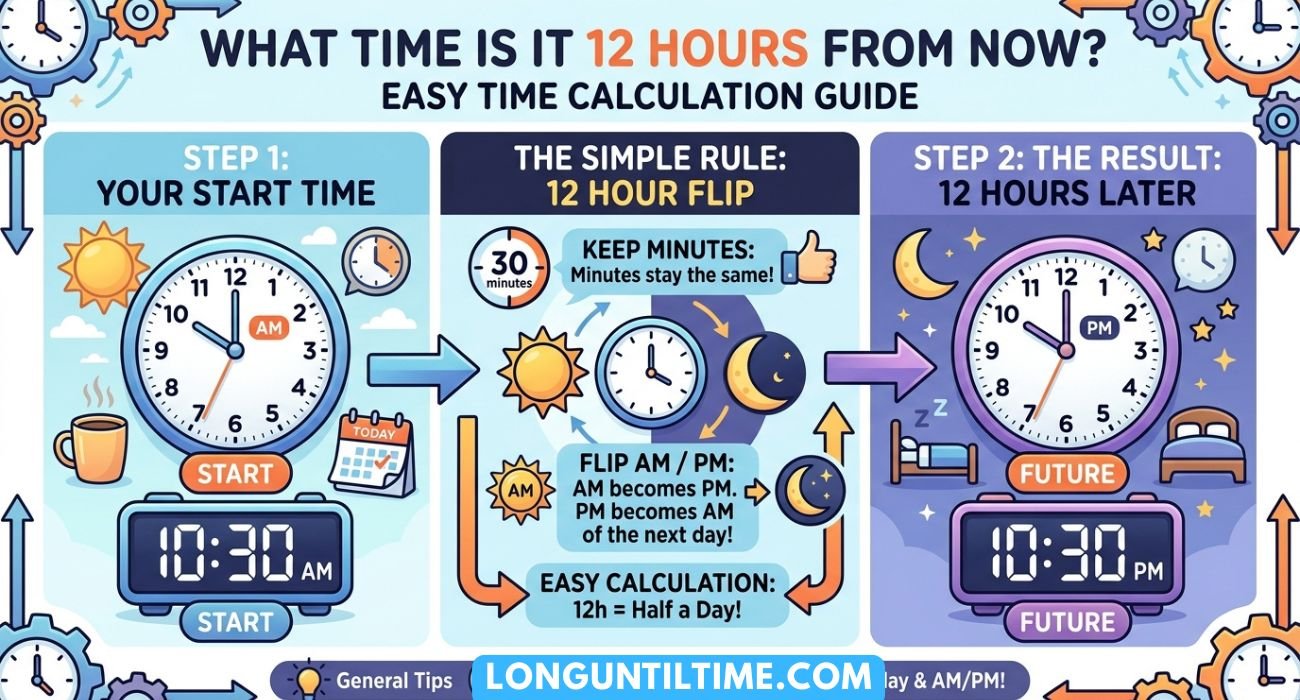
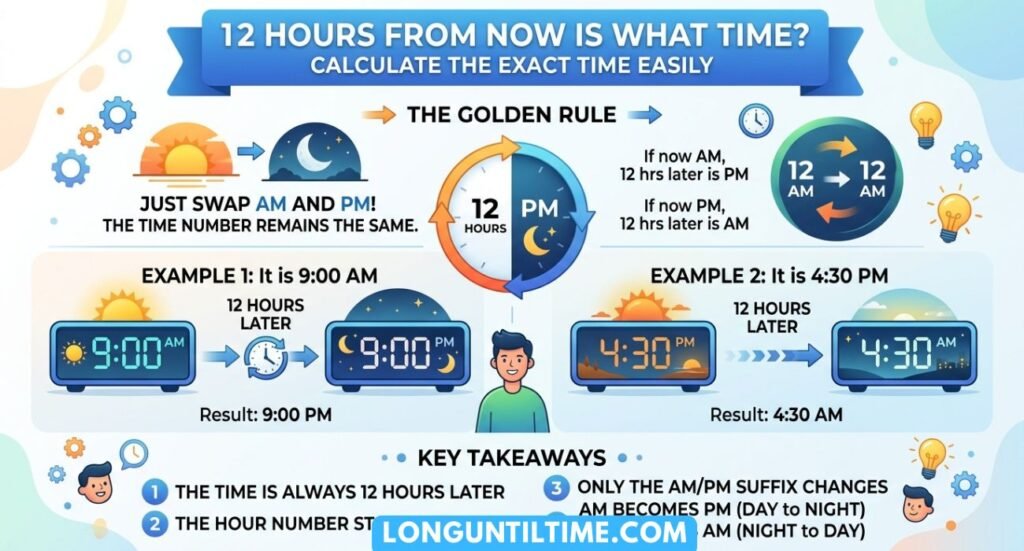
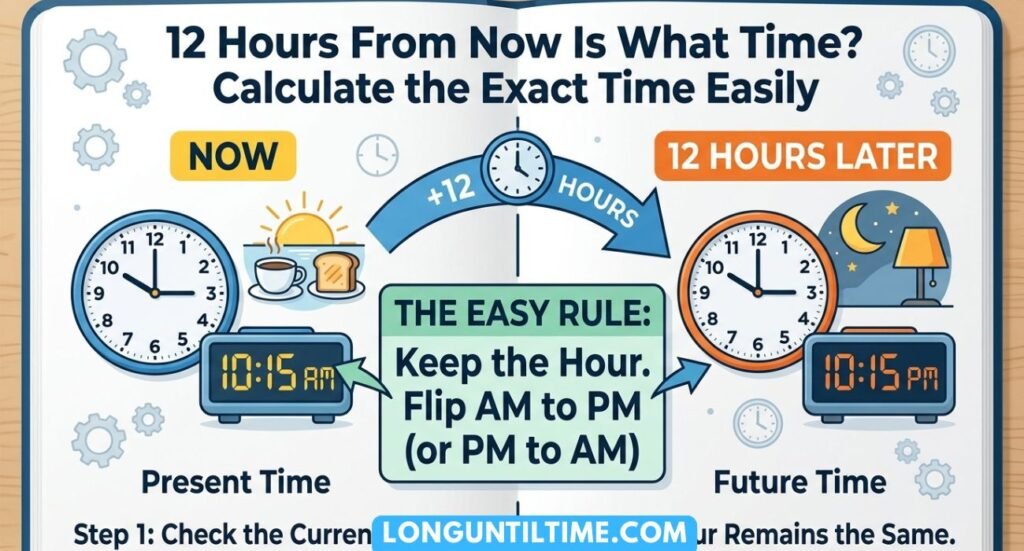
If you are wondering 12 hours from now is what time, the answer is found by adding 12 hours to your current local time. Because 12 hours is exactly half of a 24-hour day, the clock time stays the same while AM changes to PM or PM changes to AM.
For example, if it is 8:00 AM now, 12 hours from now will be 8:00 PM. If it is 8:00 PM now, 12 hours from now will be 8:00 AM the next day.
The exact date can change when the calculation passes midnight. This guide explains how to calculate 12 hours from now, how AM and PM work, what happens across midnight, and how time zones, 24-hour clocks, and time calculators affect the answer.
What Time Is 12 Hours From Now?
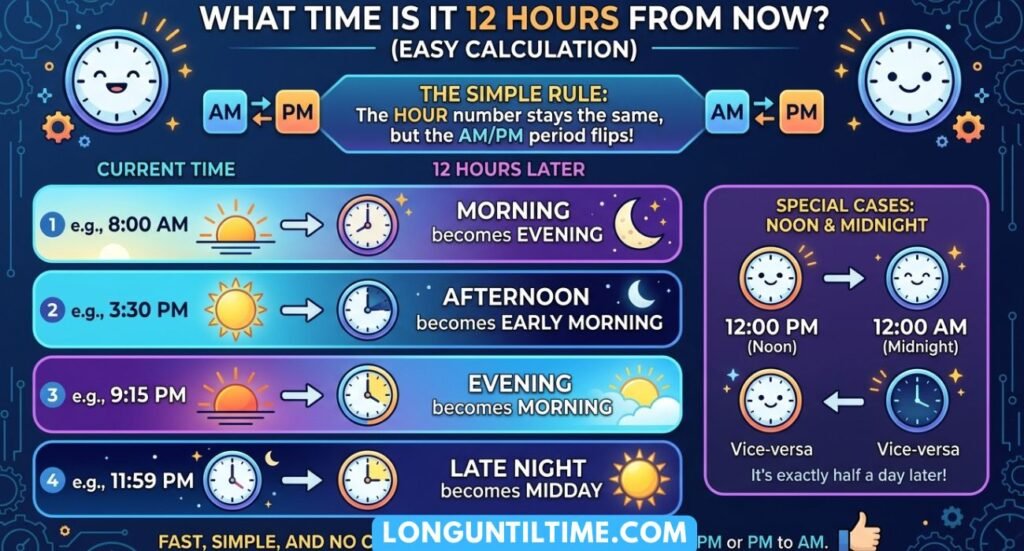
12 hours from now is the same clock time with AM and PM switched. The only additional detail to check is whether the calculation moves into the next calendar day.
For example:
| Current Time | 12 Hours From Now |
| 6:00 AM | 6:00 PM |
| 9:15 AM | 9:15 PM |
| 12:00 PM | 12:00 AM next day |
| 2:30 PM | 2:30 AM next day |
| 7:45 PM | 7:45 AM next day |
| 11:00 PM | 11:00 AM next day |
The minutes do not change when you add exactly 12 hours. A starting time of 4:25 remains 4:25; only the AM/PM designation changes.
So, if you search 12 hours from now is what time, first look at your current local clock. Then add 12 hours.
What Does “12 Hours From Now” Mean?
“12 hours from now” means a duration of exactly 12 hours beginning at the current moment.
If your clock currently shows 10:20 AM, then 12 hours later it will be 10:20 PM. If it shows 10:20 PM, the answer will be 10:20 AM on the following day.
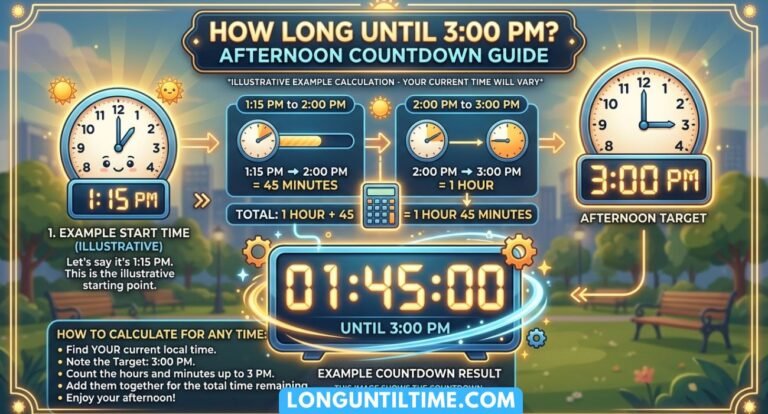
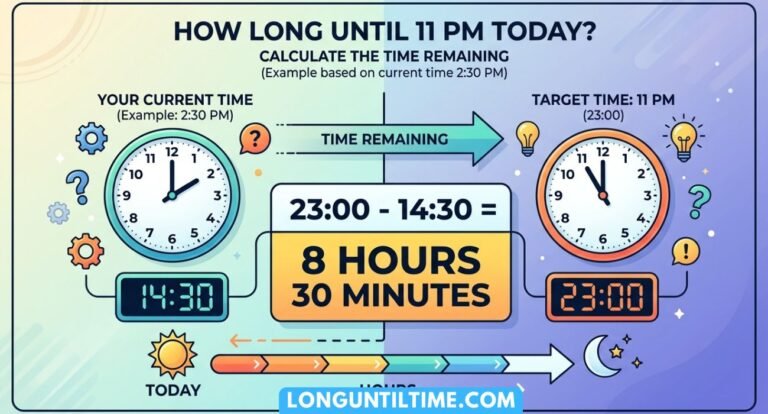
This is different from asking for a specific target time. For example, “What time is 12 hours from now?” starts with the current time and moves forward 12 hours, while “How long until 8 PM?” starts with a target clock time and calculates the remaining duration.
Is 12 Hours From Now AM or PM?
The answer depends on the current half of the day.
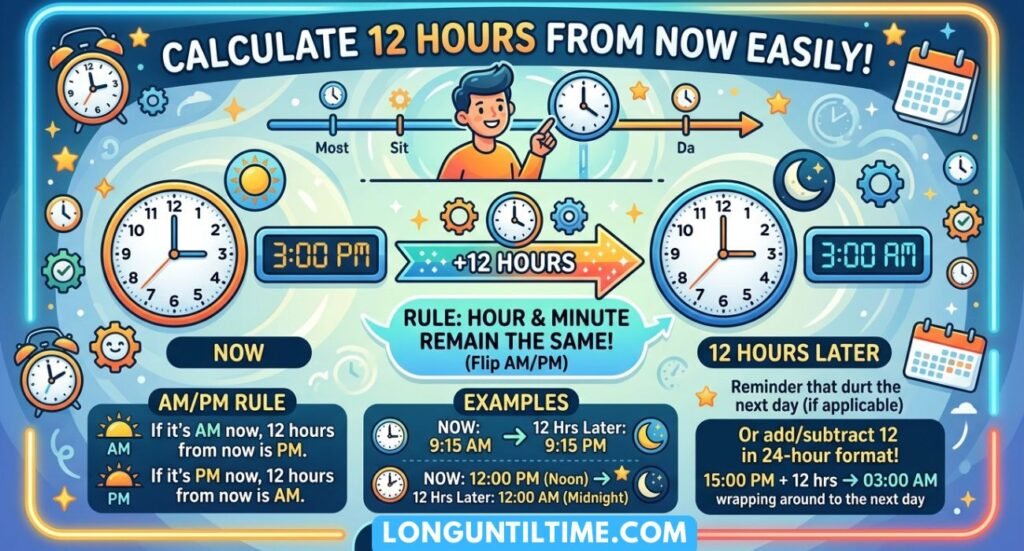
If the current time is AM, 12 hours later is PM. If the current time is PM, 12 hours later is AM.
For instance, 5:10 AM becomes 5:10 PM, while 5:10 PM becomes 5:10 AM the next day.
Why People Search “What Time Is 12 Hours From Now”
People often need a quick answer when planning something that occurs 12 hours in the future. A person might be checking a work shift, setting a reminder, planning a trip, organizing sleep, or determining when a scheduled event will occur.
The wording 12 hours from now is what time is especially useful when someone wants the future clock time rather than simply knowing that 12 hours equals a particular number of minutes or seconds.
It can also be useful when a calculation crosses midnight. For example, someone checking the time 12 hours after 9:00 PM needs to know not only that the answer is 9:00 AM, but also that it occurs on the next calendar day.
Related searches include “what time will it be 12 hours from now,” “what time is it 12 hours from now,” “12 hours from now time,” and “12 hours from now calculator.” They all generally have the same basic goal: determine the clock time after a 12-hour interval.
How to Calculate 12 Hours From Now
Calculating 12 hours from the current time is simple because 12 hours represents exactly half of a full 24-hour day.
The basic formula is:
Current time + 12 hours = future time
For a 12-hour clock, the easiest approach is to keep the hour and minutes the same and switch AM and PM.
For example:
9:40 AM + 12 hours = 9:40 PM
And:
9:40 PM + 12 hours = 9:40 AM the next day
The important part is recognizing whether the future time falls on the same date or after midnight.
Calculating 12 Hours From an AM Time
When the current time is in the morning, adding 12 hours moves the result into the evening.
Consider these examples:
7:00 AM + 12 hours = 7:00 PM
10:30 AM + 12 hours = 10:30 PM
11:45 AM + 12 hours = 11:45 PM
No date change occurs in these examples because the resulting times are still before midnight.
Calculating 12 Hours From a PM Time
When the current time is in the afternoon or evening, adding 12 hours usually takes you into the following morning.
For example:
1:00 PM + 12 hours = 1:00 AM next day
6:20 PM + 12 hours = 6:20 AM next day
11:15 PM + 12 hours = 11:15 AM next day
This is where people commonly forget to account for the date change.
Examples of 12 Hours From Now
The easiest way to understand the calculation is to see it across different parts of the day.
Suppose the current time is 3:15 PM. Twelve hours later, the time will be 3:15 AM the next day.
If the current time is 3:15 AM, twelve hours later it will be 3:15 PM on the same day.
Here are more examples:
| Starting Time | Add 12 Hours | Result |
| 4:00 AM | +12 hours | 4:00 PM |
| 8:25 AM | +12 hours | 8:25 PM |
| 11:50 AM | +12 hours | 11:50 PM |
| 12:30 PM | +12 hours | 12:30 AM next day |
| 5:15 PM | +12 hours | 5:15 AM next day |
| 9:40 PM | +12 hours | 9:40 AM next day |
| 11:59 PM | +12 hours | 11:59 AM next day |
What Time Is 12 Hours From 8 AM?
Twelve hours after 8:00 AM is 8:00 PM on the same day.
The minutes remain unchanged, and the clock moves from AM to PM.
What Time Is 12 Hours From 12 PM?
Twelve hours after 12:00 PM is 12:00 AM the next day.
In other words, noon plus 12 hours brings you to midnight.
What Time Is 12 Hours From 10 PM?
Twelve hours after 10:00 PM is 10:00 AM the next day.
Because the calculation crosses midnight, the date advances by one day.
Understanding AM and PM
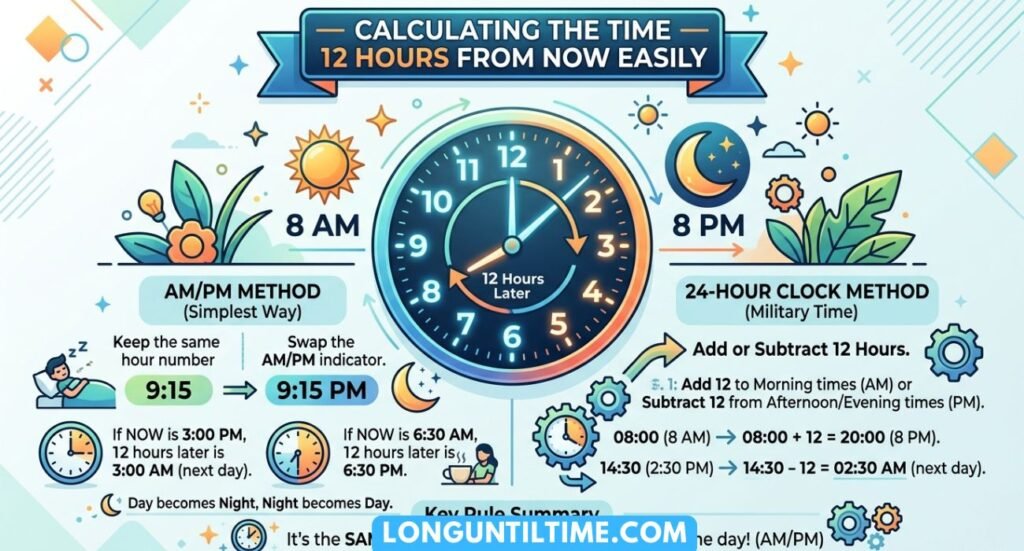
The standard 12-hour clock divides a 24-hour day into two 12-hour periods.
AM covers the period from midnight up to, but not including, noon. PM covers the period from noon up to, but not including, the next midnight.
That gives you this basic pattern:
12:00 AM → 1:00 AM → morning → 11:59 AM → 12:00 PM → afternoon/evening → 11:59 PM → 12:00 AM
Understanding this sequence makes a time calculation much easier.
When you add exactly 12 hours, the numerical clock time repeats. The AM/PM label changes because you have moved from one half of the day to the other.
What Does AM Mean?
AM comes from the Latin term ante meridiem, meaning before midday.
On a 12-hour clock, AM begins at 12:00 AM, which is midnight, and continues through 11:59 AM.
What Does PM Mean?
PM comes from post meridiem, meaning after midday.
PM begins at 12:00 PM, or noon, and continues through 11:59 PM.
The distinction is particularly important when calculating 12 hours from now, because confusing AM and PM can shift an answer by an entire half-day.
Noon vs Midnight
Noon and midnight are two of the most frequently misunderstood points on a 12-hour clock.
12:00 PM = noon
12:00 AM = midnight
Noon is the middle of the daytime period, while midnight marks the beginning of a new calendar day.
This produces two useful calculations:
12:00 AM + 12 hours = 12:00 PM
12:00 PM + 12 hours = 12:00 AM the next day
If you are scheduling an event around either of these times, writing “12 noon” or “12 midnight” can sometimes be clearer than using only “12 AM” or “12 PM.”
What Happens When You Cross Midnight?
When adding 12 hours takes the clock past 11:59 PM, the result occurs on the following calendar day.
For example:
3:00 PM + 12 hours = 3:00 AM tomorrow
8:00 PM + 12 hours = 8:00 AM tomorrow
11:30 PM + 12 hours = 11:30 AM tomorrow
The clock itself may make the calculation look simple, but the date change matters for appointments, deadlines, travel, work schedules, and other events.
Does 12 Hours From Now Always Mean Tomorrow?
No. Twelve hours from now is only tomorrow when the 12-hour interval crosses midnight.
For example, if it is 9:00 AM today, 12 hours later is 9:00 PM today. If it is 9:00 PM today, 12 hours later is 9:00 AM tomorrow.
The starting time determines whether the calendar date changes.
Using a Time Calculator
A time calculator can perform the calculation automatically. This is particularly useful when you need an exact result and do not want to manually work through AM, PM, midnight, or a date change.
A basic calculator needs a starting time and a duration. Enter the current time, choose 12 hours as the duration, and the result will show the future time.
A countdown timer can also be useful when your goal is to monitor the passage of the 12-hour interval rather than simply identify the ending clock time.
For example, if you begin a 12-hour countdown at 6:30 PM, the endpoint is 6:30 AM the next day.
How a 12-Hour Time Calculator Works
At its simplest, the calculation adds 12 hours to the starting timestamp.
If the calculator uses a 24-hour representation, it can handle the date transition mathematically. If it displays the result in a 12-hour format, it converts the result back to AM or PM.
For ordinary calculations, this is straightforward. For scheduled events involving different locations or unusual clock changes, the local time and relevant date should also be considered.
12-Hour Clock vs 24-Hour Clock
The 12-hour clock uses numbers from 1 through 12 together with AM and PM. The 24-hour clock uses numbers from 00 through 23 and does not require AM or PM.
Here is a quick comparison:
| 12-Hour Format | 24-Hour Format |
| 12:00 AM | 00:00 |
| 3:00 AM | 03:00 |
| 8:00 AM | 08:00 |
| 12:00 PM | 12:00 |
| 3:00 PM | 15:00 |
| 8:00 PM | 20:00 |
| 11:00 PM | 23:00 |
The 24-hour clock can make calculations easier because each hour has a unique numerical value.
For example, 8:00 PM is 20:00. Adding 12 hours gives 32:00, which wraps around after 24 hours to 08:00 the next day.
This produces the same answer as the 12-hour method: 8:00 AM tomorrow.
Calculating 12 Hours Using a 24-Hour Clock
With a 24-hour clock, add 12 to the hour and account for the 24-hour boundary.
For example:
06:30 + 12 hours = 18:30
14:30 + 12 hours = 26:30 → 02:30 next day
This approach is especially useful in computer systems, transportation schedules, workplaces, and other settings where AM/PM notation may not be used.
Time Zones and 12 Hours From Now
The phrase “now” is tied to a location. That means 12 hours from now can have different displayed clock times for people in different time zones if they are asking from their respective locations.
For example, a person in New York and someone in Los Angeles may look at their clocks at the same instant and see different local times. Twelve hours after each person’s current local time, each will still see the same numerical clock time they started with, but the actual date and relationship to other locations can differ.
For USA readers, common time zones include Eastern, Central, Mountain, Pacific, Alaska, and Hawaii-Aleutian time.
This becomes especially important when coordinating a scheduled event across states or between the United States and another country. A statement such as “12 hours from now” should ideally specify the relevant time zone if multiple locations are involved.
Does Daylight Saving Time Affect 12 Hours From Now?
Daylight saving time can make time calculations involving local clock readings more complicated because some locations adjust their clocks during part of the year.
For a straightforward 12-hour duration, the elapsed duration is still 12 hours. However, when you are translating that duration into a local clock time around a clock-change transition, the displayed local time may not behave as a simple everyday addition.
For important scheduled events, use a reliable date-and-time system that knows the location and date rather than relying only on mental arithmetic.
Practical Uses of Knowing Future Time
Knowing what time it will be 12 hours from now can help with many ordinary scheduling tasks.
Work and Shift Schedules
A 12-hour interval is common when people are checking the start or end of a long work period. If a shift begins at 7:00 PM, a point 12 hours later is 7:00 AM the next day.
Travel and Transportation
Travel plans often involve precise departure and arrival times. Calculating a future time can help you understand when an event occurs after a long interval, especially when crossing midnight.
When travel involves multiple locations, however, you should distinguish between elapsed time and local time at the destination.
Sleep and Daily Routines
People may use 12-hour intervals to plan sleep, wake-up times, exercise schedules, or other recurring activities. A starting time of 10:30 PM, for example, is 10:30 AM 12 hours later.
Events, Meetings, and Deadlines
If a deadline or meeting is scheduled 12 hours after a particular starting point, calculating the ending time helps prevent confusion about whether it falls on the same day or the next.
This is especially useful for digital events where participants may be located in different time zones.
Fasting and Meal Planning
A 12-hour interval can also be used as a simple duration when planning meals or other routines. The calculation is the same: identify the starting time and move forward 12 hours.
How Many Minutes Are in 12 Hours?
There are 720 minutes in 12 hours.
The calculation is:
12 hours × 60 minutes = 720 minutes
So, if you convert a 12-hour period into minutes, the result is 720.
This is useful for countdown timers, scheduling, and duration calculations.
For comparison:
6 hours = 360 minutes
12 hours = 720 minutes
24 hours = 1,440 minutes
How Many Seconds Are in 12 Hours?
There are 43,200 seconds in 12 hours.
Since one hour contains 3,600 seconds:
12 × 3,600 = 43,200 seconds
So a complete 12-hour period contains 43,200 seconds.
This conversion can be useful when working with digital timing systems or calculating durations more precisely.
How Many Milliseconds Are in 12 Hours?
There are 43,200,000 milliseconds in 12 hours.
One second contains 1,000 milliseconds, so:
43,200 seconds × 1,000 = 43,200,000 milliseconds
Therefore:
| Unit | 12 Hours |
| Hours | 12 |
| Minutes | 720 |
| Seconds | 43,200 |
| Milliseconds | 43,200,000 |
These are different ways of expressing the same duration.
Common Mistakes People Make
The calculation itself is simple, but several mistakes can lead to an incorrect answer.
Mistake 1: Confusing 12 AM and 12 PM
Remember:
12 AM = midnight
12 PM = noon
Switching these labels can completely change the interpretation of the answer.
Mistake 2: Forgetting the Date Change
If the starting time is in the afternoon or evening, adding 12 hours will usually move the result into the next morning.
For example, 10:00 PM plus 12 hours is 10:00 AM the next day, not the same day.
Mistake 3: Changing the Minutes
When adding exactly 12 hours, the minutes remain unchanged.
For example:
4:35 PM + 12 hours = 4:35 AM
It does not become 4:47 AM or another minute value.
Mistake 4: Confusing 12 Hours With 12 Minutes
Twelve hours is a much longer duration than 12 minutes.
12 hours = 720 minutes
12 minutes = 0.2 hours
Keeping the units clear prevents this common error.
Mistake 5: Ignoring the Time Zone
If “now” refers to an event involving people in different locations, identify which time zone controls the calculation.
A future time shown on a clock is always associated with a particular location and date.
Quick Reference: 12 Hours From Common Times
The following table gives a fast reference for common starting times:
| If It Is Now | 12 Hours Later |
| 1:00 AM | 1:00 PM |
| 2:00 AM | 2:00 PM |
| 3:00 AM | 3:00 PM |
| 4:00 AM | 4:00 PM |
| 5:00 AM | 5:00 PM |
| 6:00 AM | 6:00 PM |
| 7:00 AM | 7:00 PM |
| 8:00 AM | 8:00 PM |
| 9:00 AM | 9:00 PM |
| 10:00 AM | 10:00 PM |
| 11:00 AM | 11:00 PM |
| 12:00 PM | 12:00 AM next day |
The same relationship works in reverse for PM starting times. For example, 4:00 PM becomes 4:00 AM the following day after 12 hours.
Frequently Asked Questions About 12 Hours From Now
What time will it be 12 hours from now?
Twelve hours from now will be the same clock time with AM and PM switched. For example, 6:30 AM becomes 6:30 PM, while 6:30 PM becomes 6:30 AM the next day.
Is 12 hours from now tomorrow?
Not always. If adding 12 hours crosses midnight, the answer is on the next day. If it does not cross midnight, the answer remains on the current date.
What time is 12 hours after noon?
Twelve hours after 12:00 PM noon is 12:00 AM midnight the next day.
What time is 12 hours after midnight?
Twelve hours after 12:00 AM midnight is 12:00 PM noon on the same calendar day.
How many minutes are in 12 hours?
There are 720 minutes in 12 hours because 12 × 60 = 720.
How many seconds are in 12 hours?
There are 43,200 seconds in 12 hours because 12 × 3,600 = 43,200.
Does the exact current time matter?
Yes. If you want to know the precise answer to 12 hours from now is what time, you need the current time at the relevant location. The general rule is easy, but the exact clock reading depends on when the calculation is performed.
Can I use a calculator to find 12 hours from now?
Yes. A time calculator can add 12 hours automatically and handle the transition into the next day. For basic calculations, you can also simply keep the minutes and clock hour the same while switching AM and PM.
Final Takeaway: 12 Hours From Now Is What Time?
If you are asking 12 hours from now is what time, the simplest rule is: add 12 hours to the current time. On a standard 12-hour clock, the hour and minutes stay the same while AM changes to PM or PM changes to AM.
For example, 8:00 AM becomes 8:00 PM, while 8:00 PM becomes 8:00 AM the next day. Always check whether the calculation crosses midnight and, for events involving different locations, confirm the relevant time zone.

One Comment