
How Long Until 2:30? Calculate the Exact Time Left
Wondering how long until 2:30? The answer depends on your current local time. For example, if it is 1:00 PM, there is 1 hour 30 minutes until 2:30 PM. If it is 2:15 PM, only 15 minutes remain.
The calculation is simple: compare the current time with 2:30 PM and subtract the earlier time from the target time. This guide explains how to calculate the remaining hours, minutes, and seconds, use a countdown timer, handle AM and PM correctly, and understand what happens when 2:30 PM has already passed.
How Long Until 2:30 PM Depends on the Current Time
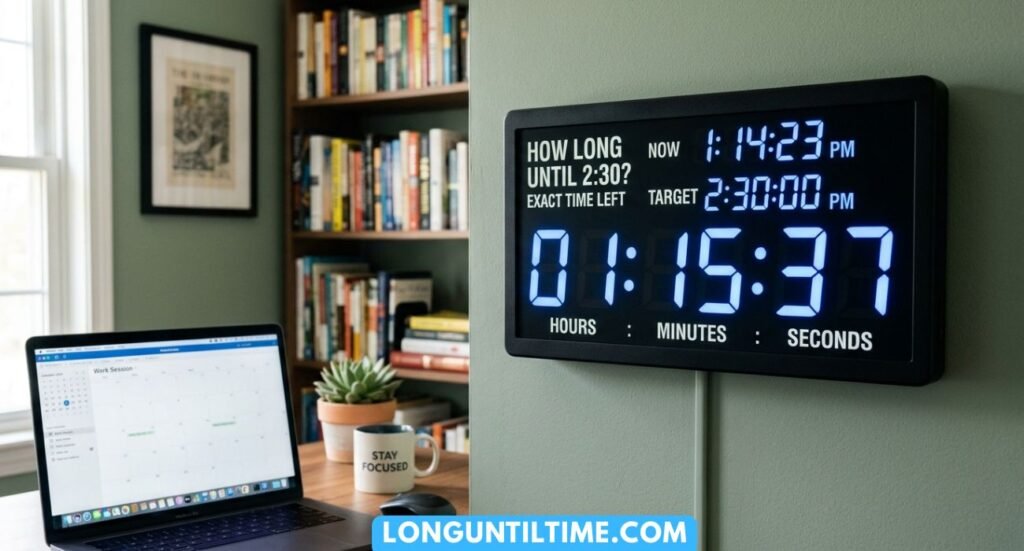
There is no single answer to how long until 2:30 PM because the countdown changes every minute. The exact answer depends on the time shown on your clock and, when relevant, your local time zone.
If your current time is earlier than 2:30 PM on the same day, simply calculate the difference between now and 2:30 PM. Here are some straightforward examples:
| Current Time | Time Until 2:30 PM |
| 8:00 AM | 6 hours 30 minutes |
| 9:00 AM | 5 hours 30 minutes |
| 10:00 AM | 4 hours 30 minutes |
| 11:00 AM | 3 hours 30 minutes |
| 12:00 PM | 2 hours 30 minutes |
| 1:00 PM | 1 hour 30 minutes |
| 1:30 PM | 1 hour |
| 2:00 PM | 30 minutes |
| 2:15 PM | 15 minutes |
| 2:29 PM | 1 minute |
| 2:30 PM | 0 minutes |
This also explains why searches such as how long till 2:30, how much time until 2:30, and time until 2:30 PM today can have different answers at different moments.
If the clock already shows a time after 2:30 PM, today’s target has passed. If you mean the next 2:30 PM, the countdown continues to tomorrow’s occurrence.
Understanding Time Until 2:30 PM with Simple Time Calculation
The easiest way to calculate the time difference is to work in hours and minutes.
Suppose the clock says 10:45 AM. The target is 2:30 PM. From 10:45 AM to 12:45 PM is two hours, and from 12:45 PM to 2:30 PM is another one hour and 45 minutes. Therefore, the total is 3 hours 45 minutes.
For times with simple hour boundaries, the calculation is even easier. From 12:00 PM to 2:30 PM is exactly 2 hours and 30 minutes.
You can also convert the entire calculation into minutes. Since 1 hour = 60 minutes, 2 hours 30 minutes equals 150 minutes.
For example:
2 hours × 60 = 120 minutes
120 + 30 = 150 minutes
So, from noon to 2:30 PM, there are 150 minutes.
Seconds can be handled the same way because 1 minute = 60 seconds. However, unless you need a highly precise countdown, hours and minutes are normally easier to understand.
A Simple Formula for the Countdown
When the current time is before 2:30 PM:
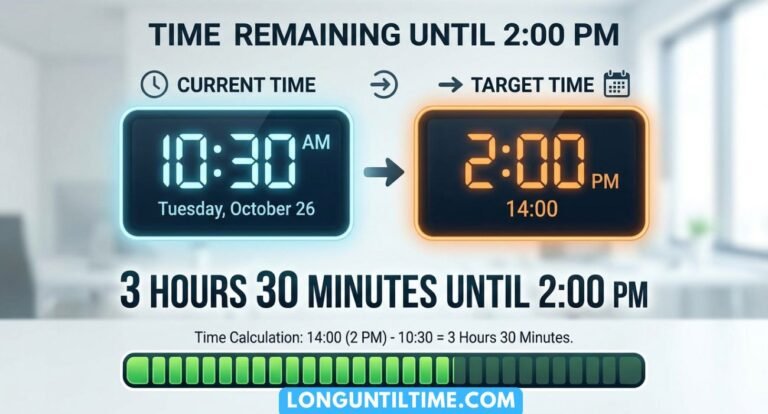
Time remaining = 2:30 PM − current time
For example:
Current time: 1:20 PM
Target: 2:30 PM
Remaining: 1 hour 10 minutes
The key is to keep AM and PM straight. 2:30 PM is in the afternoon, while 2:30 AM occurs during the early morning.
Why People Search “How Long Until 2:30 PM”
A specific time such as 2:30 PM can be connected to many everyday activities. Someone may be waiting for an appointment, a meeting, a school event, a work break, a delivery, a class, or another scheduled event.
People also search for the remaining time when they are planning their afternoon. Knowing that 90 minutes remain is more useful for planning than simply knowing that the clock currently says 1:00 PM.
The phrase how long until 2:30 PM also reflects a very direct search intent. Most people asking it want a quick calculation rather than a lengthy explanation. That is why the most useful answer should provide the calculation immediately and then offer additional information for planning or tracking the countdown.
Related searches include how long until 2:30 today, how long till 2:30 PM, how many hours until 2:30 PM, and how many minutes until 2:30 PM.
Countdown to 2:30 PM: Why We Love Watching Time
A countdown timer turns a future point in time into a visible amount of time remaining. Instead of thinking, “My meeting starts at 2:30,” you can see something like “45 minutes remaining.”
This can make a scheduled event easier to plan around. A person with 45 minutes available can decide whether to start another task, take a break, prepare for the meeting, or simply wait.
There is also a practical benefit to seeing progress. A countdown moves toward zero, making the passing time easy to understand. However, watching the clock constantly is not always helpful. If the goal is productivity, it is usually better to set the timer and focus on the task until it signals that the target time has arrived.
Best Tools for a Real-Time Countdown to 2:30 PM
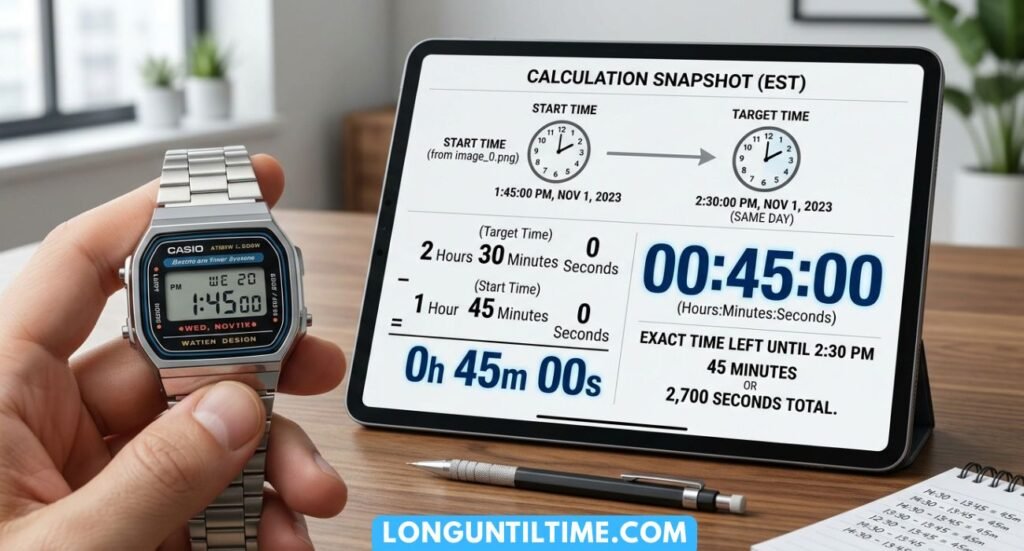
Several tools can help you track the countdown to 2:30 PM without repeatedly doing the calculation yourself.
A phone’s clock or timer application is often enough for a simple reminder. You can also use a digital clock, an online timer, a smartwatch, a computer widget, or a calendar reminder.
A timer is especially useful when you need an alert at exactly 2:30 PM. A calendar reminder is better when 2:30 PM represents a meeting or appointment because it can be associated with an event.
A time calculator is useful when you want to calculate the difference between two specific times. For example, if you need to know how much time is available between 11:35 AM and 2:30 PM, a calculator can provide the exact duration.
The most important factor is accuracy. A useful tool should use the correct local time, recognize the correct AM/PM period, and update the countdown continuously.
How Long Until 2:30 PM Today? Practical Examples
Let’s look at more detailed examples of how long until 2:30 PM today.
If the current time is 9:15 AM, the remaining period is 5 hours 15 minutes. From 9:15 AM to 2:15 PM is five hours, followed by another 15 minutes to reach 2:30 PM.
If the time is 11:40 AM, there are 2 hours 50 minutes left. From 11:40 AM to 12:00 PM is 20 minutes, then two hours and 30 minutes remain until 2:30 PM.
At 12:20 PM, the remaining time is 2 hours 10 minutes.
At 1:45 PM, only 45 minutes remain.
At exactly 2:30 PM, the countdown reaches zero.
What If It Is Already After 2:30 PM?
This is an important part of calculating the answer correctly.
If it is 3:00 PM, 2:30 PM has already occurred today. Therefore, if you are asking about today’s event, there is no remaining time.
If you mean the next 2:30 PM, you need to count from 3:00 PM today through midnight and then from midnight to 2:30 PM tomorrow. That gives:
9 hours until midnight + 2 hours 30 minutes = 11 hours 30 minutes
The same principle applies to any time after the target.
The Psychology Behind Waiting Until 2:30 PM
Waiting for a specific time can feel very different depending on what you are doing. When you are busy with an interesting task, an hour may seem to pass quickly. When you are repeatedly checking the clock, the same period can feel much longer.
A fixed time can also act as a mental checkpoint. For example, someone might think of 2:30 PM as the point when a meeting starts, a work block ends, or an afternoon task must be completed.
This is one reason a countdown can be useful. Rather than thinking vaguely about waiting, you can divide the remaining period into manageable sections.
For instance, if there are two hours until 2:30 PM, you might spend the first hour completing an important task and the second hour preparing for whatever happens at 2:30.
The goal is not to make every minute revolve around the clock. Instead, the countdown can provide a simple boundary for organizing your time.
See Also : How Long Until 12 PM? Calculate the Time Until Noon
Time Management and the Afternoon Routine
2:30 PM can be a useful checkpoint in an afternoon schedule. By that point, many people have already completed part of their workday or school day and may need to shift their attention toward later tasks.
Suppose you have 90 minutes until 2:30 PM. Rather than treating those 90 minutes as one large block, you could divide them into focused periods. You might spend 50 minutes on an important task, take a short break, and use the remaining time to prepare for a scheduled event.
The exact structure depends on your routine. The useful idea is to match the amount of work to the amount of time available.
If you have only 15 minutes until 2:30 PM, starting a task that normally takes an hour may create unnecessary pressure. A short administrative task, preparation step, or quick review would be more realistic.
Time Tracking Makes Waiting More Useful
Time tracking changes the question from “How long do I have to wait?” to “What can I reasonably accomplish before 2:30?”
For example, if it is 12:30 PM, you have exactly two hours before 2:30 PM. That is enough time for several smaller activities, but it is also limited enough that priorities matter.
You can use the target time as a natural stopping point. A task can begin at 1:00 PM and end at 2:00 PM, leaving 30 minutes for preparation or transition.
This approach is particularly useful when multiple activities compete for the same afternoon period. Instead of guessing how much time remains, you can calculate the available duration and plan accordingly.
Time tracking also helps prevent a common mistake: assuming that a few hours of available time means there is enough time for everything. A countdown makes the actual limit visible.
How Different People Experience the Countdown
The meaning of 2:30 PM depends on the person’s schedule.
For a student, it might be the time a class ends or an after-school activity begins. For an employee, it could be the start of a meeting or a deadline for a task. For someone working remotely, 2:30 PM might simply be a convenient point for switching from one type of work to another.
Parents may use a specific afternoon time to coordinate errands, pickups, or family activities. Travelers may be watching the clock because of a scheduled departure or appointment.
The underlying calculation remains the same, but the reason for watching the clock changes.
This is also why a simple answer to how long until 2:30 can be surprisingly useful. The number itself is universal, while the purpose behind the countdown is personal.
South Asian Afternoon Traditions
Afternoon schedules can vary significantly across cultures and households. In South Asian communities, the period around midday and early afternoon may include lunch, school routines, work, family responsibilities, rest, or preparation for later activities.
A specific time such as 2:30 PM can therefore have different meanings depending on someone’s daily schedule. For one person, it may fall during a work period; for another, it may be connected to school, family activities, or a planned break.
It is useful to remember that there is no single South Asian afternoon routine. Countries, cities, families, workplaces, schools, and individual schedules can all follow different patterns.
The basic time calculation does not change. If the target is 2:30 PM, the remaining duration still depends on the current local clock time.
Using a Countdown Without Becoming Obsessed
A countdown is most useful when it helps you organize your time. It becomes less useful when you feel the need to check it constantly.
If you have an important appointment at 2:30 PM, setting one reminder may be enough. You do not necessarily need to watch the seconds disappear throughout the entire afternoon.
For productivity, it can be better to start a task, set an appropriate timer, and focus until the timer ends. This keeps the target time in the background instead of making it the center of your attention.
You can also use different levels of precision depending on the situation. If an event starts at 2:30 PM, knowing the remaining hours and minutes is usually sufficient. Tracking individual seconds is rarely necessary unless the event specifically requires that level of accuracy.
Making the Most of the Time Before 2:30 PM
Once you know how long until 2:30 PM, the next question is how to use the remaining time.
If you have several hours, choose one or two meaningful priorities instead of trying to complete everything. If you have about an hour, select a task that fits comfortably within that window. If you have only 10 or 15 minutes, use the period for preparation, a quick task, or a transition.
For example, suppose it is 1:30 PM and you have one hour until 2:30 PM. You could spend the first 40 minutes finishing a focused task, use 10 minutes to review your work, and reserve the final 10 minutes for preparation.
The important principle is to respect the actual amount of time available. A countdown is not just a way to watch time pass; it can help you make better decisions about what is realistic before a fixed point in the day.
Quick Reference for the Time Until 2:30 PM
The following reference makes common calculations easy:
| Current Time | Remaining Until 2:30 PM |
| 10:00 AM | 4 hours 30 minutes |
| 10:30 AM | 4 hours |
| 11:00 AM | 3 hours 30 minutes |
| 11:30 AM | 3 hours |
| 12:00 PM | 2 hours 30 minutes |
| 12:30 PM | 2 hours |
| 1:00 PM | 1 hour 30 minutes |
| 1:30 PM | 1 hour |
| 2:00 PM | 30 minutes |
| 2:15 PM | 15 minutes |
| 2:29 PM | 1 minute |
| 2:30 PM | 0 minutes |
These examples assume the target is 2:30 PM on the same day.
For an exact live answer, you need to compare 2:30 PM with the current clock time in the relevant time zone. The result changes continuously, so a value calculated earlier will eventually become outdated.
How to Plan Your Afternoon Around 2:30 PM
Knowing how long until 2:30 can help you organize the rest of your afternoon without rushing. If you have a few hours left, use that time for important tasks, appointments, study, or work before your 2:30 PM deadline.
A simple plan can make the remaining time easier to manage. Instead of constantly checking the clock, decide what you want to finish before 2:30 PM and give each task a realistic amount of time.
What to Do When You Have 30 Minutes Until 2:30 PM
When there are only 30 minutes until 2:30 PM, focus on small tasks that can realistically be completed within that window. You could review notes, answer important messages, organize your workspace, or prepare for an upcoming meeting.
Avoid starting something that requires much more time than you have available. A short countdown can help you stay focused and finish with enough time to transition to whatever is scheduled at 2:30 PM.
See Also : How Long Until 12 PM? Calculate the Time Until Noon
Turning the Countdown to 2:30 PM Into a Productive Routine
A countdown to 2:30 PM does not have to mean simply waiting for the clock to reach a certain point. You can use the remaining time as a clear productivity window and choose one meaningful task to complete before the target time.
For example, if you have 90 minutes remaining, divide the period into focused work and a short preparation period. This approach makes how long until 2:30 a practical planning question rather than simply a countdown.
Frequently Asked Questions About How Long Until 2:30
How long until 2:30 PM today?
It depends on the current time. For example, if it is 1:00 PM, there are 1 hour 30 minutes until 2:30 PM. If it is 2:15 PM, there are 15 minutes remaining.
How long until 2:30 from 12 PM?
There are 2 hours 30 minutes from 12:00 PM to 2:30 PM.
How many minutes until 2:30 PM?
First calculate the remaining hours and minutes, then convert the hours into minutes. For example, 1 hour 30 minutes equals 90 minutes.
What time is 30 minutes before 2:30 PM?
Thirty minutes before 2:30 PM is 2:00 PM.
What time is one hour before 2:30 PM?
One hour before 2:30 PM is 1:30 PM.
Is 2:30 PM afternoon or evening?
2:30 PM is generally considered afternoon. It occurs after noon and before the evening period.
How do I calculate how long until 2:30?
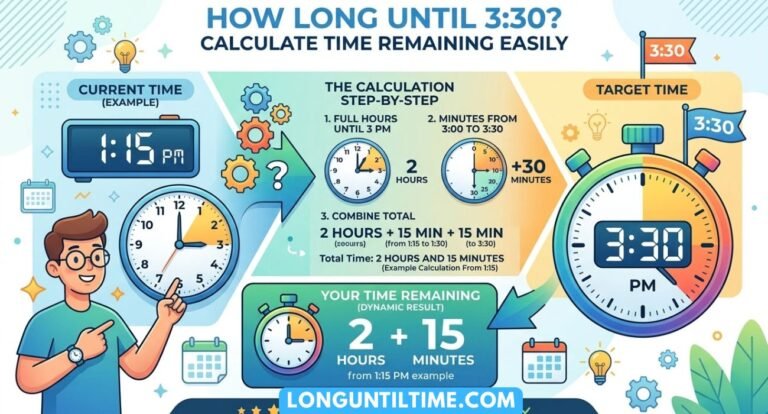
Take the current time and find the difference between it and 2:30 PM. If the current time is 1:15 PM, for example, the difference is 1 hour 15 minutes.
What if 2:30 PM has already passed?
If today’s 2:30 PM has passed, the remaining time until today’s occurrence is zero. If you are waiting for the next 2:30 PM, calculate the time from the current moment to 2:30 PM tomorrow.
Does the time zone affect how long until 2:30 PM?
Yes, when the target event is tied to a particular location. A person in New York and a person in Los Angeles can have different local times and therefore different countdowns to their respective 2:30 PM. When coordinating an event across locations, always clarify which time zone the 2:30 PM refers to.
How does the 24-hour clock represent 2:30 PM?
In the 24-hour clock, 2:30 PM is written as 14:30. This format removes the need to distinguish between AM and PM.
How many seconds are in 2 hours 30 minutes?
Two hours contain 7,200 seconds, while 30 minutes contain 1,800 seconds. Together, 2 hours 30 minutes equals 9,000 seconds.
Conclusion
So, how long until 2:30 depends entirely on your current local time. If the clock shows 1:00 PM, you have 1 hour 30 minutes left; at 2:00 PM, you have 30 minutes; and at 2:30 PM, the countdown reaches zero.
The simplest method is to subtract the current time from 2:30 PM, remembering that 1 hour equals 60 minutes and that AM/PM matters. If 2:30 PM has already passed, calculate toward the next day’s 2:30 PM when necessary.
Whether you are checking a schedule, preparing for an appointment, planning your afternoon, or simply curious about the remaining time, a countdown timer or time calculator can make the answer quick and accurate.
One Comment