
How Long Until 2:45? Calculate the Exact Time Left
Wondering how long until 2:45? The answer depends on your current local time. For example, if it is 2:00 PM, there are 45 minutes left. If it is 2:30 PM, there are only 15 minutes remaining.
A simple way to calculate it is to subtract the current time from 2:45 PM. This article explains how to work out the time difference, use a countdown timer, understand 2:45 PM in different clock formats, and handle situations involving time zones, midnight, and the next day’s 2:45 PM.
Why So Many People Search “How Long Until 2:45 PM”
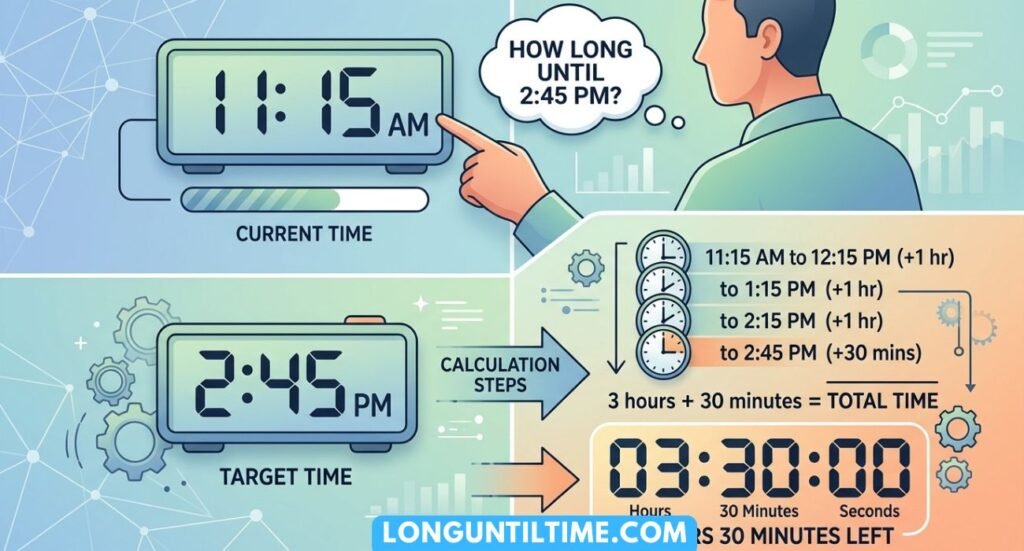
The question “how long until 2:45 PM” usually has a practical purpose. Someone may be waiting for an appointment, a school dismissal time, a meeting, a work deadline, a break, or another scheduled event.
Unlike asking what time it is, asking how long until 2:45 PM focuses on the remaining time. That makes the answer useful for planning. Knowing that 2:45 PM is 40 minutes away gives you a clearer idea of what you can accomplish than simply looking at a clock.
People may also search for variations such as “how long till 2:45,” “how much time until 2:45 PM,” “how many minutes until 2:45,” or “2:45 PM countdown.” These searches all have essentially the same goal: finding the amount of time between now and the target time.
The key point is that there is no fixed answer unless the current time and location are known.
Understanding 2:45 PM in Different Clock Formats
2:45 PM uses the standard 12-hour clock, which divides a 24-hour day into two 12-hour periods: AM and PM.
The same time can be written as 14:45 using the 24-hour clock. This format is common in schedules, transportation systems, workplaces, digital systems, and other situations where avoiding AM/PM confusion is useful.
| Clock format | 2:45 PM |
| 12-hour clock | 2:45 PM |
| 24-hour clock | 14:45 |
| Written out | Two forty-five in the afternoon |
| Minutes after midnight | 885 minutes |
The last row can be useful when performing calculations. From midnight to 2:45 PM is 14 hours and 45 minutes, or:
14 × 60 + 45 = 885 minutes
Remember that 2:45 AM is a completely different time. It occurs early in the morning, while 2:45 PM occurs in the afternoon.
How Long Until 2:45 PM Depends on Your Current Time
The exact answer to how long until 2:45 PM changes continuously because the clock is always moving forward.
If the current time is before 2:45 PM on the same day, subtract the current time from 2:45 PM.
| Current time | Time until 2:45 PM |
| 12:00 PM | 2 hours 45 minutes |
| 12:30 PM | 2 hours 15 minutes |
| 1:00 PM | 1 hour 45 minutes |
| 1:30 PM | 1 hour 15 minutes |
| 2:00 PM | 45 minutes |
| 2:15 PM | 30 minutes |
| 2:30 PM | 15 minutes |
| 2:40 PM | 5 minutes |
| 2:44 PM | 1 minute |
| 2:45 PM | 0 minutes |
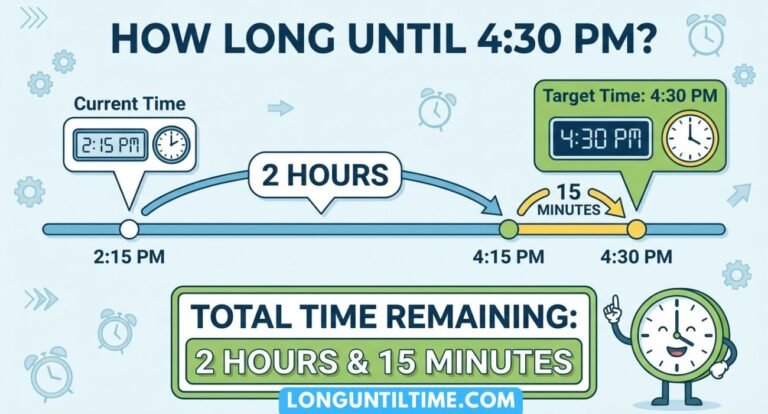
For example, suppose your clock says 1:20 PM. From 1:20 PM to 2:20 PM is one hour, and from 2:20 PM to 2:45 PM is another 25 minutes. Therefore, the answer is 1 hour and 25 minutes.
If it is already 2:45 PM, the countdown has reached zero.
If it is 3:00 PM, today’s 2:45 PM has already passed. If you mean the next occurrence of 2:45 PM, you would normally count forward to 2:45 PM tomorrow.
A simple formula for calculating the time
You can think of the calculation as:
Target time − current time = remaining time
When the times are close together, mental math is easy. When the calculation crosses an hour, midnight, or a date boundary, converting both times into minutes can make the process less confusing.
For instance:
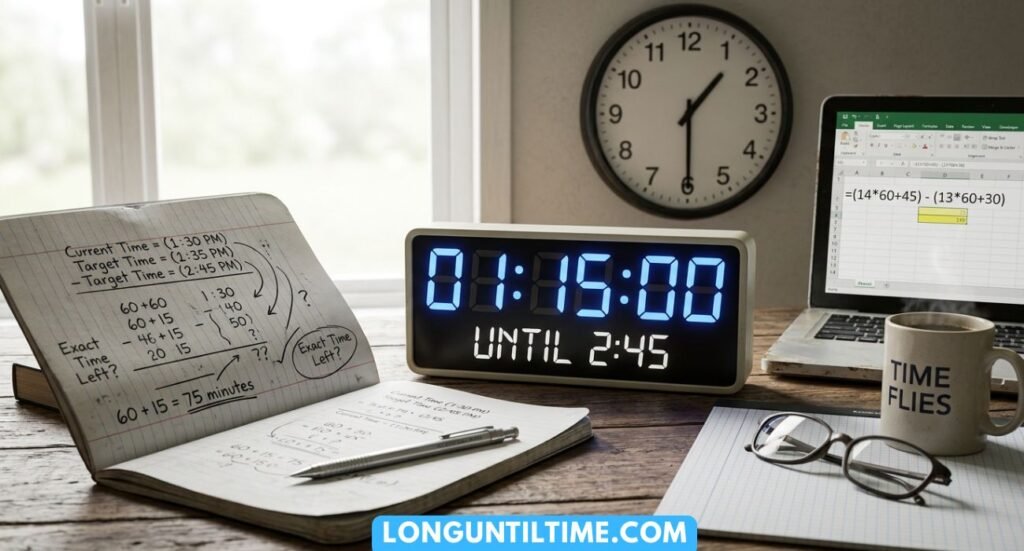
2:45 PM = 885 minutes after midnight
If the current time is 1:30 PM:
1:30 PM = 810 minutes after midnight
Then:
885 − 810 = 75 minutes
So there are 75 minutes, or 1 hour 15 minutes, until 2:45 PM.
How a Live Countdown Actually Works
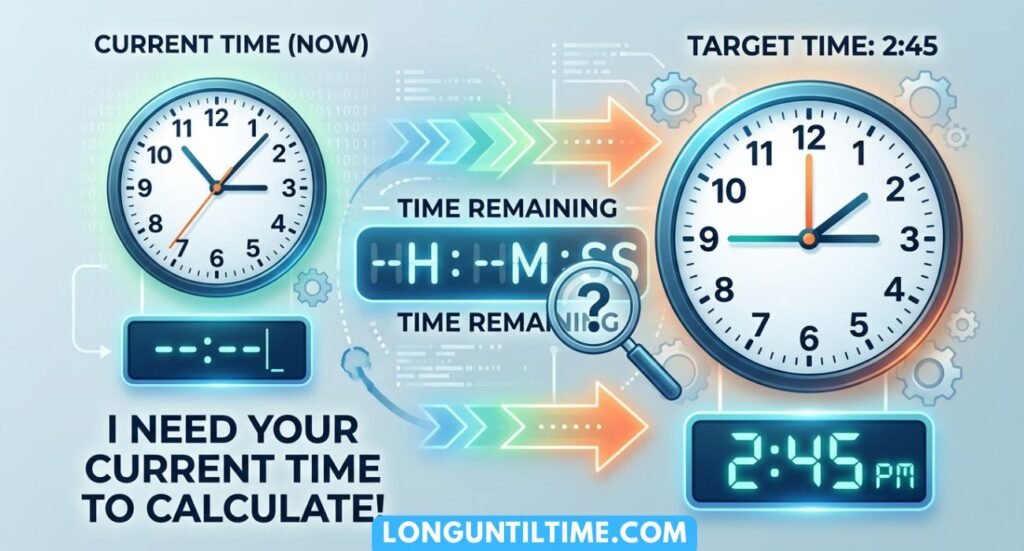
A live countdown continuously compares the current clock time with a specified target. Instead of calculating the answer once, it updates as each second passes.
Suppose a countdown initially shows 20 minutes remaining. After 30 seconds, it should show approximately 19 minutes and 30 seconds remaining. After another minute, approximately 18 minutes and 30 seconds remain.
This is why the answer to “how long until 2:45?” can change while you are reading it.
A countdown generally needs three pieces of information:
- The current date and time.
- The target date and time.
- The relevant local time zone.
The difference between those two moments produces the countdown.
For a target later today, the calculation is straightforward. For a target that has already passed, a countdown must determine whether the user wants the previous occurrence or the next occurrence.
See Also : 12 Hours From Now Is What Time? Calculate the Exact Time Easily
Why Time Zones Matter More Than People Expect
Local time matters whenever you ask how long until a particular clock time.
Imagine two people are planning to meet at 2:45 PM local time. One person is in New York and another is in Los Angeles. Their clocks show different local times because they are in different U.S. time zones.
As a result, their countdowns to their respective local 2:45 PM can show different amounts of time.
The major U.S. time zones include Eastern, Central, Mountain, and Pacific Time, along with Alaska and Hawaii-Aleutian time zones. The exact relationship between them can also change when daylight saving time is observed.
This distinction is especially important for online meetings, travel, remote work, and events involving people in multiple locations. “2:45 PM” by itself does not identify one universal moment unless the relevant time zone is known.
For a personal countdown, your device’s clock and time-zone settings should normally be correct. If they are incorrect, an otherwise accurate timer can display an incorrect result for your intended location.
How Long Until 2:45 PM for Everyday Activities
A countdown to 2:45 PM can be useful whenever you are working toward a fixed afternoon deadline.
For example, if you have 90 minutes before 2:45 PM, you could use that period for a focused work session. If only 30 minutes remain, you might choose a smaller task rather than starting something that normally takes an hour.
Consider a person who needs to leave for an appointment at 2:45 PM. If it is 2:00 PM, the person has 45 minutes. That does not necessarily mean they have 45 minutes of free time because getting ready, gathering belongings, and traveling may all need to happen before the target time.
A better approach is to work backward. If travel takes 20 minutes and preparation takes 10 minutes, the person should not treat the entire 45-minute window as available. They have only about 15 minutes for other tasks, assuming the travel and preparation estimates are accurate.
This illustrates an important difference between time remaining and usable time. A countdown tells you how long remains until a deadline; it does not automatically account for everything you need to do before reaching it.
Using a Countdown Calculator Instead of Mental Math
Mental calculation works well for simple times, but a time calculator or online countdown can be more convenient when you need an exact result.
A calculator can handle hours, minutes, and seconds automatically. A 2:45 PM countdown is particularly useful when you want to see the remaining time without repeatedly checking a clock and recalculating it yourself.
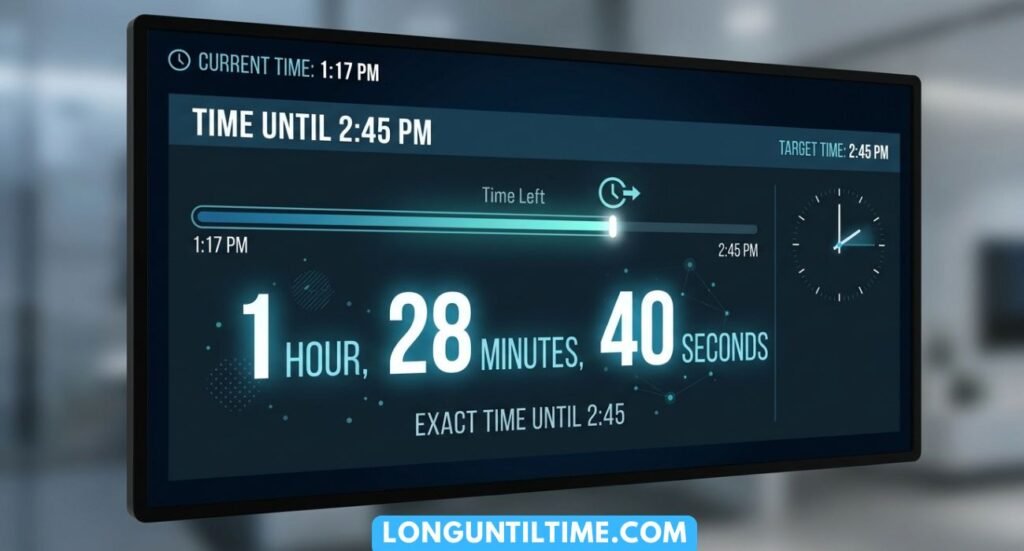
For example, if the current time is 1:37:20 PM, mentally calculating the exact number of seconds until 2:45 PM is unnecessary. A live calculator can determine the duration directly.
A digital countdown is also useful when the target time is approaching. Instead of displaying only “1 hour 8 minutes,” it can show a more precise result such as hours, minutes, and seconds.
The main advantage is convenience and continuous updating. The underlying calculation remains the same: determine the difference between the current moment and the target moment.
How Long Until 2:45 PM and Better Time Management
A fixed target such as 2:45 PM can turn a vague plan into a specific deadline.
Instead of thinking, “I will finish this sometime this afternoon,” you can decide, “I want this task finished before 2:45 PM.” That gives the task a clear endpoint.
You can also divide the available period into smaller blocks. If you have two hours and 45 minutes until 2:45 PM, you might reserve time for several tasks and leave a small buffer between them.
The important part is not simply watching a countdown. It is using the remaining time realistically.
If a task normally takes 90 minutes and only 45 minutes remain, you have several choices: shorten the task, postpone it, delegate part of it, or change the deadline. A countdown provides information that helps you make that decision.
Afternoon Planning Around 2:45 PM
2:45 PM can act as a useful afternoon checkpoint. You might use it to finish one work block, begin an appointment, review your progress, or transition from one activity to another.
For example, imagine an afternoon schedule that looks like this:
| Time | Activity |
| 12:30 PM–1:15 PM | Lunch |
| 1:15 PM–2:00 PM | Focused work |
| 2:00 PM–2:30 PM | Smaller tasks |
| 2:30 PM–2:45 PM | Review and preparation |
| 2:45 PM | Meeting or scheduled activity |
This kind of schedule gives 2:45 PM a purpose rather than treating it as an arbitrary clock time.
It is also useful to create a buffer. If something must happen exactly at 2:45 PM, avoid planning another activity that ends at 2:45 PM. Delays, interruptions, travel, and preparation can consume the remaining minutes.
Common Questions About 2:45 PM
Is 2:45 PM considered afternoon?
Yes. 2:45 PM is generally considered afternoon because it occurs after 12:00 PM noon and before evening.
The exact point at which people describe the day as “evening” can vary by context and season, but 2:45 PM is ordinarily an afternoon time.
What is 2:45 PM in Military Time?
2:45 PM is 14:45 in military time or the 24-hour clock.
For PM times from 1:00 PM through 11:59 PM, you generally add 12 to the hour. Therefore:
2 + 12 = 14
So 2:45 PM becomes 14:45.
Why does the countdown change every second?
Because seconds continuously pass between the current moment and the target time.
A countdown that includes seconds is measuring a duration rather than simply displaying a clock time. As each second passes, the remaining duration becomes one second shorter.
Small differences can also occur because of how a website, browser, computer, or phone refreshes and displays the countdown.
Why is my countdown different from someone else’s?
The most common reason is that the two countdowns are based on different local times or time zones.
Differences can also result from an incorrect device clock, incorrect time-zone settings, or a countdown configured for a different date.
If two people are supposed to count down to the same event, they should make sure they are using the same target date, exact time, and time zone.
Does the countdown reset tomorrow?
It can, depending on how the countdown is designed.
If the target is specifically 2:45 PM today, the countdown reaches zero when today’s 2:45 PM arrives. A daily countdown may then begin counting toward 2:45 PM tomorrow.
For a one-time event, however, the timer may simply stop at zero instead of automatically starting another countdown.
Digital Tools That Make Countdowns Easier
Modern devices make it easy to track a target time without performing the calculation manually. A smartphone, computer, digital clock, calendar application, or online timer can all be used for this purpose.
A countdown timer is useful when the main goal is seeing how much time remains. A calendar reminder is often better when the goal is remembering that something needs to happen at a particular time.
For example, if you simply want to know how long until 2:45 PM, a live countdown is appropriate. If you have an appointment at 2:45 PM and need a notification beforehand, a calendar or alarm can be more useful.
For important events, it is sensible to check that your device has the correct date, time, and time-zone settings. An incorrect system clock can affect any time-based tool that relies on it.
Beyond the Countdown: Seeing the Progress of Your Day
A countdown answers one specific question: how much time remains before a target?
But the same information can help you understand your entire day. If 2:45 PM is your afternoon deadline, you can consider how much of the day has passed and what remains afterward.
For example, someone may use the period before 2:45 PM for high-priority work and reserve the later afternoon for routine tasks. Someone else may have school, an appointment, or a commute tied to that time.
This turns a countdown into a planning tool rather than just a clock display.
It is also useful to distinguish between a point in time and a duration. 2:45 PM is a point in time. “45 minutes until 2:45 PM” is a duration. Understanding that difference prevents many common time-calculation mistakes.
See Also : What Time Was 6 Hours Ago? How to Calculate It Easily
How Schools, Offices, and Businesses Use Time-Based Countdowns
Fixed times are central to many daily schedules.
A school may have a class ending at 2:45 PM. An office may schedule a meeting for that time. A business may have an appointment, delivery, event, or shift change at 2:45 PM.
In each case, the clock time establishes a shared reference point. A countdown then translates that reference point into a duration that tells someone how much time they have left.
For example, if an employee has a presentation scheduled for 2:45 PM, knowing that 90 minutes remain may help them decide whether to continue preparing slides or switch to practicing the presentation.
The same principle applies to students. If a class ends at 2:45 PM, the time remaining can help them organize their work without guessing how much of the period is left.
Tips for Staying on Schedule Until 2:45 PM
A countdown is most useful when you combine it with realistic planning. If you need to be somewhere at 2:45 PM, work backward from that time instead of assuming every remaining minute is available.
Keep your current time accurate, particularly when traveling or switching between time zones. When precision matters, include seconds rather than relying only on hours and minutes.
Give yourself a buffer for activities that can take longer than expected. If a task has to be completed before 2:45 PM, finishing at exactly 2:45 may already be too late if you need time to transition to the next activity.
Finally, choose tasks based on the amount of time actually available. A short countdown is better suited to a small task, quick review, or preparation period than a large project.
Quick Reference: How Long Until 2:45?
If you want a quick answer without doing the calculation yourself, use this reference for common times:
| Current time | Remaining time until 2:45 PM |
| 12:00 PM | 2 hours 45 minutes |
| 12:15 PM | 2 hours 30 minutes |
| 12:30 PM | 2 hours 15 minutes |
| 12:45 PM | 2 hours |
| 1:00 PM | 1 hour 45 minutes |
| 1:15 PM | 1 hour 30 minutes |
| 1:30 PM | 1 hour 15 minutes |
| 1:45 PM | 1 hour |
| 2:00 PM | 45 minutes |
| 2:15 PM | 30 minutes |
| 2:30 PM | 15 minutes |
| 2:40 PM | 5 minutes |
| 2:44 PM | 1 minute |
| 2:45 PM | 0 minutes |
These examples assume the current time is on the same day and before 2:45 PM.
How Long Until 2:45 PM When You Are on a Tight Schedule
Knowing how long until 2:45 PM can help you decide what can realistically be completed before your deadline. Instead of guessing, check the time remaining and divide it between important tasks, preparation, and any necessary travel.
For example, if you have 30 minutes left, focus on one small priority rather than starting a task that needs an hour. This simple approach makes a countdown more useful for everyday planning.
Planning Backward From 2:45 PM
Another practical way to manage time is to work backward from 2:45 PM. If you need 15 minutes to get ready and another 20 minutes to travel, you already need 35 minutes before the scheduled time.
This method helps you identify when to stop other activities. Rather than treating 2:45 PM as the time to begin preparing, you can use the countdown to 2:45 PM to determine when preparation should start.
What to Do When 2:45 PM Is Almost Here
When only a few minutes remain until 2:45 PM, avoid taking on a large new task. Use the final minutes to finish a quick action, save your work, gather what you need, or prepare for the next scheduled activity.
A 2:45 PM countdown is especially helpful during this final period because the remaining time becomes easier to understand in minutes and seconds. This allows you to transition smoothly instead of realizing too late that the target time has arrived.
FAQs
How long until 2:45 PM if it is 1:00 PM?
There are 1 hour and 45 minutes until 2:45 PM when the current time is exactly 1:00 PM.
How many minutes are there until 2:45 PM from 2:00 PM?
There are 45 minutes from 2:00 PM to 2:45 PM.
How long until 2:45 PM from 2:30 PM?
There are 15 minutes until 2:45 PM from 2:30 PM.
How long until 2:45 if it is already after 2:45 PM?
If today’s 2:45 PM has passed, the next 2:45 PM is normally tomorrow. For example, from 3:00 PM today to 2:45 PM tomorrow is 23 hours and 45 minutes.
Is 2:45 PM the same as 14:45?
Yes. 2:45 PM and 14:45 represent the same time. The first uses the 12-hour clock, while the second uses the 24-hour clock.
How can I calculate how long until 2:45 manually?
Convert the current time and 2:45 PM into minutes after midnight, then subtract the current total from 885. If the current time is after 2:45 PM, add 24 hours when calculating toward the next day’s 2:45 PM.
Why can two people get different answers for “how long until 2:45”?
Their time zones, device clocks, dates, or countdown settings may be different. A target such as 2:45 PM needs a location or time zone when comparing people in different places.
Conclusion
The answer to how long until 2:45 depends entirely on the current local time. Before 2:45 PM, subtract the current time from 2:45 PM to find the remaining duration. At 2:45 PM, the countdown reaches zero, and after 2:45 PM, the next target is generally 2:45 PM on the following day.
For simple calculations, mental math is enough. For an exact, continuously changing result, a live countdown timer or time calculator is more convenient. Once you know the time remaining, you can use it to plan appointments, work, school activities, errands, and the rest of your afternoon more effectively.
One Comment