
How Long Until 2:10? Counting Down to 2:10 PM This Afternoon
If you are asking how long until 2:10, the answer depends on your current time, but for most readers the target is 2:10 PM: the early-afternoon moment when an appointment begins, a class changes, or a train pulls in. There is no single fixed number, because the gap shrinks by a minute every minute. The method, though, never changes: subtract the time now from 2:10 PM, and if 2:10 PM has already passed today, count on to tomorrow’s instead.
At 11:00 AM, for example, exactly 3 hours 10 minutes remain until 2:10 PM in your local time. Below you will find a quick reference table covering the whole day, a clear fix for the one mistake that ruins more of these calculations than any other (mixing up 2:10 AM and 2:10 PM), four worked examples, and practical advice for planning around a 2:10 appointment, lesson, or departure.
Quick Reference: Time Remaining Until 2:10 PM
If you only need the number, find your current time in the left column. This first table covers the stretch of the day before the target, while 2:10 PM is still ahead of you.
| Current Time | Time Remaining Until 2:10 PM | In Minutes |
|---|---|---|
| 6:00 AM | 8 hours 10 minutes | 490 minutes |
| 8:00 AM | 6 hours 10 minutes | 370 minutes |
| 10:00 AM | 4 hours 10 minutes | 250 minutes |
| 12:00 PM | 2 hours 10 minutes | 130 minutes |
| 1:00 PM | 1 hour 10 minutes | 70 minutes |
| 1:30 PM | 40 minutes | 40 minutes |
| 2:00 PM | 10 minutes | 10 minutes |
| 2:05 PM | 5 minutes | 5 minutes |
| 2:09 PM | 1 minute | 1 minute |
Notice the pattern in the on-the-hour rows: the answer is always a whole number of hours plus ten minutes. That is because 2:10 PM falls 850 minutes after midnight (14 × 60 + 10), so the remaining time is simply 850 minus the minutes already gone since midnight, whatever your starting point.
If 2:10 PM Has Already Passed Today
Once the clock moves past 2:10 PM, the target quietly changes: you are now counting toward tomorrow’s 2:10 PM, which is why the answer jumps back up toward a full day instead of turning negative.
| Current Time | Time Remaining Until the Next 2:10 PM | In Minutes |
|---|---|---|
| 3:00 PM | 23 hours 10 minutes | 1,390 minutes |
| 6:00 PM | 20 hours 10 minutes | 1,210 minutes |
| 9:00 PM | 17 hours 10 minutes | 1,030 minutes |
| 11:30 PM | 14 hours 40 minutes | 880 minutes |
Early-morning readers are in the opposite position: at 1:00 AM, today’s 2:10 PM is still ahead of you, a straightforward 13 hours 10 minutes away. Every nearby afternoon target works exactly the same way, too. The count toward how long until 2:15 is simply five minutes longer than the count to 2:10 from the same starting moment, because that target sits five minutes later.
2:10 PM Is Not 2:10 AM
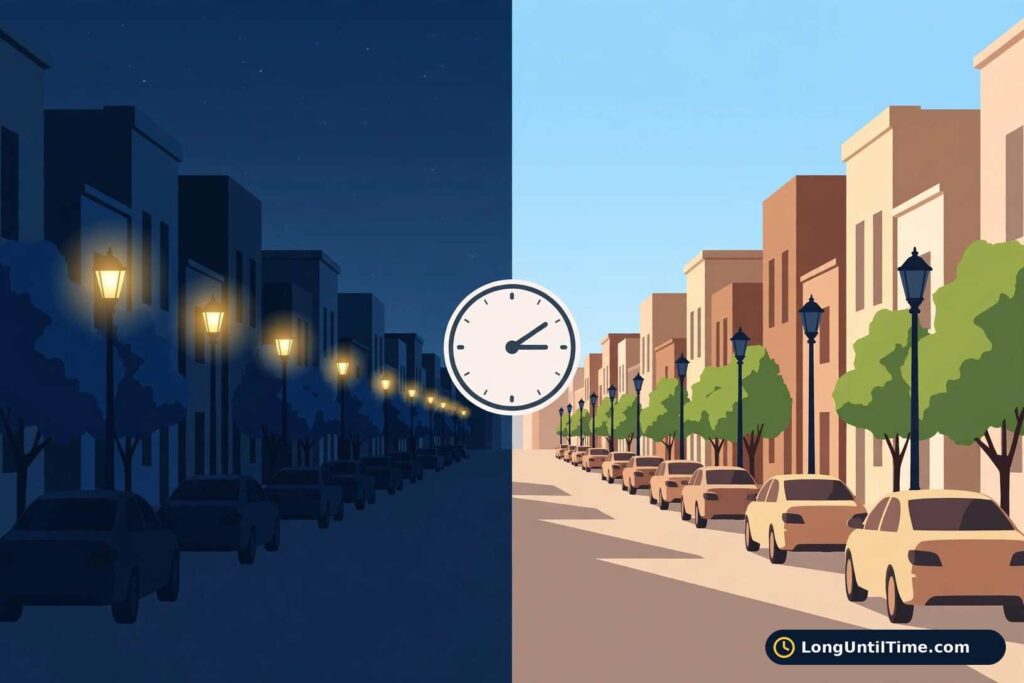
More wrong answers come from this mix-up than from any slip in arithmetic. On a 12-hour clock, 2:10 appears twice a day: once in the small hours of the morning and once in the early afternoon. Those two moments sit 12 hours apart, so choosing the wrong one does not make your answer slightly off; it makes it half a day off. The labels AM and PM are the only thing separating them. AM, from the Latin ante meridiem, means before midday, and PM, from post meridiem, means after midday. A 2:10 appointment, class, or pickup in ordinary daytime life is almost always the PM one.
The 24-hour clock removes the trap completely. It runs from 00:00 to 23:59 with no labels to misread, so 2:10 PM is written as 14:10 and 2:10 AM as 02:10. In minutes after midnight, the gap is just as plain: 2:10 AM is minute 130 of the day, while 2:10 PM is minute 850, and 850 − 130 = 720 minutes, exactly 12 hours. If the time really matters — an alarm, a booking, a reminder — setting it in 24-hour format, or saying “two ten in the afternoon” out loud, is the simplest way to make sure everyone means the same moment.
How to Calculate the Time Until 2:10 PM
For a rough answer, count forward from where you are: whole hours first, then the leftover minutes. For an exact answer, use the minutes method, which converts both times into minutes since midnight and subtracts. That subtraction is the whole secret: the time difference between now and 2:10 PM is all the question is really asking for. A countdown timer on a phone or an online time calculator performs the same subtraction automatically and keeps refreshing it, but doing it by hand once makes the table above easy to trust. Here are four worked examples, one for each situation you are likely to meet.
Example 1: An Ordinary Morning (9:20 AM)
Count forward in chunks. From 9:20 AM to 12:20 PM is 3 hours, and from 12:20 PM to 2:10 PM is another 1 hour 50 minutes. Together, that gives 4 hours 50 minutes until 2:10 PM (290 minutes).
Example 2: Inside the Final Hour (1:47 PM)
Once you are inside the last hour, hours stop helping and minutes take over. From 1:47 PM to 2:00 PM is 13 minutes, and from 2:00 PM to 2:10 PM is 10 more, so 23 minutes remain until 2:10 PM. Right at the end, seconds start to matter as well: at 2:09:20 PM, exactly 40 seconds are left before the target arrives.
Example 3: After the Target, Rolling to Tomorrow (4:35 PM)
At 4:35 PM, today’s 2:10 PM is already 2 hours 25 minutes in the past, so the target becomes tomorrow’s. From 4:35 PM to midnight is 7 hours 25 minutes, and from midnight to 2:10 PM is 14 hours 10 minutes. Added together, there are 21 hours 35 minutes until the next 2:10 PM.
Example 4: The Minutes Method (11:45 AM)
Convert both times into minutes since midnight. 11:45 AM is 11 × 60 + 45 = 705 minutes, and 2:10 PM (14:10) is 850 minutes. Subtract: 850 − 705 = 145 minutes. Convert back by dividing by 60, and 145 minutes is 2 hours with 25 minutes left over, so there are 2 hours 25 minutes until 2:10 PM. This method never struggles with the noon boundary, which is exactly where counting forward is most likely to go wrong.
The Final Minutes: When Seconds Take Over
For most of the day, hours and minutes are all the precision anyone needs. In the last stretch, the scale changes. The final 10 minutes hold 600 seconds, and the final minute holds 60, which is why countdown displays switch to a minutes-and-seconds readout near the end. For a 2:10 PM departure, appointment, or class change, those last seconds are the ones that decide whether you arrive early or late, so they deserve more respect than the long, forgiving hours earlier in the day.
Why Your Time Zone Changes the Answer
2:10 PM is a local moment, not a worldwide one. Because the Earth is divided into time zones, the clock reaches 2:10 PM in each region at a different instant. When it is 2:10 PM in New York, it is only 11:10 AM in Los Angeles, so a West Coast reader at that same moment still has a full 3 hours until their own 2:10 PM. This matters whenever the 2:10 belongs to someone else: a call, livestream, or class listed as “2:10 PM Eastern” begins at 11:10 AM Pacific. Convert the event into your own local time first, then count down to the converted time, and the answer will be right.
Planning Around a 2:10 PM Target
Most 2:10 targets are ordinary but unforgiving: a dentist appointment, the end of a lunch break, a class, a school pickup, a train. The useful habit is to work backwards from the target rather than forwards from now. Decide when you must leave or log on, subtract the travel or setup time, and treat that earlier moment as your real deadline. A checkpoint an hour beforehand helps as well: at 1:10 PM, anything that is not yet ready for the 2:10 commitment is unlikely to fix itself in the time remaining.
The same working-backwards habit serves any afternoon target, not just this one. If your commitment falls a little later in the day, our guide on how long until 3:10 applies the identical method to that target, step by step.
Frequently Asked Questions
How long until 2:10 PM from 1:00 PM?
There are 1 hour 10 minutes, or 70 minutes, from 1:00 PM until 2:10 PM. Early afternoon is the easiest stretch to count, since you simply cross one full hour and then add the final ten minutes.
How long until 2:05 PM?
The same method gives the answer for 2:05: just subtract your current time from 2:05 PM instead. Because 2:05 arrives five minutes earlier than 2:10, the remaining time is always five minutes shorter than the matching answer for 2:10 on this page.
What is 2:10 PM in 24-hour time?
2:10 PM is 14:10 in 24-hour time. You get there by adding 12 to the hour for any PM time after noon, which is why 2:10 AM stays 02:10 instead.
It is 3:00 PM now. How long until 2:10 PM?
There are 23 hours 10 minutes until the next 2:10 PM, which falls tomorrow. Once today’s target has passed, the countdown always rolls forward to the following day rather than going negative.
How many minutes are there from noon to 2:10 PM?
There are 130 minutes between 12:00 PM and 2:10 PM. That is two full hours plus the extra ten minutes that give this target its distinctive answers.
Is 2:10 PM in the afternoon?
Yes, 2:10 PM is early afternoon, two hours and ten minutes after noon. The PM label means post meridiem, after midday, so every PM time belongs to the second half of the day.
Does the time until 2:10 PM change in another time zone?
Yes, because the countdown runs on local time, and 2:10 PM arrives in each time zone at a different moment. Two people checking at the same instant in different zones can honestly get answers hours apart.
Conclusion
Working out how long until 2:10 comes down to one subtraction: your current time taken away from 2:10 PM. Read the answer off the quick reference table, count forward in hours and minutes, or use the minutes method when you cross noon. If 2:10 PM has already passed, count on to tomorrow’s instead, and always settle the AM and PM question first, because that single mix-up costs a full 12 hours.
For anything that matters — an appointment, a class, a departure — do the small calculation once and set a timer rather than guessing from the clock face. And if you enjoy understanding the instrument behind all this measuring, the long and surprisingly inventive history of the humble clock makes a good read.
One Comment