What Time Is It 8 Hours From Now? The Day Changes Only After 4 PM
If you are asking what time is it 8 hours from now, the short answer is: add eight hours to your current time, keep the minutes as they are, and run two checks — one for the label, one for the day. The count moves forward in your own local time, so the AM and PM label can change along the way, and a late start can run past midnight into tomorrow. At 9:00 AM, eight hours from now is 5:00 PM today; at 9:00 PM it is 5:00 AM tomorrow, because the count runs out of today.
People usually ask this at the start of something with a fixed length. A work shift runs eight hours, so anyone clocking in wants the clock-out time: a 7:00 AM start ends at 3:00 PM. Medication repeats every eight hours — a dose taken at 6:00 AM returns at 2:00 PM and 10:00 PM. The trap is borrowed from the twelve-hour question: people expect the numbers to stay put and the label to flip. With eight hours, the numbers always move, the label only sometimes flips, and the day is separate.
This article gives you three ways to land on the answer: a quick reference table, a step-by-step method, and the minutes-based calculation a time calculator uses. You will also see why the time difference sometimes leaves the label untouched, how the count reads on the 24-hour clock, why time zones change the reading but never the gap, and why the answer keeps the same seconds as now.
Quick Reference: What 8 Hours From Now Is
Find your start in the left column and read across, checking the day column: the last three rows belong to tomorrow:
| Current Time | 8 Hours From Now Is | Same Day or Next Day |
|---|---|---|
| 12:00 AM | 8:00 AM | Same Day |
| 4:00 AM | 12:00 PM | Same Day |
| 9:00 AM | 5:00 PM | Same Day |
| 11:59 AM | 7:59 PM | Same Day |
| 12:00 PM | 8:00 PM | Same Day |
| 3:59 PM | 11:59 PM | Same Day |
| 4:00 PM | 12:00 AM | Next Day |
| 6:45 PM | 2:45 AM | Next Day |
| 9:00 PM | 5:00 AM | Next Day |
Three patterns hold the table together. First, the minutes never move: eight hours is 480 minutes exactly, so every row keeps its minutes. Second, the day splits at 4:00 PM: starts before it land today, starts at or after it land tomorrow, because 4:00 PM is the first start whose eight hours run past the end of the day. Third, the label is the odd one out: most rows flip it, but the 12:00 AM and 12:00 PM rows keep theirs. The same thinking stretches further: our guide on 10 hours from now covers the ten-hour version, where the day line moves earlier, to 2:00 PM.
8 Hours From Now: Why the Label Flips Only Sometimes
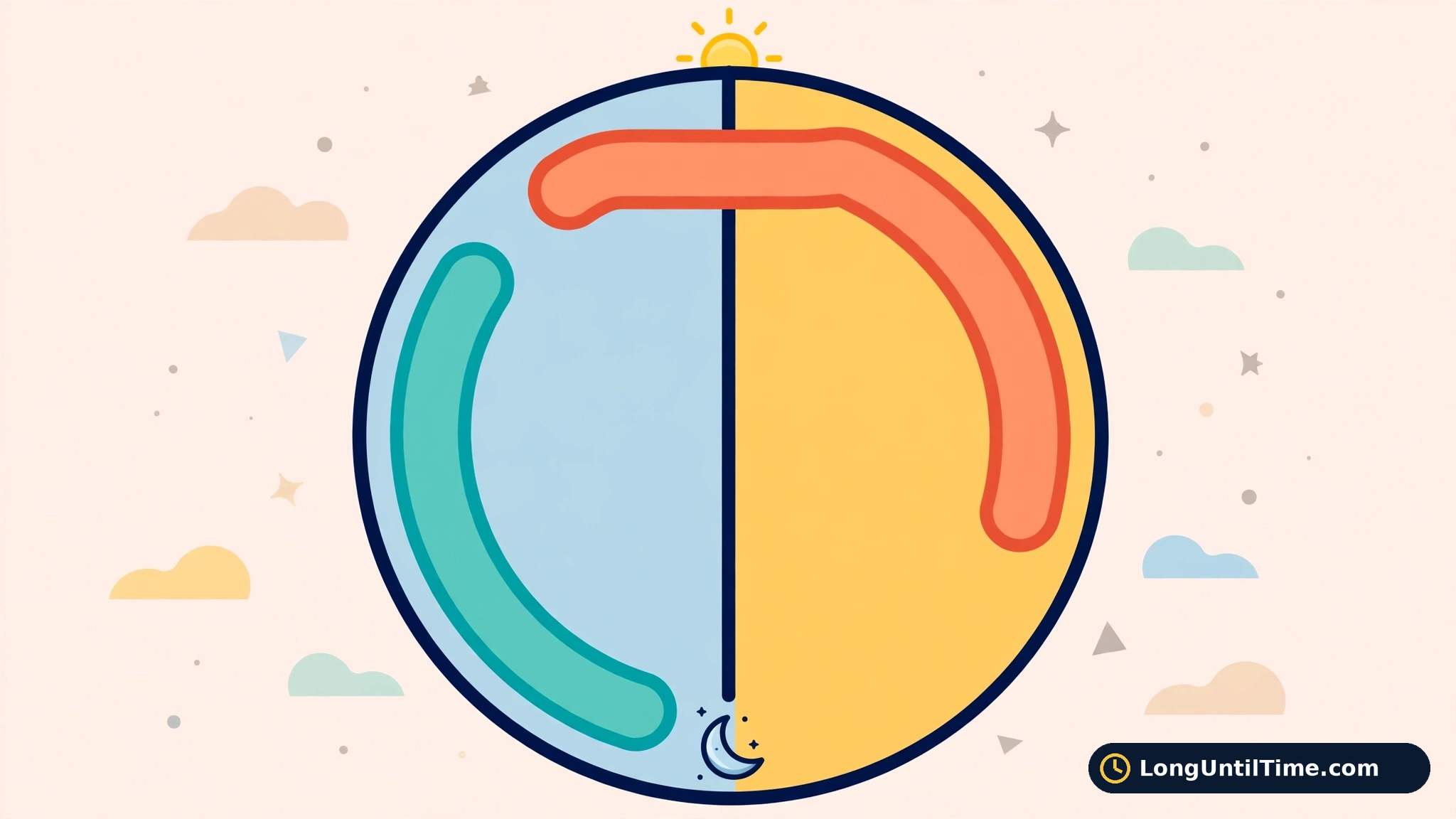
Eight hours is where the tidy twelve-hour rule breaks down. Twelve hours swaps the label every time, landing exactly on the opposite half of the day. Eight hours is shorter than a half day, so the count reaches the other half only if it crosses a boundary — noon or midnight — on the way. If your start sits between 12:00 and 3:59, in either half, the whole eight hours fits inside that same half: 1:00 AM plus eight hours is 9:00 AM, and 2:00 PM plus eight hours is 10:00 PM.
For every other start, the count crosses a boundary, and the label flips. Morning starts from 4:00 AM onward cross noon — 9:00 AM lands at 5:00 PM — and starts from 4:00 PM onward cross midnight: 9:00 PM lands at 5:00 AM tomorrow. That produces two classic errors: flipping the label automatically, as the twelve-hour rule teaches, turns a 1:00 AM start into “9:00 PM” — twelve hours away from the true 9:00 AM — while keeping the label out of caution turns a 9:00 AM start into “5:00 AM,” not the true 5:00 PM.
One question protects you: does my eight hours cross noon or midnight? If it does, flip the label; if not, keep it. Then ask the separate day question — did I start at or after 4:00 PM? — because only that second line can make the answer tomorrow.
How to Calculate 8 Hours From Now
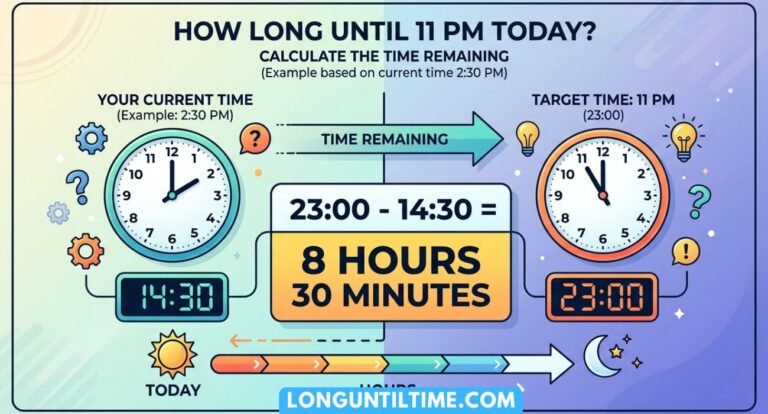
The everyday method starts with the hour number: add 8, keep the minutes, and if the hour total passes 12, subtract 12 — from 9, eight hours lands on 5. Then run the two checks above: flip the label only on a crossing, and roll the day only for starts at or after 4:00 PM. From a 24-hour reading, add 8 to the hour; if the result is 24 or more, subtract 24 and count the day as tomorrow. One more cross-check: eight hours from now is always exactly four hours before the twelve-hours-from-now answer, so at 9:00 AM, stepping back four hours from 9:00 PM gives 5:00 PM. Here are four worked examples.
Example 1: An Ordinary Morning Start (9:25 AM)
Add eight hours, keep the minutes: 9:25 AM becomes 5:25 PM. The span crosses noon, so the label flips, but the day holds: 5:25 PM today.
Example 2: An Evening Start Crossing Midnight (9:40 PM)
At 9:40 PM, only 2 hours and 20 minutes of today remain, so the count crosses midnight: 5:40 AM tomorrow. The label flip and the day change travel together here, because crossing midnight causes both.
Example 3: The Boundary, 3:59 PM vs 4:00 PM
One minute of start time changes the day. From 3:59 PM, eight hours lands at 11:59 PM today — a minute to spare, label unchanged, since the span never reaches midnight. From 4:00 PM, the same eight hours land exactly on 12:00 AM tomorrow. Four o’clock in the afternoon is the line: starts before it stay today; starts at or after it roll over.
Example 4: The Full Minutes Method (6:50 PM)
Convert the start to minutes since midnight: 6:50 PM is 18:50 in 24-hour time, and 18 × 60 + 50 = 1,130 minutes. Add the 480 minutes in eight hours: 1,130 + 480 = 1,610. That passes the 1,440 minutes in a full day, so subtract them: 1,610 − 1,440 = 170 minutes, which is 02:50 in 24-hour time, or 2:50 AM tomorrow. The method matches the shortcut exactly.
Minutes and Seconds: The Exact Moment 8 Hours From Now
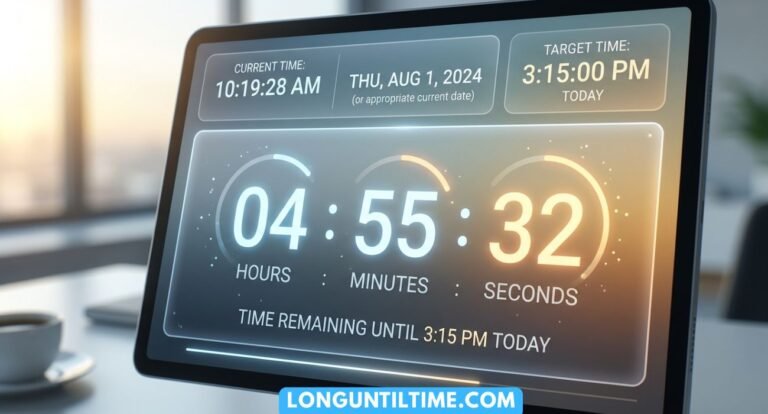
Adding whole hours changes only the hour, never the smaller units. If it is now 2:14 and 9 seconds in the afternoon, eight hours from now it will be 10:14 and 9 seconds in the evening, because eight hours is a whole number of minutes: 480 of them, or 28,800 seconds. A countdown timer set for eight hours counts down to the same minute and second you started with.
With timestamps, that precision matters: a message sent at 2:14 PM is exactly eight hours old at 10:14 PM.
Why Your Time Zone Changes the Reading, Not the Gap
Eight hours from now is a single fixed moment, but its clock reading depends on where the clock is. The gap is elapsed time — the same everywhere — while the label, hour number, and day belong to the local clock. An event stamped 3:00 PM in a zone three hours ahead of you is 12:00 PM on your clock, and eight hours later reads 8:00 PM for you and 11:00 PM for them — one moment, two readings.
So convert any foreign timestamp into your own zone first, then add. One wrinkle: twice a year, where daylight saving is observed, the clocks jump by an hour and an hour of local time is skipped or repeated. On those days, eight hours by the clock face can differ by an hour from eight full elapsed hours, so for a flight, a dose, or a deadline, count elapsed hours rather than labels.
Planning With an 8-Hours-From-Now Answer
The eight-hour shift is the standard block of the working day: a 7:00 AM start ends at 3:00 PM, while a night shift starting at 11:00 PM ends at 7:00 AM tomorrow — and that “tomorrow” is exactly the word that gets dropped from logs and handovers. Medication runs on it too: doses land at 6:00 AM, 2:00 PM, and 10:00 PM, and the next belongs to the following morning.
The same habit works looking further ahead: the companion piece on 12 hours from now covers the half-day jump, where the numbers hold still and only the label moves. Whatever the setting, write the answer as a time and a day together.
Frequently Asked Questions
What time is it 8 hours from now?
It is eight hours later than your current time: add 8 to the hour, keep the minutes, then check the label and the day. From 9:00 AM it is 5:00 PM today; from 9:00 PM, 5:00 AM tomorrow.
What time is 8 hours from now from 9 AM?
Eight hours from 9:00 AM is 5:00 PM today. The span crosses noon, so the label flips, but the day holds.
What time is 8 hours from now from 10 PM?
Eight hours from 10:00 PM is 6:00 AM tomorrow. Crossing midnight changes both the label and the day.
Does the AM or PM label always change when you add 8 hours?
No — the label changes only when the eight hours cross noon or midnight. Starts between 12:00 and 3:59 keep their label — 1:00 AM lands at 9:00 AM.
Is 8 hours from now today or tomorrow?
It is tomorrow only if you start at or after 4:00 PM. Every earlier start lands on the same day.
How many minutes is 8 hours from now?
Eight hours from now is 480 minutes ahead of the current moment, or 28,800 seconds. Adding 480 to your minutes since midnight is the most reliable method.
What is 8 hours from now in 24-hour format?
Add 8 to the hour, and if the result is 24 or more, subtract 24 and count the answer as the next day. For example, 21:15 becomes 05:15 tomorrow, while 09:30 becomes 17:30 today.
How do I work out 8 hours from now without a calculator?
Add 8 to the hour number, keep the minutes, then ask two questions: did the count cross noon or midnight, and did I start at or after 4:00 PM? The first settles the label; the second, the day.
Conclusion
Finding the time for 8 hours from now comes down to one addition and two checks. Add eight hours, keep the minutes; flip the label only on a noon or midnight crossing; and call it tomorrow only for starts at or after 4:00 PM. The quick reference table settles common starts at a glance, and the minutes method handles the rest.
For anything that will be acted on — a clock-out time, a dose, a landing — write the answer as a time and a day together, because the addition is easy and the day is the part that slips. Readers who live by that eight-hour rhythm can browse the encyclopedia entry on shift work, which traces how the shift came to structure jobs and rosters.