
What Time Was 6 Hours Ago? How to Calculate It Easily
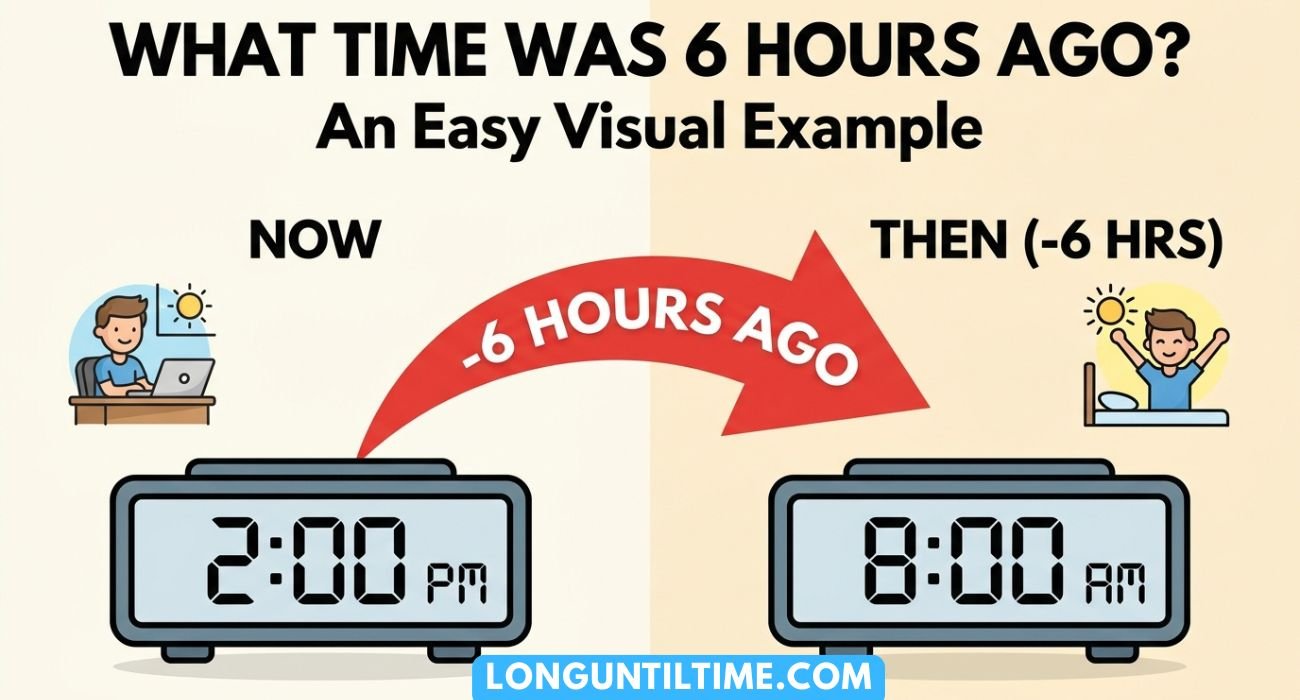
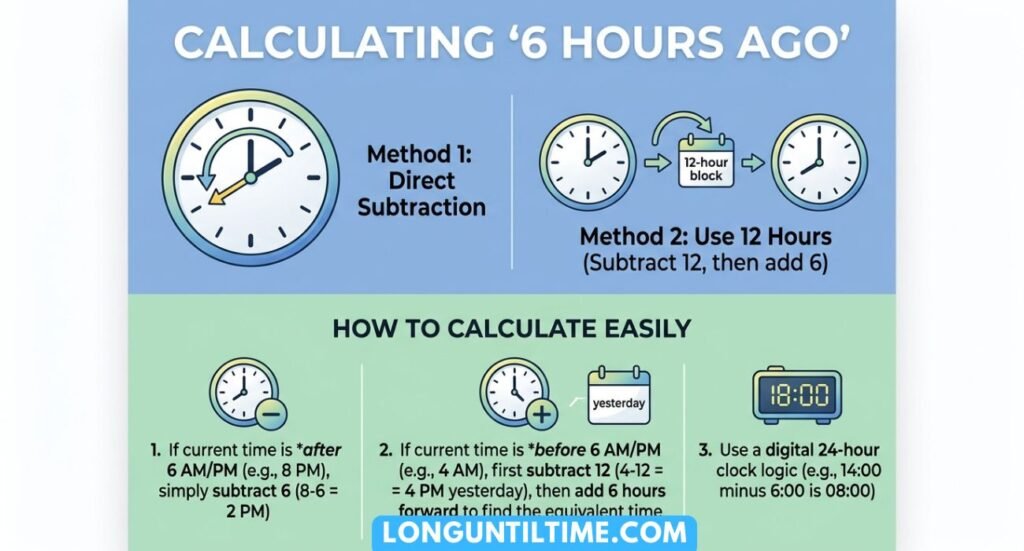
If you are asking what time was 6 hours ago, simply subtract 6 hours from your current time. For example, if it is 8:00 PM now, 6 hours ago it was 2:00 PM. If the calculation crosses midnight, the answer falls on the previous day.
The exact answer always depends on your current local time and, for situations involving different locations, your time zone. This guide explains how to calculate six hours ago using both the 12-hour and 24-hour clock, handle midnight and date changes, and use a time calculator when you need an instant answer.
Understanding What Time Was It 6 Hours Ago
“What time was 6 hours ago?” is a relative-time question. It asks you to find the clock time that occurred exactly six hours before a particular moment.
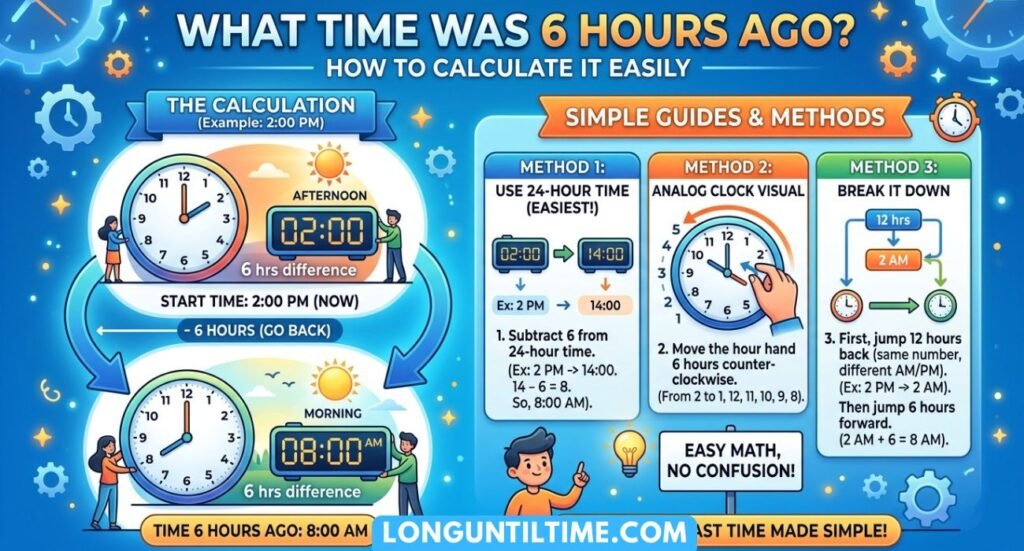
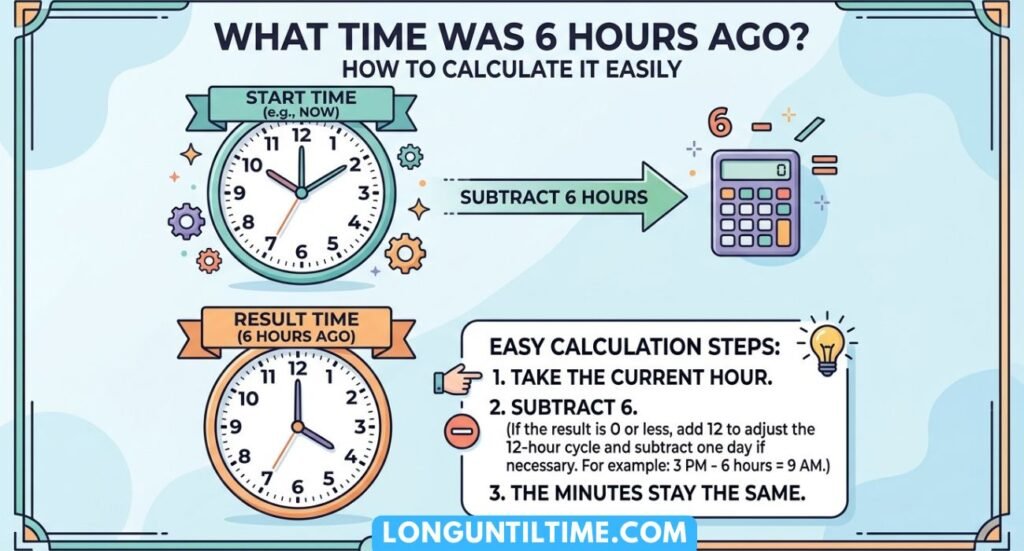
The basic calculation is:
Current time − 6 hours = time 6 hours ago
The minutes and seconds normally stay the same. Only the hour changes unless the calculation passes midnight and moves into the previous calendar day.
For example, if the current time is 10:25 AM, then six hours earlier was 4:25 AM. If the current time is 3:40 AM, six hours earlier was 9:40 PM on the previous day.
This is why knowing only the phrase “6 hours ago” is not enough to give one universal clock time. The answer changes continuously as the current time changes.
Related searches include “what was 6 hours ago from now,” “what time was it six hours earlier,” and “what was the time 6 hours ago.” They all use the same basic time-subtraction method.
How to Calculate 6 Hours Ago
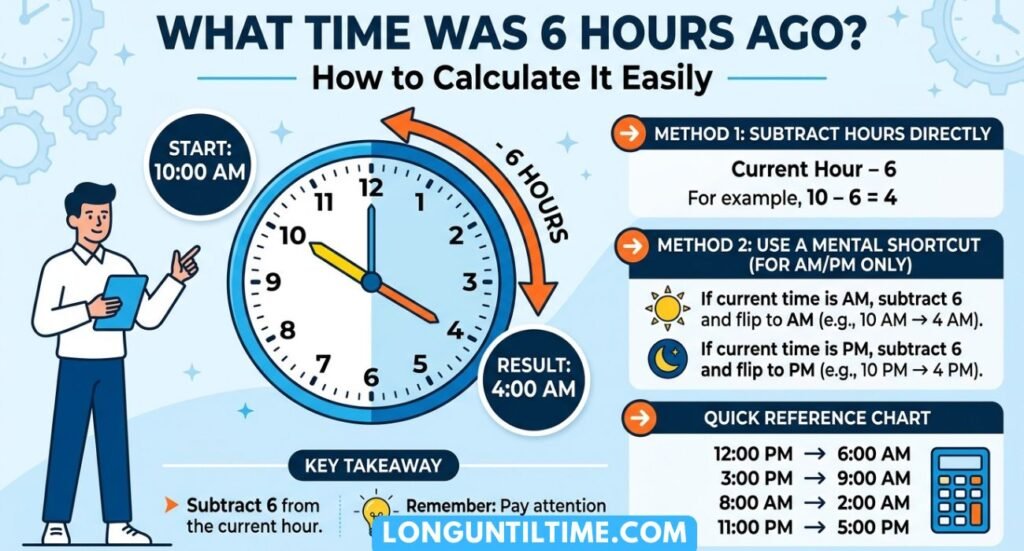
The easiest way to calculate six hours ago is to subtract six from the current hour while keeping the minutes and seconds unchanged.
Suppose the current time is 7:30 PM.
7:30 PM − 6 hours = 1:30 PM
The calculation is straightforward because it stays within the same day.
Now consider 3:15 AM:
3:15 AM − 6 hours = 9:15 PM the previous day
Here, subtracting six hours takes you across midnight. The clock moves backward from 3:15 AM to 12:00 AM and then continues into the previous evening.
A useful rule is:
If the current hour is less than 6, subtracting six hours will usually move the answer to the previous day.
The minutes do not need to be converted when you are subtracting a whole number of hours. For example, 11:47 AM becomes 5:47 AM, not 5:07 AM.
Why People Search “What Was 6 Hours Ago From Now”
People often need to convert a relative time into an exact clock time. A message may say that something happened “six hours ago,” or someone may remember an event only by how long ago it occurred.
For example, you might want to know when a work task was completed, when a message was sent, or what time an appointment-related event occurred. Converting the relative duration into a clock time makes the event easier to understand.
The phrase what was 6 hours ago from now also becomes useful when checking digital timestamps. Phones, websites, messaging services, and other applications may show relative labels such as “6 hours ago” instead of displaying the exact time.
The calculation itself remains simple: identify the reference time, subtract six hours, and check whether the date changes.
Everyday Situations Where Time Six Hours Earlier Matters
A six-hour time difference appears in many ordinary schedules. The calculation can be useful whenever you know one time but need to identify another point exactly six hours earlier.
Work Shifts
Work schedules often involve fixed periods of several hours. If you know when a shift ended, you can calculate its start time when the shift lasted six hours.
For example, a six-hour shift ending at 6:00 PM would have started at 12:00 PM.
Overnight work makes the calculation slightly more important. A shift ending at 4:00 AM could have started at 10:00 PM the previous day if it lasted six hours.
For payroll, attendance, or official scheduling, use the recorded workplace timestamps rather than relying on mental arithmetic alone.
Medication Schedule
Time calculations can help someone understand the spacing between scheduled medication times. If a schedule specifies a six-hour interval, subtracting six hours can identify the earlier reference time.
For example, six hours before 2:00 PM is 8:00 AM.
However, a time calculation should not be used to decide whether a dose should be taken, skipped, or repeated. Medication instructions can depend on the specific medicine and individual circumstances, so follow the prescribed instructions or ask a qualified healthcare professional when uncertain.
Sleep Tracking
Sleep records often cross midnight, making relative-time calculations useful.
If someone wakes at 5:30 AM and wants to know what time it was six hours earlier, the answer is 11:30 PM the previous day.
This distinction matters because the date changes even though the elapsed interval is exactly six hours.
Sleep-tracking apps may also display timestamps according to the device’s local time, so a time-zone or clock-setting change can affect how an event appears.
Customer Support
Customer support systems frequently record the time a ticket, email, or chat was created. If a support agent sees an event marked as occurring six hours earlier, converting that relative time into an exact timestamp can help establish the sequence of events.
For example, if the current reference time is 4:00 PM, an event six hours earlier occurred at 10:00 AM.
When records involve people in different locations, however, the time zone must also be considered. A timestamp in Eastern Time is not necessarily the same displayed clock time in Pacific Time.
Flight Schedules
Flight schedules are another situation where time calculations can become confusing. Airlines and airports generally display departure and arrival times according to the relevant local airport time.
A six-hour interval may cross midnight, and a flight can also cross one or more time zones. Therefore, subtracting six hours from a displayed flight time is useful for elapsed-time reasoning, but it does not replace checking the official schedule.
For travel planning, always distinguish between elapsed hours and the local clock time shown for a particular airport.
Time Arithmetic Made Simple
Time arithmetic becomes easier when you separate hours, minutes, seconds, and calendar dates.
The fundamental relationships are:
1 hour = 60 minutes
1 minute = 60 seconds
To find a time six hours earlier, you generally subtract 360 minutes from the current time.
For example:
5:45 PM − 6 hours = 11:45 AM
Because the calculation does not cross midnight, the date remains the same.
But:
2:45 AM − 6 hours = 8:45 PM on the previous day
The elapsed time is still exactly six hours. The only difference is that the calendar date has changed.
| Current Time | Six Hours Earlier |
| 12:00 PM | 6:00 AM |
| 3:00 PM | 9:00 AM |
| 6:00 PM | 12:00 PM |
| 10:00 PM | 4:00 PM |
| 1:00 AM | 7:00 PM previous day |
| 2:30 AM | 8:30 PM previous day |
| 5:15 AM | 11:15 PM previous day |
This approach also works with seconds. If the current time is 9:18:45 PM, six hours earlier is 3:18:45 PM.
Examples Using Both 12-Hour and 24-Hour Clock
The calculation does not change when you switch clock formats. The main difference is how the time is written.
12-Hour Clock
The 12-hour clock uses AM and PM to distinguish between morning and afternoon/evening.
For example:
8:30 PM − 6 hours = 2:30 PM
Another example:
4:15 AM − 6 hours = 10:15 PM the previous day
The second example crosses midnight, so the previous calendar date must be included.
Here are a few more examples:
| Current Time | Calculation | 6 Hours Ago |
| 9:00 AM | 9 − 6 | 3:00 AM |
| 1:00 PM | 13 − 6 | 7:00 AM |
| 7:30 PM | 19 − 6 | 1:30 PM |
| 3:45 AM | 3 − 6 | 9:45 PM previous day |
| 11:20 PM | 23 − 6 | 5:20 PM |
24-Hour Clock
The 24-hour clock represents the day using hours from 00 through 23. It avoids the need for AM and PM.
For example:
20:30 − 6 hours = 14:30
And:
04:15 − 6 hours = 22:15 on the previous day
The same relationship can be shown as:
| 24-Hour Current Time | Six Hours Earlier |
| 09:00 | 03:00 |
| 13:00 | 07:00 |
| 18:30 | 12:30 |
| 20:45 | 14:45 |
| 03:15 | 21:15 previous day |
The 24-hour format can make calculations easier because there is no AM/PM label to interpret.
What Time Will It Be in 6 Hours?
“What time was 6 hours ago” looks backward, while “what time will it be in 6 hours” looks forward.
The formulas are:
Six hours ago = current time − 6 hours
Six hours from now = current time + 6 hours
For example, if the current time is 11:00 AM, six hours from now will be 5:00 PM.
If the current time is 9:30 PM, six hours from now will be 3:30 AM the next day.
The important distinction is that adding six hours can move the date forward, while subtracting six hours can move it backward.
Time Zones Can Change Everything
A calculation of six elapsed hours is universal, but the local clock time can differ between locations.
The United States spans several major time zones, including Eastern, Central, Mountain, Pacific, Alaska, and Hawaii-Aleutian time. At the same instant, a clock in New York can show a different time from a clock in Los Angeles.
This matters when someone asks what time an event occurred six hours ago but does not specify where the event took place.
For example, if a person in one time zone says an event happened six hours ago, someone in another time zone should not automatically assume that both people will see the same clock time for that event. The elapsed duration is six hours, but the local representation depends on the applicable UTC offset.
Daylight saving time can add another layer of complexity because some U.S. locations change their UTC offset during part of the year.
For a simple personal calculation, use your current local clock. For international travel, business records, or system logs, identify the time zone before interpreting the timestamp.
Technology Depends on Accurate Time Calculation
Modern devices constantly work with timestamps. Smartphones, computers, websites, messaging services, calendars, and online systems all need a reliable way to represent when an event occurred.
A device might store an event using a standardized time reference and then display it in the user’s local time. This is one reason two people can view the same event but see different clock times.
Time-related software also needs to handle:
- Time zones, because locations have different local times.
- Daylight saving changes, where applicable.
- Date boundaries, especially around midnight.
- Minutes and seconds, when an exact timestamp matters.
- System clock accuracy, because an incorrect device clock can produce an incorrect displayed time.
This is particularly relevant when a website says “6 hours ago.” The label is meaningful only relative to the system’s current timestamp and the rules used to display it.
Using an Hours Ago Calculator
An hours ago calculator can perform the subtraction automatically. This is useful when you want an exact result without doing the calculation manually.
A typical time calculator works from a reference date and time, then subtracts the requested number of hours. For six hours ago, the calculation is simply:
Reference date and time − 6 hours
For a basic calculation, you may only need the current time. For a more precise result, especially when dealing with another location, you should also account for the relevant time zone.
An online calculator is particularly useful when the calculation involves a larger number of hours, multiple days, or a precise timestamp containing minutes and seconds.
Still, the underlying arithmetic remains simple enough to check manually.
Common Mistakes People Make
The most common error is forgetting the AM/PM transition. Someone may subtract six from the displayed hour without realizing that the result belongs to a different part of the day.
Another mistake is forgetting the date when the calculation crosses midnight. For example, six hours before 2:00 AM on September 3 is 8:00 PM on September 2, not 8:00 PM on September 3.
People also sometimes confuse a six-hour duration with a clock reading. “Six hours ago” describes elapsed time; it does not represent one fixed time of day.
A further source of confusion is the time zone. An event that occurred six hours earlier can have different local clock representations depending on where the observer is located.
Finally, remember that 60 minutes make one hour. If you are working with minutes rather than whole hours, convert carefully. For instance, 90 minutes equals 1 hour 30 minutes, not 1 hour 90 minutes.
Why Relative Time Feels Different From Exact Time
Relative time and exact time describe the same event in different ways.
“Six hours ago” tells you the distance in time between now and an earlier event. “2:30 PM” tells you the clock position of that event.
Relative descriptions are convenient because they remain easy to understand as time passes. If something happened six hours ago, you do not necessarily need to know its exact timestamp to understand that it happened earlier today.
Exact timestamps are more useful when you need to compare multiple events, check a schedule, or establish precisely when something happened.
For example, imagine two messages were sent at 8:00 AM and 10:00 AM. Saying that the first message was six hours ago and the second was four hours ago may be useful relative to a 2:00 PM reference time. But the exact timestamps make the two-hour difference immediately clear.
Understanding this distinction makes questions such as what time was 6 hours ago much easier to solve.
How to Find 6 Hours Ago From Any Time
You can use the same process regardless of the starting time:
- Start with the exact current or reference time.
- Subtract six hours.
- Keep the minutes and seconds unchanged when subtracting a whole six-hour interval.
- Check whether the calculation crossed midnight.
- If it crossed midnight, move the date back by one day.
- If another location is involved, confirm the applicable time zone.
For example, start with 1:20 AM on September 3.
Subtract six hours:
1:20 AM → 12:00 AM = 1 hour 20 minutes
The remaining time is 4 hours 40 minutes.
Continue backward into the previous evening:
12:00 AM − 4 hours 40 minutes = 7:20 PM
Therefore:
Six hours before 1:20 AM on September 3 was 7:20 PM on September 2.
This method works even when the starting time is close to midnight.
Frequently Asked Questions
What time was 6 hours ago?
Six hours ago is the current time minus six hours. For example, if it is 6:00 PM now, six hours ago it was 12:00 PM.
What was 6 hours ago from now?
To find what was 6 hours ago from now, subtract six hours from your current local time. If the calculation passes midnight, the answer is on the previous calendar day.
How do I calculate 6 hours earlier?
Subtract six hours from the reference time. The minutes and seconds normally remain unchanged. Then check whether the calculation crossed midnight.
What is 6 hours ago in the 24-hour clock?
It depends on the current time. For example, if it is 18:00, six hours ago was 12:00. If it is 03:00, six hours ago was 21:00 on the previous day.
Does 6 hours ago always mean the same clock time?
No. Six hours ago changes continuously because it is measured relative to the current moment. The answer also depends on the time zone when different locations are involved.
What time was 6 hours ago if it is 3 AM?
Six hours before 3:00 AM is 9:00 PM on the previous day.
What time was 6 hours ago if it is noon?
Six hours before 12:00 PM is 6:00 AM on the same day.
What is the difference between 6 hours ago and 6 hours from now?
“6 hours ago” means six hours before the reference time. “6 hours from now” means six hours after the reference time.
Conclusion
To answer what time was 6 hours ago, subtract six hours from the current or reference time. For example, 8:00 PM becomes 2:00 PM, while 3:00 AM becomes 9:00 PM on the previous day.
The key things to watch are AM and PM, midnight, date changes, minutes and seconds, and time zones. For a straightforward calculation, mental subtraction is enough; for more complicated timestamps, an hours-ago calculator can provide a quick check.


One Comment