
What Time Was It 12 Hours Ago? Same Numbers, Opposite Half of the Day
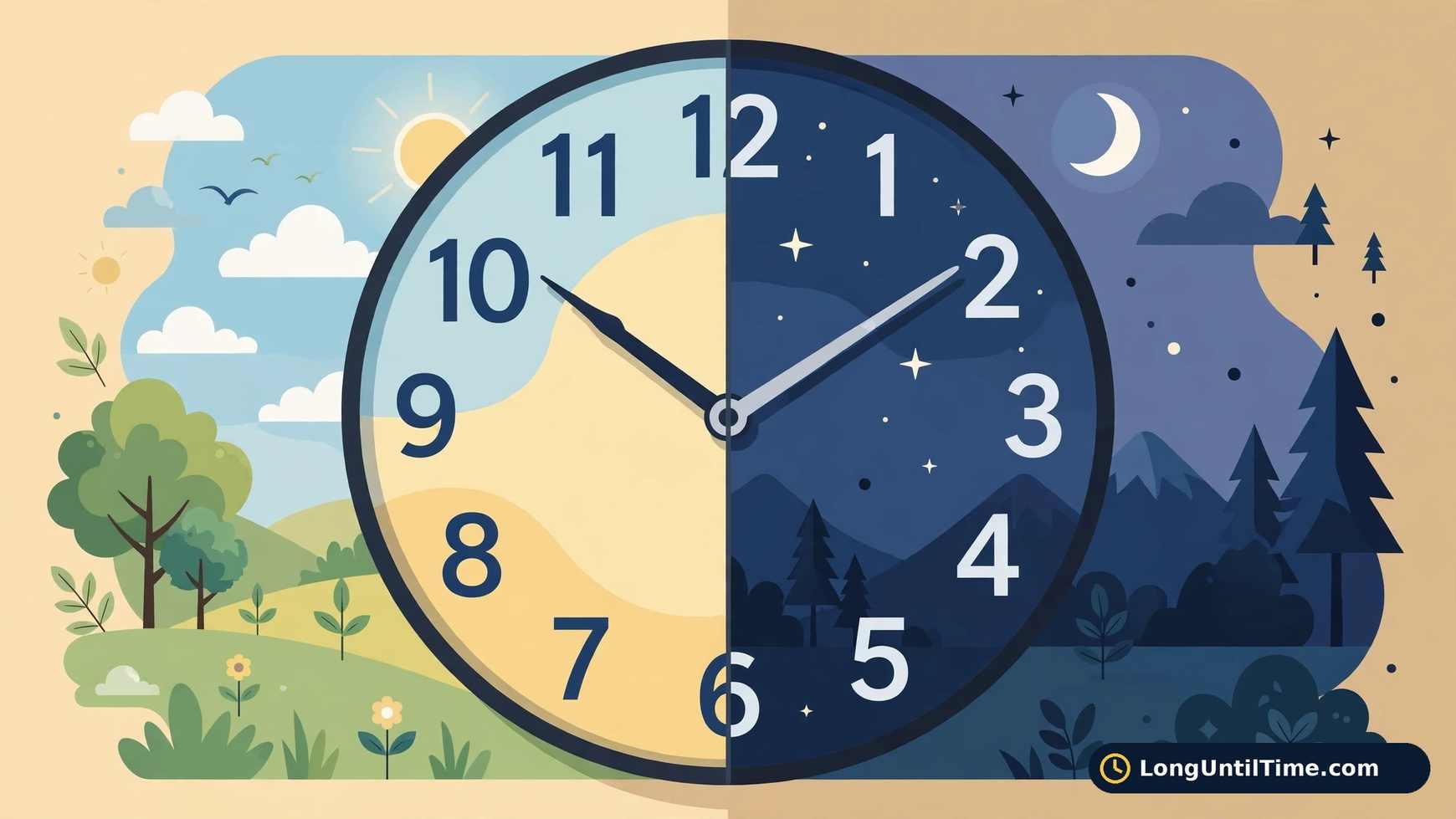
If you are asking what time was it 12 hours ago, the shortcut is simple: take your current time, keep the hour number and the minutes exactly as they are, and flip the label. Twelve hours is half a day, so in your own local time the answer sits on the opposite side of the clock — an evening reading becomes a morning one, and the AM and PM label is the only part of the time that moves. At 8:20 PM, twelve hours ago was 8:20 AM today. At 7:15 AM, it was 7:15 PM yesterday, because a morning start reaches back past midnight into the day before.
People usually ask this at the halfway point of something. Someone mid-fast wants to know when the twelve hours began, a nurse on a long shift wants the start time for a log, and anyone on a twice-a-day routine — medication, feeding a baby, a pet’s dose — is really asking when the previous round happened. Timestamps raise it too, when a photo stamped in the evening needs placing against a morning event. In each case the trap is the same: the answer looks too easy, because the numbers refuse to change, and it is tempting to fix a result that was already right.
This article gives you three ways to land on the answer: a quick reference table for common starting times, a step-by-step method with worked examples, and the minutes-based calculation a time calculator uses. You will also see why the time difference leaves the smaller units untouched, how the count reads on the 24-hour clock, why time zones can move the reading, and why the answer keeps the same seconds as now.
Quick Reference: What 12 Hours Ago Was
If your starting time is below, no calculation is needed. Find it in the left column, read across, and check the day column, because every morning row belongs to yesterday:
| Current Time | 12 Hours Ago Was | Same Day or Previous Day |
|---|---|---|
| 12:00 AM | 12:00 PM | Previous Day |
| 6:00 AM | 6:00 PM | Previous Day |
| 8:30 AM | 8:30 PM | Previous Day |
| 10:00 AM | 10:00 PM | Previous Day |
| 11:59 AM | 11:59 PM | Previous Day |
| 12:00 PM | 12:00 AM | Same Day |
| 3:00 PM | 3:00 AM | Same Day |
| 6:45 PM | 6:45 AM | Same Day |
| 9:00 PM | 9:00 AM | Same Day |
| 11:30 PM | 11:30 AM | Same Day |
Three patterns hold the table together. First, the hour number never moves: every row keeps its numeral and minutes, and only the label flips. Second, the day splits at noon: every AM start lands on the previous day, because fewer than twelve hours of today exist behind it, while every PM start stays today. Third, the edge rows: noon lands on midnight at the start of today, and midnight on noon yesterday. The same thinking shrinks to shorter gaps, and our guide on 11 hours ago covers the odd-hour version, where the numeral shifts by one instead of staying still.
12 Hours Ago: The Same Numbers, the Opposite Half of the Day
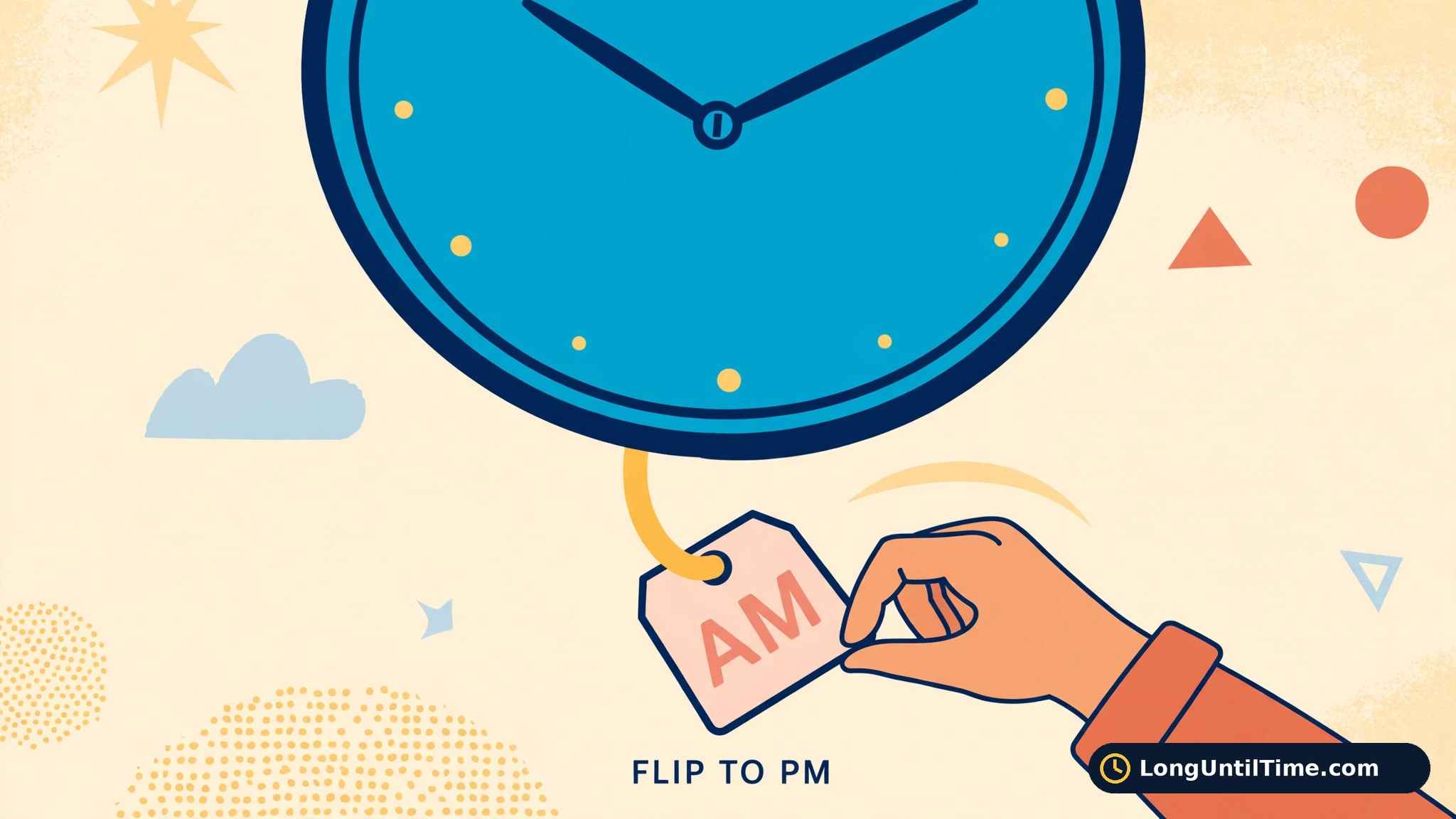
Twelve hours is the one subtraction where people expect the numbers to change, and they do not. On the clock face it is one full turn of the hour hand, back to the exact numeral it started from. The only change is which half of the day you are standing in — and because the result differs from the start only in two small letters, it feels wrong.
That feeling produces two classic errors. The first is moving the numeral anyway, counting back on fingers and losing one around the top of the clock. The second is keeping the label: writing 5:00 PM yesterday when the true answer is 5:00 AM today, twelve hours from where the moment belongs. Both come from correcting a result that needed no correction.
The day follows one clean rule. Any AM start lands on the previous day’s PM, because the count runs out of today first; any PM start lands on the same day’s AM. The boundary cases sit on the line: noon reaches back to midnight at the start of the same day, and midnight to noon on the previous day. One check protects you: the answer should show your exact numbers with the opposite label, and say yesterday only when your start is in the AM half.
How to Calculate 12 Hours Ago
The everyday method has one move: keep the hour number and minutes, and swap AM for PM or PM for AM. From a 24-hour reading, subtract 12 from the hour instead; if the result is negative, add 24 and count the day as yesterday. Here are four worked examples.
Example 1: An Evening Start That Stays Today (8:20 PM)
At 8:20 PM, a full twelve hours of today lies behind you, so the count never leaves the date. Flip the label and nothing else: twelve hours ago was 8:20 AM today.
Example 2: A Morning Start Landing Yesterday Evening (7:15 AM)
Only seven and a quarter hours of today exist at 7:15 AM, so the count finishes in yesterday evening. Keep the numbers, flip the label, attach the day: 7:15 PM yesterday. The minutes stayed at 15; only the label and the day moved.
Example 3: The Edge Cases, Noon and Midnight
Twelve hours before 12:00 PM is 12:00 AM today, midnight at the very start of the same date, because noon has exactly twelve hours of today behind it. Twelve hours before 12:00 AM is 12:00 PM yesterday: at midnight, none of today has happened yet, so the whole half day belongs to yesterday and ends at its noon. These two rows are the ones most often written against the wrong day.
Example 4: The Full Minutes Method (9:25 AM)
Convert the start to minutes since midnight: 9:25 AM is 9 × 60 + 25 = 565 minutes. Subtract the 720 minutes in twelve hours and you get −155. A negative result signals the previous day, so add the 1,440 minutes in a full day: −155 + 1,440 = 1,285 minutes, which is 21 hours and 25 minutes, written 21:25 in 24-hour time, or 9:25 PM yesterday. The method matches the shortcut exactly.
Minutes and Seconds: The Exact Moment 12 Hours Ago
Subtracting whole hours changes only the hour and the label, never the smaller units. If it is now 3:27 and 48 seconds in the afternoon, twelve hours ago it was 3:27 and 48 seconds in the morning, because twelve hours is a whole number of minutes: 720 of them, or 43,200 seconds.
This matters with timestamps. If it is now 10:05 AM, a log stamped 10:05 PM yesterday sits exactly twelve hours back, and the :05 is not an approximation to round away. Keep the smaller units attached, and the moment you recover is exact.
Why Your Time Zone Can Move the Answer
Twelve hours ago is a single fixed moment, but its clock reading depends on where the clock is. If a server or colleague stamps an event in another zone, that reading belongs to their zone. An event logged at 4:00 PM in a zone three hours ahead of you happened at 1:00 PM on your clock, and counting back from the printed time gives 4:00 AM instead of the true 1:00 AM — three hours out.
Convert the timestamp into your own zone first, then subtract. One calendar wrinkle: twice a year, in regions that observe daylight saving, the clocks jump by an hour and an hour of local time is skipped or repeated. On those days, twelve hours ago by the clock face can differ by an hour from twelve full hours of elapsed time, so count elapsed hours rather than labels for a precise interval.
Planning With a 12-Hours-Ago Answer
Twice-daily routines are built on this gap. Medication taken at 7:00 AM and 7:00 PM sits twelve hours apart, so when a dose is missed or doubled, the 12-hours-ago answer tells you when the previous one was due: 7:00 PM yesterday. Newborn feeding schedules run on a similar half-day rhythm, and so do many pet medications.
Fasting windows use it in the other direction: a twelve-hour fast that ends at 8:00 AM began at 8:00 PM yesterday. For anything medical, follow the label or your clinician, and use this calculation to keep records straight. Work logs ask it too: a shift ending at 6:00 PM began at 6:00 AM today, and the record is only right when the day is attached correctly. The same habit works looking forward, and the companion piece on 12 hours from now covers the forward-looking version. Whatever the setting, write the answer as a time and a day together.
Frequently Asked Questions
What time was it 12 hours ago?
It was exactly half a day before now, with the same hour number and minutes and the opposite AM or PM label. Any morning start lands on the previous day.
What time was it 12 hours ago from 3 PM?
Twelve hours before 3:00 PM was 3:00 AM today. An afternoon start has more than twelve hours of today behind it, so the count never leaves the date.
What time was it 12 hours ago from 10 AM?
Twelve hours before 10:00 AM was 10:00 PM yesterday. Only ten hours of today exist at that point, so the remaining two hours run into yesterday evening.
How many minutes is 12 hours ago?
Twelve hours is 720 minutes before the current moment, or 43,200 seconds. Converting your start to minutes since midnight and subtracting 720 is the most reliable method.
Is 12 hours ago always yesterday?
No, starts in the PM half stay on the same day. From 9:00 PM, for example, the count reaches back only to 9:00 AM this morning.
What was the time 12 hours ago in 24-hour format?
Subtract 12 from the hour number, and if the result is negative, add 24 and count the day as yesterday. For example, 18:45 becomes 06:45 on the same day, while 07:20 becomes 19:20 on the previous day.
Does the clock number change when you count back 12 hours?
No, the number is exactly the same — only the AM or PM label flips. That is what makes this gap different from every other “hours ago” question.
How do I work out 12 hours ago without a calculator?
Keep the hour number and the minutes, flip the label, and write “yesterday” whenever the current time is in the AM half. Then sanity-check the day: PM starts stay today, AM starts do not.
Conclusion
Finding the time for 12 hours ago comes down to one flip and one check. Keep the numbers exactly as they are, swap the AM or PM label, and attach yesterday whenever your start sits in the morning half. The quick reference table settles common starting times at a glance, and the minutes method handles every other start without guesswork.
For anything that will be acted on — a dose record, a shift log, a fasting window — write the answer as a time and a day together, because the arithmetic is easy and the day is the part that slips. The half-day swing is older than clocks: the tradition of solar time read the day from the Sun’s position, with noon and midnight half a day apart on its arc.




2 Comments