Whole Day or All Day: Which Phrase Fits the Hours You Mean?
Two phrases sit side by side in English and look interchangeable: whole day or all day. They are not. One treats the day as a single solid block; the other spreads an activity across its hours — and picking the wrong one quietly changes what your sentence claims.
Say the whole day and you are holding up one complete day, start to finish, as a single thing that can be spent, lost or wasted. Say all day and the day dissolves into hours filled by whatever you were doing: working, waiting, raining, sleeping.
This guide settles the pair the way a clock would. It counts what a whole day actually spans, shows where each phrase belongs, walks through four everyday scenes, and finishes with the mistakes that give writers away.

Quick Answer
Both phrases are correct English; they simply point at different things. Whole day names the day itself, one complete block of 24 hours, and it always travels with an article: the whole day, a whole day. All day names duration — an activity stretching across the hours — and it never takes an article at all.
A five-second test separates them. If the entire day can step into your sentence without breaking it, you want whole day. If for hours on end fits instead, you want all day.
Register plays a small part too. Whole day leans a touch formal, at home in careful writing and announcements; all day is the everyday default of speech, the form conversations reach for first. When in doubt, let the frame decide, not the tone.
Quick Reference: Whole Day vs All Day at a Glance
The whole contrast fits on one small card:
| Point | Whole day | All day |
|---|---|---|
| What it names | One complete day, held as a single block | Hours filled by an activity |
| The article | Always carries the or a before it | Never carries an article |
| Typical sentence | The whole day was wasted | It rained all day |
| Clock reading | 24 hours, start to finish | However long the activity lasted |
Keep the card’s middle row in mind. Nearly every error with this pair is an article error: a missing the before whole, or an unwanted the parked in front of all.
What a Whole Day Spans on the Clock
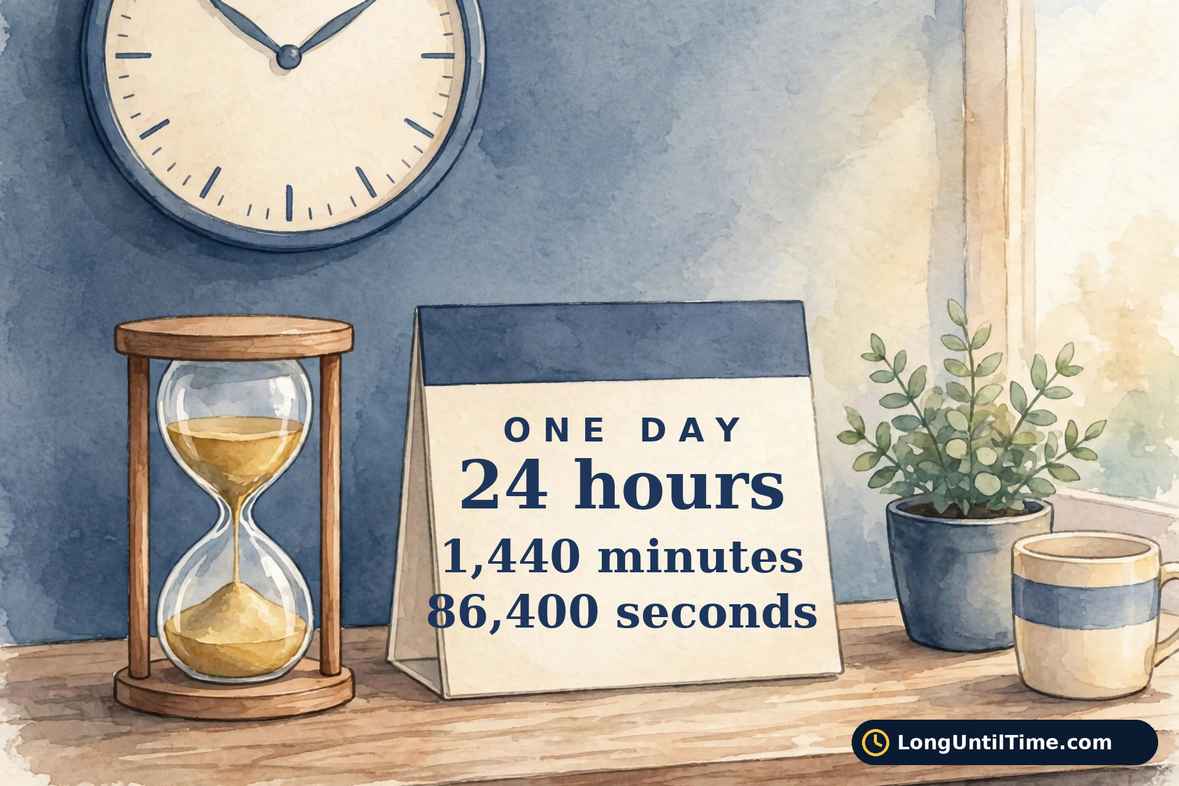
A whole day, counted out in full, is 24 hours. Break it down and it holds 1,440 minutes, or 86,400 seconds — every tick from one midnight to the next, with nothing left over and nothing missing.
Astronomers keep a stricter count. Measured against the fixed stars, Earth finishes one full turn in 23 hours, 56 minutes and 4 seconds — the sidereal day, shorter than the calendar day by roughly four minutes.
The day we live by is the solar day, noon to noon, and it drifts slightly across the year as Earth’s orbit speeds up and slows down; the clock’s tidy 24 hours is that wandering day averaged out — the same circle that puts 12 hours ago in the day’s opposite half.
Whole Day: The Day as One Complete Block
Whole day handles the day as a solid object. The whole day points to one specific day that speaker and listener both have in mind — yesterday, the wedding day, the day of the storm — and picks it up whole, as a single block.
Swap the for a and the job changes from pointing to measuring. A whole day means any one complete day, counted as a unit of quantity: the journey took a whole day, give it a whole day to dry.
Because the block is a thing, it can be spent, lost, wasted or saved. The whole day was ruined by one phone call works because the sentence hands you the day entire, then tells you its fate.
All Day: Hours Filled With an Activity
All day looks past the day to whatever fills it. It rained all day says nothing about the day as an object; it reports rain occupying the hours, falling in the morning, still falling at dusk.
The phrase never carries an article, and it stretches with long when you want the stretch underlined: all day long. It also shrinks gracefully — all morning, all afternoon, all week — because any stretch of hours can be filled the same way.
At work, all day rarely means 24 hours. The shop that opens all day and the colleague in meetings all day are filling the working day, the stretch until 6 PM brings the rush-hour close — not the full circle of the clock.
Before a Noun: The Hyphenated Forms
Both phrases also work as adjectives in front of nouns, and there they wear hyphens. An all-day meeting, all-day parking, an all-day breakfast: the activity stretches across the day’s working hours, and the hyphen glues the phrase into one describing word.
Whole-day appears the same way, chiefly in British writing: a whole-day workshop, a whole-day closure. It measures the event in complete days rather than filled hours — one block booked out, not a stretch of activity.
The hyphens vanish the moment the phrase moves behind the verb. The meeting lasted all day needs none, and it took the whole day keeps its article instead. Position decides the punctuation, just as it decides the phrase.
Worked Examples: The Same Hours, Two Frames
Four ordinary scenes show the swap at work. The hours on the clock never change; only the frame around them does.
The Airport Wait
Flights were cancelled at nine in the morning and boarding began at six in the evening: nine hours, 540 minutes, on airport chairs. Say the whole day was lost and the day itself is the casualty. Say you waited all day and the waiting fills the frame.
The Shop Sign
A bakery that opens at seven and shuts at seven paints open all day on its window, and nobody expects bread at midnight. The sign promises the trading hours filled, end to end — all day doing its ordinary, uncalendared work.
The Long Drive
Driving the coast road ate a whole day: one full block, dawn to dawn, measured out in complete days. We drove all day tells the same journey from inside the car, hours of road unspooling past the windows.
Sleeping After a Night Shift
The nurse home from nights gives the whole day to sleep: the block is handed over entire, curtains drawn against all of it. She slept all day reports the same rest from within, hour piled on hour of it.
The Mistakes That Give Writers Away
The classic slip is the dropped article: I worked whole day. Whole is an adjective hunting for its article, and without the or a the sentence stalls. All day needs no such help, which is exactly why learners overcorrect.
The mirror error adds what should not be there: the all day, or whole day long, a blend of all day long and the whole day that satisfies neither pattern. Pick one frame and let its grammar run clean.
The third slip is scale. Two busy hours are not the whole day, however they felt, and a lunch break is not all day either. Keep whole for the complete block and all for the filled stretch, and the exaggeration stays honest.
Frequently Asked Questions
Is it “the whole day” or “all day”?
Each one is right, for a different job. The whole day names one complete day as a block; all day describes an activity filling the hours. Choose by what your sentence is really about: the day, or the doing.
How many hours are in a whole day?
Twenty-four: 1,440 minutes, or 86,400 seconds, midnight to midnight. The spin beneath it, timed against the stars, takes 23 hours, 56 minutes and 4 seconds — the sidereal day.
Does “all day” mean 24 hours?
Almost never. All day covers the stretch an activity lasted — a shift, a rainfall, a wait. At work it means the working day, which ends long before the clock completes its circle.
Can I say “whole day” with no article?
No. Whole day always needs the or a in front of it: the whole day for one known day, a whole day for any single complete day. Bare whole day is the commonest learner error with this pair.
Is “all day long” correct?
Yes — all day long is the set phrase, with long underlining the stretch. Whole day long is not standard; write the whole day through, or simply the whole day, when the block is your subject.
Conclusion
The rule fits in one breath: whole day for the block, all day for the filling. Keep the article with whole, keep it away from all, and the hours will describe themselves. It is the sort of small, exact choice Gimme Meaning exists to settle.
When the frame is chosen well, a single word carries the whole weight of the hours — which is why the humble day itself, one turn of the Earth, repays a closer look.