
How Long Until 11:15 PM? The Late-Evening Quarter Hour
If you are asking how long until 11:15, there is no single fixed answer, because the answer depends on your current time — but the calculation takes only seconds once you know the method. This article treats the target as 11:15 PM — forty-five minutes before midnight: the moment the late news signs off, last orders are called, and the night bus pulls up. In your local time, the remaining time is the gap between now and 23:15, which is how the 24-hour clock writes 11:15 PM.
If 11:15 PM is still ahead tonight, you count forward to it. If it has already gone by, the count rolls to tomorrow’s 11:15 PM — and because this target sits deep in the evening, a start just after midnight means waiting almost the whole day. Below: a reference table, the fix for the 11:15 AM mix-up, the quarter-past-eleven trap, four worked examples, and planning advice.
Quick Reference: Time Remaining Until 11:15 PM
If you only need the number, find your current time in the left column. This table covers times before 11:15 PM, when the target falls tonight.
| Current Time | Time Remaining Until 11:15 PM | In Minutes |
|---|---|---|
| 6:00 AM | 17 hours 15 minutes | 1,035 minutes |
| 9:00 AM | 14 hours 15 minutes | 855 minutes |
| 12:00 PM | 11 hours 15 minutes | 675 minutes |
| 2:00 PM | 9 hours 15 minutes | 555 minutes |
| 4:00 PM | 7 hours 15 minutes | 435 minutes |
| 6:00 PM | 5 hours 15 minutes | 315 minutes |
| 8:00 PM | 3 hours 15 minutes | 195 minutes |
| 10:00 PM | 1 hour 15 minutes | 75 minutes |
| 10:30 PM | 45 minutes | 45 minutes |
| 11:00 PM | 15 minutes | 15 minutes |
Every row follows the same pattern. 11:15 PM sits 1,395 minutes after midnight, so the remaining time is always 1,395 minus the minutes passed since your day began. A countdown timer on your phone performs that subtraction as the minutes tick away. The late-evening marks come in tidy quarter-hour steps, and our guide to how long until 11:45 pm covers the mark thirty minutes after this one.
After 11:15 PM: Counting to Tomorrow’s 11:15 PM
Once the clock moves past 11:15 PM, tonight’s target is spent. Counters and reminders aim at the next one, exactly 24 hours later, so the remaining time leaps back up:
| Current Time | Time Remaining Until the Next 11:15 PM | In Minutes |
|---|---|---|
| 11:30 PM | 23 hours 45 minutes | 1,425 minutes |
| 11:59 PM | 23 hours 16 minutes | 1,396 minutes |
| 12:00 AM | 23 hours 15 minutes | 1,395 minutes |
| 12:30 AM | 22 hours 45 minutes | 1,365 minutes |
That jump is not an error: it is the same target, one day later. Note the last two rows — after midnight, the next 11:15 PM belongs to the new day’s own evening, so those counts subtract directly from 1,395.
11:15 PM or 11:15 AM? The Half-Day Mix-Up
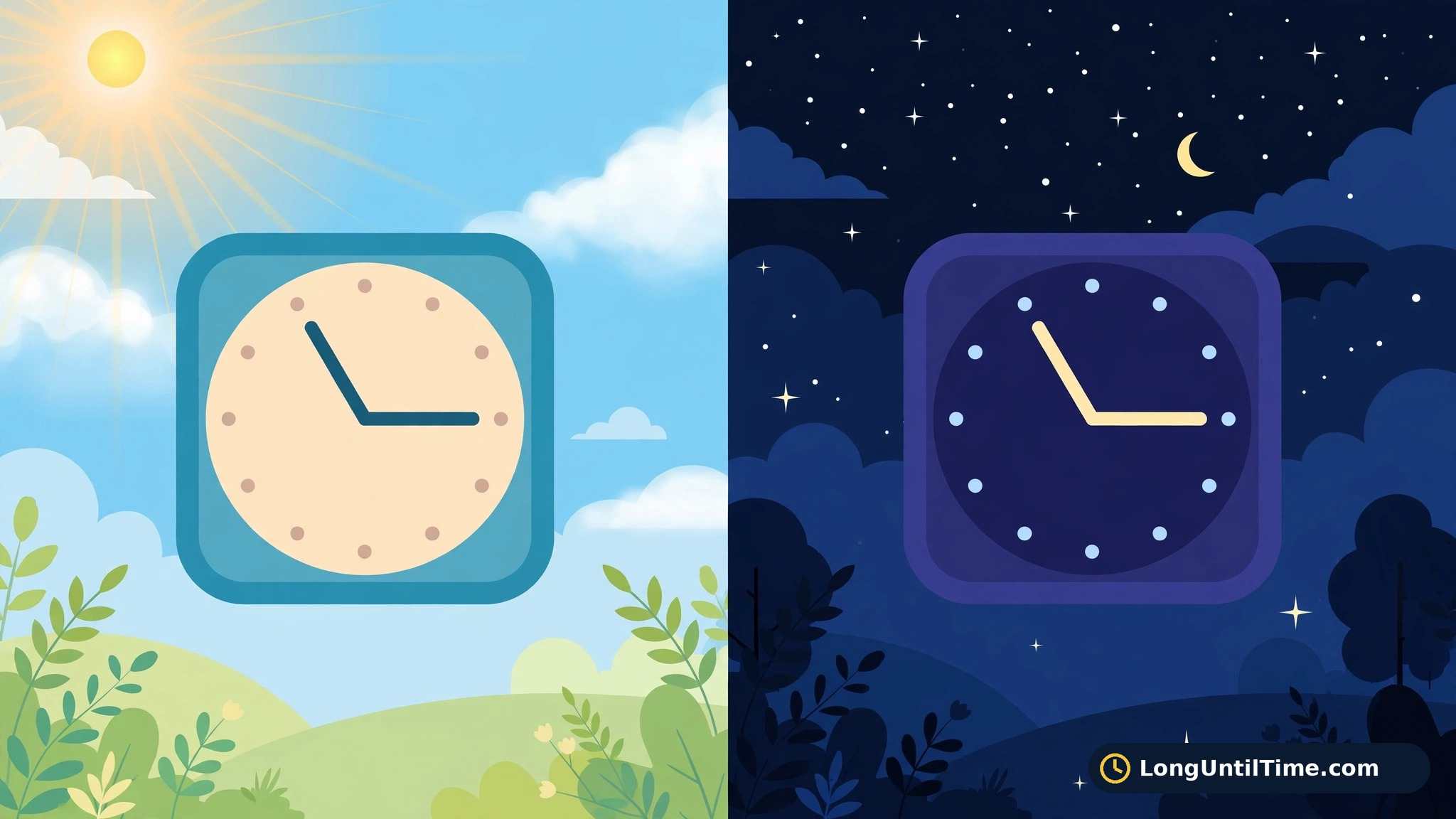
The clock shows 11:15 twice every day, and the two versions sit 12 hours apart. 11:15 AM is late morning, 675 minutes after midnight, while 11:15 PM is forty-five minutes before midnight at 1,395 minutes; the difference between them is 720 minutes, a half day. The labels AM and PM are the only thing separating the two on a 12-hour clock, and a dropped label is the most common reason a countdown to this target goes wrong.
The 24-hour clock removes the trap: 11:15 AM stays 11:15 and 11:15 PM becomes 23:15, leaving no label to misread. Picture the stakes at 8:00 PM: tonight’s 11:15 PM is 3 hours 15 minutes away, but counting toward 11:15 AM lands you on tomorrow late morning, 15 hours 15 minutes away — and any reminder built on the wrong version fires half a day off.
Quarter Past Eleven: The Spoken Trap
This target also has a spoken name: 11:15 is quarter past eleven, because a quarter of an hour — fifteen minutes — has passed since eleven struck. Unlike “quarter to twelve,” this phrase carries no hint of which half of the day it belongs to: said over breakfast it means 11:15 AM, said after dinner, 11:15 PM. The trap is that a time heard early in the day sticks to the morning eleven. Picture it at 9:00 PM: someone plans against the eleven they met at breakfast — but that eleven is long gone. Tonight’s reading is 2 hours 15 minutes away; the morning one is 14 hours 15 minutes away, on the far side of tomorrow’s breakfast.
The slip also runs the other way. At 11:20 AM, today’s first quarter past eleven slipped by five minutes ago, so the next one is tonight’s, 11 hours 55 minutes away — anyone who hears the phrase at lunch and assumes it means “in a few minutes” has the wrong eleven. The fix costs nothing: pin the label on — “quarter past eleven tonight” — or say 23:15, which can only mean one moment in the day.
How to Calculate the Time Until 11:15 PM
Two methods cover every situation. For a quick estimate, count forward in chunks: whole hours first, then the leftover minutes. For an exact answer, convert both times into minutes since midnight and subtract. That subtraction is the whole secret: the time difference between now and 11:15 PM is all the question is really asking for. Here are four worked examples, one for each situation you are likely to meet.
Example 1: An Ordinary Evening Start (7:35 PM)
Count forward in two chunks: from 7:35 PM to 10:35 PM is 3 hours, and from 10:35 PM to 11:15 PM another 40 minutes — 3 hours 40 minutes in total.
Example 2: Inside the Final Hour (10:52 PM)
Once you are inside the last hour, minutes do all the work. From 10:52 PM, 8 minutes carry you to 11:00 PM and 15 more reach the target, so 23 minutes remain until 11:15 PM.
Example 3: After the Target, Rolling to Tomorrow (11:40 PM)
At 11:40 PM, tonight’s 11:15 PM passed twenty-five minutes ago — yet the target is tomorrow’s, and the count crosses midnight and a date change within minutes. From 11:40 PM to midnight is just 20 minutes; from there to the next 11:15 PM is 23 hours 15 minutes. Together that makes 23 hours 35 minutes — a nearly full-day wait beginning a mere twenty-five minutes after the mark itself.
Example 4: The Minutes Method (9:28 PM)
This is exactly how an online time calculator does it, and it works for any current time. First convert the target: 11:15 PM is 23:15 in 24-hour time, and 23 × 60 + 15 = 1,395 minutes after midnight. Then convert the current time: 9:28 PM is 21 × 60 + 28 = 1,288 minutes. Subtract: 1,395 − 1,288 = 107 minutes, and 107 minutes is 1 hour with 47 minutes left over, so there are 1 hour 47 minutes until 11:15 PM.
The Final Stretch: Minutes and Seconds Before 11:15 PM
In the last few minutes, hours and whole minutes stop telling the whole story, and seconds take over. At 11:10 PM, exactly 5 minutes — 300 seconds — remain. At 11:14:30 PM, only 30 seconds are left. If last orders or a night bus departure sits at 11:15 PM, treat those final 300 seconds as working time, not a cushion; the next bus may be the last one of the night.
Why Your Time Zone Can Move the Answer
11:15 PM is a local moment, not a worldwide one, because the world is divided into time zones. A closing time set for 11:15 PM in Chicago falls at 12:15 AM in New York — already the next calendar day — 10:15 PM in Denver, and 9:15 PM in Los Angeles. If an event lives in another zone, convert it to your local time first and count down to that; counting toward the unconverted 11:15 is a quiet way to arrive an hour — or a date — off.
Planning Around an 11:15 PM Target
An 11:15 PM target belongs to the wind-down: the end of the late news, last orders at the pub, the last comfortable night bus home, or a lights-out alarm that protects tomorrow’s early start. Work backward from the target rather than forward from now: decide what “done” looks like at 11:15 PM — home through the door, bag packed for the morning, screen off and book open — then subtract your travel or winding-down time to find your real start, often thirty to forty-five minutes earlier.
Setting two timers, one for the target and one for that earlier real deadline, turns the last stretch of the evening into two clear checkpoints. The same backward habit works for the mark twenty-five minutes later: our guide to how long until 11:40 pm covers the final approach to the day’s last quarter hour.
Frequently Asked Questions
How long until 11:15 PM from 9:00 PM?
There are 2 hours 15 minutes from 9:00 PM until 11:15 PM. A nine o’clock start leaves you the whole late evening to fill.
How many minutes are left at 10:45 PM?
Exactly 30 minutes remain between 10:45 PM and 11:15 PM. The count spans the turn of the hour, but minutes alone still settle it.
It is 12:20 AM now. How long until 11:15 PM?
There are 22 hours 55 minutes until 11:15 PM. Just after midnight, the target belongs to the evening ahead, so the count runs through almost the whole day.
What is 11:15 PM in 24-hour time?
11:15 PM is 23:15 in 24-hour time. Add 12 to the hour for any time after noon, and the AM/PM label disappears entirely.
How many minutes after midnight is 11:15 PM?
11:15 PM falls 1,395 minutes after midnight. That number powers the minutes method: subtract your minutes since midnight from 1,395 to get the time remaining.
How long until 11:15 PM from 6:00 PM?
There are 5 hours 15 minutes from 6:00 PM until 11:15 PM. From six o’clock the wait spans dinner, prime time, and the late news.
Is 11:15 PM the same as quarter past eleven?
Yes — 11:15 PM is fifteen minutes after eleven at night. The same phrase spoken in the morning means 11:15 AM, twelve hours earlier, which is why the label matters.
Why does my countdown suddenly show almost a full day?
Because tonight’s 11:15 PM has already passed, so the countdown has rolled over to tomorrow’s. With this target, the jump happens the moment the clock moves past quarter past eleven at night.
Conclusion
Working out how long until 11:15 comes down to one habit: compare your current time with 23:15, the 24-hour form of 11:15 PM. Count forward in chunks for a quick estimate, or subtract your minutes since midnight from 1,395 for an exact answer, and if the target has already passed, aim at tomorrow’s 11:15 PM instead. Keep the label attached to every version of the time — digits, 23:15, or “quarter past eleven tonight” — because the morning twin sits a full half day away.
For anything that matters — a night bus you cannot miss, the end of a late shift, a wind-down that keeps tomorrow intact — do the calculation once, set a timer, and let the clock-watching go. Readers curious about this last stretch of the day can browse the encyclopedia entry on evening.