
What Time Was 15 Hours Ago? How to Calculate It Easily
If you are wondering what time was 15 hours ago, the answer is found by subtracting 15 hours from the current local time. Because 15 hours is less than a full day, the calculation may stay on the same date or cross midnight into the previous date.
For example, if the current time is 8:00 PM, 15 hours earlier was 5:00 AM on the same day. If the current time is 10:00 AM, 15 hours earlier was 7:00 PM on the previous day. The exact answer therefore depends on your current time and location.
This guide explains how to calculate 15 hours ago manually, use the 12-hour and 24-hour clock, handle midnight and date changes, understand time zones, and check the result with a time calculator or digital clock.
What Does “15 Hours Ago” Actually Mean?
“15 hours ago” means a point in time exactly 15 hours before a particular starting time. The starting point is normally the current time, although it could also be a specific time mentioned in a message, schedule, timestamp, or event.
The calculation is straightforward:
Time 15 hours ago = Current time − 15 hours
Suppose the current time is 6:00 PM. Counting backward 15 hours gives:
6:00 PM − 15 hours = 3:00 AM
So, 15 hours before 6:00 PM was 3:00 AM on the same calendar day.
However, if the current time is 8:00 AM, the calculation works differently:
8:00 AM − 15 hours = 5:00 PM on the previous day
This happens because moving backward 15 hours crosses midnight.
The phrase can therefore refer to either today or yesterday. It does not automatically mean the previous calendar day.
How to Calculate 15 Hours Ago Manually
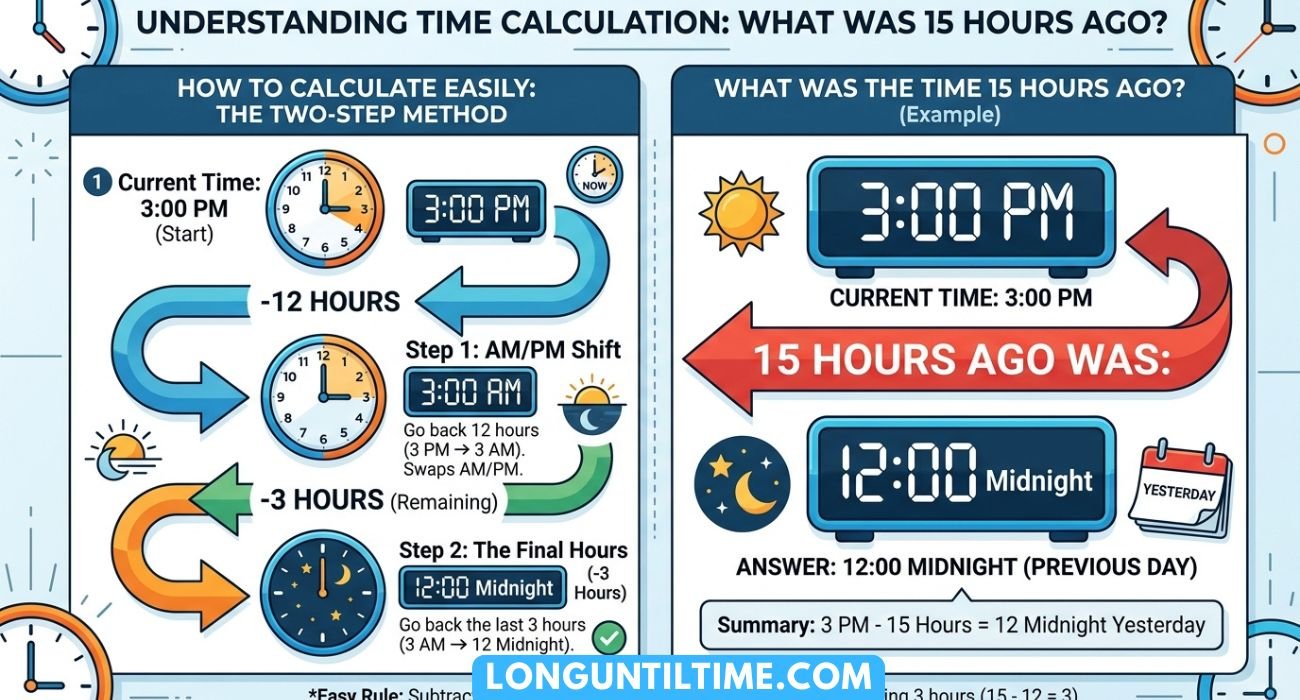
The easiest way to find what time was 15 hours ago is to subtract 15 from the current hour while keeping the minutes and seconds unchanged.
For instance, if the current time is 9:30 PM:
9:30 PM − 15 hours = 6:30 AM
The minutes remain at 30 because you are subtracting whole hours.
A useful method is to break 15 hours into smaller parts:
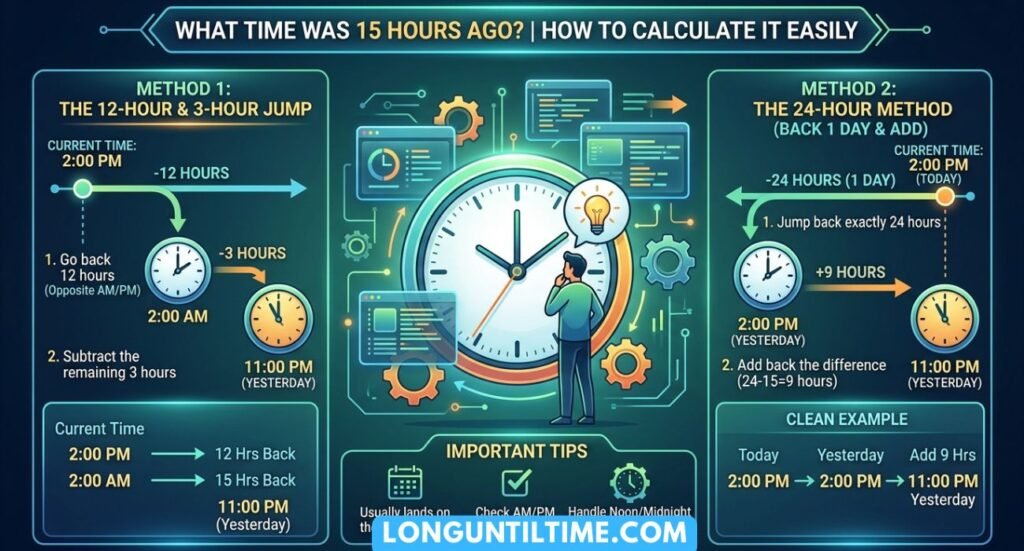
15 hours = 12 hours + 3 hours
Starting with 9:30 PM:
- Subtract 12 hours → 9:30 AM.
- Subtract another 3 hours → 6:30 AM.
Therefore, 6:30 AM was 15 hours ago.
When the subtraction passes midnight, simply move the date back by one day. For example:
7:00 AM − 15 hours = 4:00 PM yesterday
The calculation is easier when you think in terms of elapsed time rather than simply changing the number displayed on the clock.
Using a 24-Hour Clock
The 24-hour clock can make calculations particularly simple.
For example, 9:00 PM is written as 21:00.
21:00 − 15:00 = 06:00
So, 15 hours before 21:00 was 06:00.
If subtraction produces a negative number, add 24:
08:00 − 15:00 = −07:00
Then:
−07:00 + 24:00 = 17:00
Therefore, 15 hours before 8:00 AM was 5:00 PM on the previous day.
What Time Was It 15 Hours Ago in Pakistan?
To determine what time was 15 hours ago in Pakistan, start with the current local time in Pakistan and subtract 15 hours.
Pakistan uses Pakistan Standard Time (PKT), which is UTC+5. The same subtraction principle applies regardless of the location:
Current Pakistan time − 15 hours = time 15 hours ago in Pakistan
For example, if it is 10:00 AM in Pakistan:
10:00 AM − 15 hours = 7:00 PM the previous day
If it is 11:00 PM:
11:00 PM − 15 hours = 8:00 AM the same day
This is also useful when comparing Pakistan with the United States. A person in Pakistan and a person in the U.S. can be looking at the same moment while their clocks show different times because of the difference between their local time and the applicable U.S. time zone.
When making an international calculation, first identify the local time in the location you care about. Then perform the 15-hour subtraction.
Understanding Time Zones and Why They Matter
The answer to what time was 15 hours ago depends on the clock you are using.
A moment is the same worldwide, but local clocks display that moment differently. The United States spans several major time zones, including Eastern, Central, Mountain, and Pacific Time. Alaska and Hawaii use additional time-zone rules.
For example, an event recorded at a particular instant could appear as one clock time in New York and a different clock time in Los Angeles. If you are trying to determine when something happened 15 hours earlier, you need to know which location’s clock the original timestamp represents.
Daylight Saving Time can add another layer of complexity. Some U.S. locations change their UTC offset during part of the year, while others do not. As a result, the difference between two locations is not always the same throughout the year.
This matters when checking:
scheduled events, work shifts, online meetings, social media timestamps, international calls, or travel information.
For a simple calculation within one location, you normally only need the current local time. For a comparison between locations, identify both time zones before calculating.
See Also : How Much Time Until 2:45? Calculate the Countdown to 2:45 PM
The Mathematics Behind 15 Hours
The mathematics of 15 hours is simple but useful for understanding why the calculation works.
One hour contains 60 minutes:
1 hour = 60 minutes
Therefore:
15 × 60 = 900 minutes
So, 15 hours equals 900 minutes.
In seconds:
900 × 60 = 54,000 seconds
Thus:
15 hours = 900 minutes = 54,000 seconds
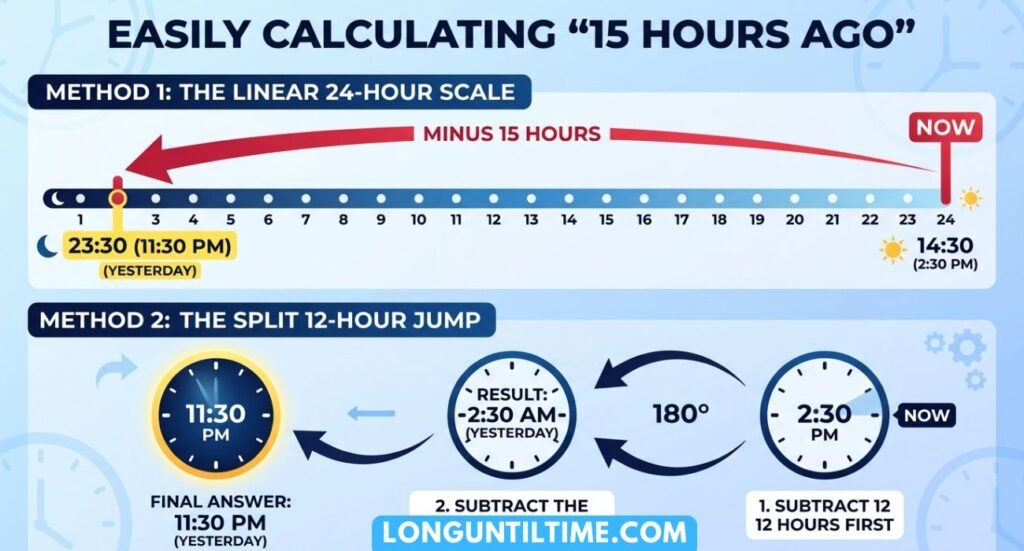
On a 24-hour clock, there is another useful shortcut. Instead of moving backward 15 hours, you can move forward 9 hours because:
24 − 15 = 9
In other words, going back 15 hours reaches the same clock position as going forward 9 hours, while the calendar date must be interpreted correctly.
For example:
2:00 PM − 15 hours = 11:00 PM
The result is on the previous day.
The mathematical rule can be represented as:
Past time = Starting time − 15 hours
When using a 24-hour clock, calculations effectively wrap around after 24:00. This is sometimes called modulo-24 time, but you do not need advanced mathematics to use it.
What Time Was It 15 Hours Ago? Real Examples
The best way to understand the calculation is to see how it works with different starting times.
| Current time | 15 hours earlier | Date relationship |
| 6:00 AM | 3:00 PM | Previous day |
| 9:00 AM | 6:00 PM | Previous day |
| 12:00 PM | 9:00 PM | Previous day |
| 3:00 PM | 12:00 AM | Previous day |
| 6:00 PM | 3:00 AM | Same day |
| 9:00 PM | 6:00 AM | Same day |
| 11:30 PM | 8:30 AM | Same day |
Notice that the boundary is important. When the current time is before 3:00 PM, subtracting 15 hours takes you into the previous calendar day. At exactly 3:00 PM, 15 hours earlier is midnight at the beginning of that same calendar day.
Example One
Suppose the current time is 9:00 AM.
Subtract 15 hours:
9:00 AM − 15 hours = 6:00 PM
Because 15 hours takes the calculation across midnight, the answer is:
6:00 PM yesterday
So, if someone asks what time was 15 hours ago when it is 9:00 AM, the answer is 6:00 PM on the previous day.
Example Two
Suppose the current time is 2:00 PM.
Subtract 15 hours:
2:00 PM − 15 hours = 11:00 PM
The result is:
11:00 PM yesterday
The important detail is that the answer is not 11:00 PM today. Going backward from 2:00 PM by 15 hours crosses midnight.
Example Three
Now consider 7:30 PM.
Subtract 15 hours:
7:30 PM − 15 hours = 4:30 AM
Therefore, 15 hours before 7:30 PM was:
4:30 AM the same day
The 30 minutes remain unchanged because only whole hours were subtracted.
Example Four
Suppose it is 11:00 PM.
Subtracting 15 hours gives:
11:00 PM − 15 hours = 8:00 AM
So, 15 hours earlier was 8:00 AM on the same day.
This is a useful example because the calculation crosses backward over the afternoon but does not cross midnight.
Example Five
Suppose the current time is 6:45 AM.
Subtract 15 hours:
6:45 AM − 15 hours = 3:45 PM
Because the calculation moves backward across midnight, the result is:
3:45 PM yesterday
The minutes stay at 45, illustrating that subtracting complete hours does not change the minute portion of the time.
See Also : 12 Hours From Now Is What Time? Calculate the Exact Time Easily
When Was 15 Hours Ago From Now?
To find 15 hours ago from now, you need the exact current local time.
For example, if your clock currently says 4:20 PM:
4:20 PM − 15 hours = 1:20 AM
Therefore, 15 hours ago was 1:20 AM today.
If your clock says 10:20 AM:
10:20 AM − 15 hours = 7:20 PM yesterday
This demonstrates why there is no single permanent answer to “what time was 15 hours ago?” The answer changes every minute.
For an exact result, use the current time shown by your device or a reliable clock and subtract 15 hours. If you are working with a timestamp from another location, make sure the timestamp’s time zone is known first.
Tools That Can Help You Calculate 15 Hours Ago
You do not need a specialized tool for a basic 15-hour calculation, but digital tools can reduce mistakes when dates, time zones, or precise timestamps are involved.
A time calculator can subtract a specified number of hours from a given time and is especially useful when you are working with minutes or seconds. A world-clock service can help when the calculation involves multiple locations.
Your phone, computer, smartwatch, or other digital clock can also provide the starting time. If you are checking an event that happened 15 hours ago, compare the event’s timestamp with your current clock rather than relying on memory.
For more complicated calculations involving dates and international locations, an online time-zone calculator can account for local clock rules. This is particularly helpful when time zones, daylight-saving changes, or international scheduling are involved.
A countdown timer serves a different purpose. It generally counts forward or backward toward a duration or target rather than answering a historical question, but it can still help you measure a 15-hour period accurately.
What Time Was It 15 Hours Ago and Why Do People Ask?
People ask what time was 15 hours ago for many practical reasons. A timestamp may show that an action occurred “15 hours ago,” but someone may want to convert that relative description into an actual clock time.
For example, someone might be reviewing an email, checking when a message was sent, looking at an online activity timestamp, or trying to determine when a scheduled task occurred.
The calculation can also be useful for work. If a shift, reminder, or task occurred 15 hours before a particular time, converting the duration into a clock time makes the sequence easier to understand.
International communication is another common situation. A person may know that a meeting occurred 15 hours earlier but need to translate that interval into their own local time.
The key is to distinguish between a duration and a clock time. “15 hours” describes elapsed time. “3:00 PM” describes a position on a clock. Subtracting the duration from a known clock time connects the two.
The Human Side of Time: Memory and Perception
People often remember events approximately rather than as exact timestamps. Someone may remember that a message arrived “last night” or that a meeting happened “this morning,” but those descriptions do not provide a precise time.
A 15-hour interval gives you a fixed duration, which can make the event easier to place on a timeline.
For example, if it is currently 10:00 AM and an event occurred 15 hours ago, the event happened at 7:00 PM the previous day. That is much more precise than simply saying it happened “yesterday evening.”
This distinction matters when comparing several events. If one event occurred 15 hours ago and another occurred 10 hours ago, the two timestamps are exactly five hours apart, assuming they refer to the same time reference and no other timing complication is involved.
Digital timestamps are particularly useful because they provide a reference point that can be checked instead of relying entirely on memory.
What Was 15 Hours Ago Across Different Parts of the Day?
The result changes depending on the starting time. Understanding the pattern makes mental calculations much faster.
Morning
If the current time is in the morning, subtracting 15 hours usually takes you to the previous afternoon or evening.
For example:
8:00 AM − 15 hours = 5:00 PM yesterday
11:00 AM − 15 hours = 8:00 PM yesterday
The earlier the morning time, the farther back into the previous evening the answer moves.
Afternoon
Afternoon calculations often cross midnight.
For example:
1:00 PM − 15 hours = 10:00 PM yesterday
At 3:00 PM, exactly 15 hours earlier is midnight.
After 3:00 PM, the answer falls on the same calendar day.
Evening
For evening times, subtracting 15 hours generally produces a morning time on the same day.
For example:
6:00 PM − 15 hours = 3:00 AM
10:00 PM − 15 hours = 7:00 AM
This makes evening times some of the easiest to calculate mentally.
Night
Late-night times also normally lead to the morning when you move backward 15 hours.
For example:
11:30 PM − 15 hours = 8:30 AM
The result remains on the same calendar date because the 15-hour interval does not reach the previous midnight.
Common Mistakes When Calculating 15 Hours Ago
One of the most common mistakes is forgetting the date change. If the calculation crosses midnight, the resulting time belongs to the previous calendar day.
Another mistake is confusing AM and PM. For example, 7:00 AM and 7:00 PM are 12 hours apart, so using the wrong period produces a completely different result.
A third problem is subtracting 15 from the clock number without considering the 12-hour cycle. For example, simply doing 8 − 15 does not give a usable 12-hour-clock answer. You need to account for the transition through midnight.
Minutes can also cause confusion. If the starting time is 4:25 PM, subtracting exactly 15 hours gives 1:25 AM. The minutes remain 25.
Time zones are another source of errors. If an event’s timestamp is from another country or U.S. time zone, first determine what that timestamp represents locally before subtracting 15 hours.
Finally, avoid assuming that “15 hours ago” always means “yesterday.” Whether the date changes depends on the starting time.
How to Quickly Calculate 15 Hours Ago in Your Head
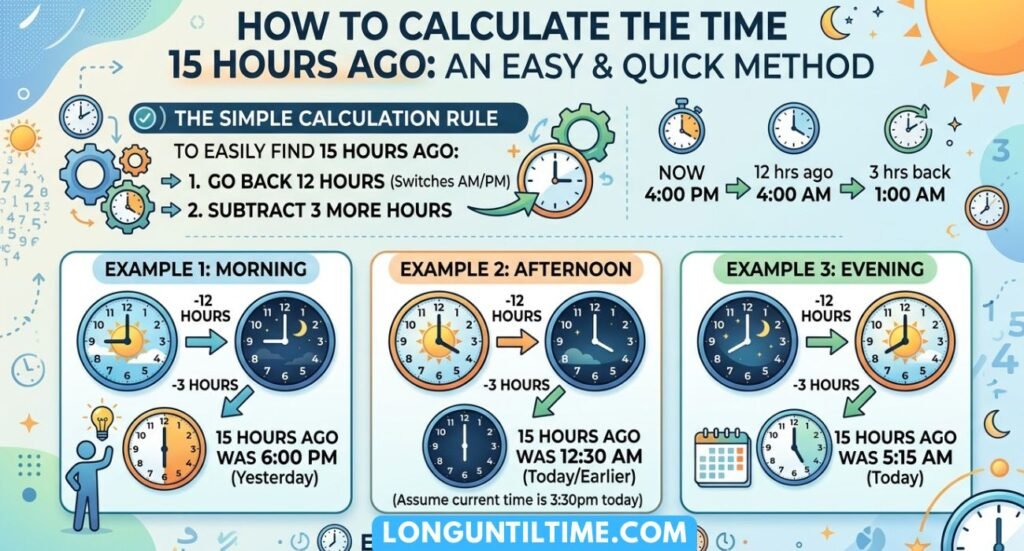
A fast mental trick is to subtract 12 hours first and then subtract another 3 hours.
For example, starting at 8:00 PM:
8:00 PM − 12 hours = 8:00 AM
Then:
8:00 AM − 3 hours = 5:00 AM
So:
8:00 PM − 15 hours = 5:00 AM
Another useful shortcut is to think of 15 hours backward as 9 hours forward on a 24-hour clock.
For example, convert 10:00 AM to 10:00 in 24-hour notation:
10 + 9 = 19
19:00 is 7:00 PM. Because the calculation wrapped around the 24-hour day, that result belongs to the previous date.
For everyday use, the 12-hours-plus-3-hours method is often easier because it avoids complicated clock arithmetic.
A Simple Reference for 15 Hours Ago
The following examples can help you recognize the pattern quickly:
| Starting time | Time 15 hours ago |
| 12:00 AM | 9:00 AM yesterday |
| 3:00 AM | 12:00 PM yesterday |
| 6:00 AM | 3:00 PM yesterday |
| 9:00 AM | 6:00 PM yesterday |
| 12:00 PM | 9:00 PM yesterday |
| 3:00 PM | 12:00 AM |
| 6:00 PM | 3:00 AM |
| 9:00 PM | 6:00 AM |
| 11:00 PM | 8:00 AM |
The exact date wording depends on the date associated with the starting time. “Yesterday” means the calendar day immediately before the starting date.
Frequently Asked Questions
What time is 15 hours?
15 hours is a duration equal to 900 minutes or 54,000 seconds.
It represents 15 consecutive hours on a clock.
What is 15 hours before 11 AM?
15 hours before 11:00 AM is 8:00 PM the previous day.
Calculation: 11:00 AM − 15 hours = 8:00 PM yesterday.
What time is 15 hours in a day?
A day has 24 hours, so 15 hours represents 15/24 of a day, or 62.5% of a full day.
That leaves 9 hours remaining in the 24-hour day.
What time before 15 hours?
“15 hours before” means subtracting 15 hours from a specific starting time.
For example, 15 hours before 6:00 PM is 3:00 AM the same day.
Conclusion
Finding what time was 15 hours ago is a simple subtraction problem: take the current local time and subtract 15 hours. The main challenge is remembering whether the calculation crosses midnight and therefore moves to the previous calendar date.
For a quick mental calculation, subtract 12 hours and then another 3 hours. Keep the minutes and seconds unchanged when subtracting exactly 15 whole hours. If you’re comparing locations, check the relevant time zone first.
Once you understand the 24-hour cycle, AM/PM system, midnight boundary, and date change, calculating 15 hours ago becomes quick and reliable for everyday schedules, timestamps, meetings, and other time-related questions.



One Comment