
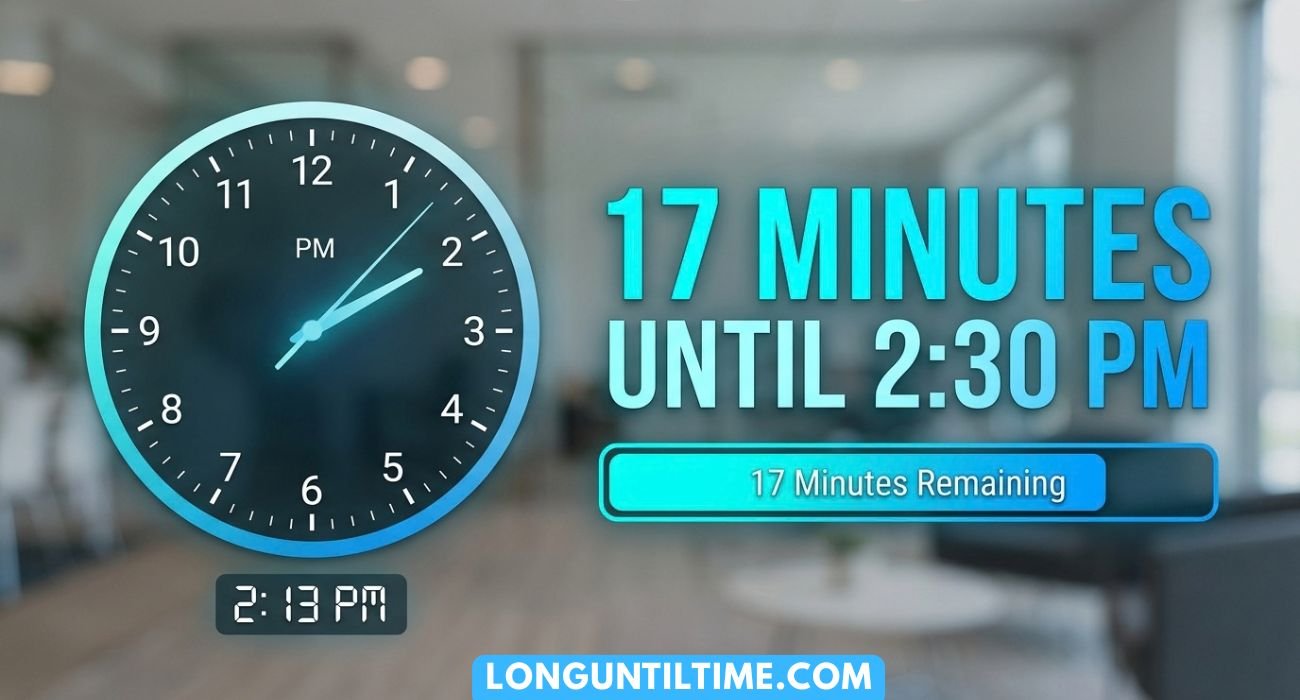
How Long Until 2:30? Calculate the Time Until 2:30 PM
If you are asking how long until 2:30, the exact answer depends on your current local time. For example, if it is 1:00 PM, there are 1 hour and 30 minutes until 2:30 PM. If it is 2:00 PM, only 30 minutes remain.
The calculation is simple: compare the current time with 2:30 PM, also written as 14:30 in the 24-hour clock. If 2:30 PM has already passed, the next occurrence is 2:30 PM on the following day.
This guide explains how to calculate the remaining time, use a live countdown, understand 12-hour and 24-hour time, account for time zones and Daylight Saving Time, and use the countdown for everyday planning.
Understanding How Long Until 2:30 PM
How long until 2:30 PM? There is no single answer because the remaining duration changes continuously. The answer depends on the current hour, minute, second, date, and location.
For example, suppose your local time is 12:00 PM. From noon to 2:30 PM is 2 hours and 30 minutes. If the time is 1:30 PM, the remaining time is exactly 1 hour. At 2:15 PM, only 15 minutes remain.
Here is a quick reference:
| Current Time | Time Until 2:30 PM |
|---|---|
| 9:00 AM | 5 hours 30 minutes |
| 10:00 AM | 4 hours 30 minutes |
| 11:00 AM | 3 hours 30 minutes |
| 12:00 PM | 2 hours 30 minutes |
| 1:00 PM | 1 hour 30 minutes |
| 1:30 PM | 1 hour |
| 2:00 PM | 30 minutes |
| 2:15 PM | 15 minutes |
| 2:29 PM | 1 minute |
| 2:30 PM | 0 minutes |
These examples assume that you are calculating toward 2:30 PM on the same day.
If the current time is 3:00 PM, today’s 2:30 PM has already passed. If you want to know when 2:30 PM occurs next, you would calculate the duration until 2:30 PM the following day.
The same idea applies to searches such as how long till 2:30 PM, how much time until 2:30 PM, and how long until 2:30 PM today.
How Long Until 2:30 PM Changes Every Second
The countdown to 2:30 PM is not a fixed number. It changes every second because time continues moving toward the target.
Suppose it is exactly 1:00 PM. You have 90 minutes until 2:30 PM. One minute later, you have 89 minutes. After another 30 minutes, only 59 minutes remain.
The relationship between the units is straightforward:
1 hour = 60 minutes
1 minute = 60 seconds
Therefore, 1 hour and 30 minutes equals 90 minutes or 5,400 seconds.
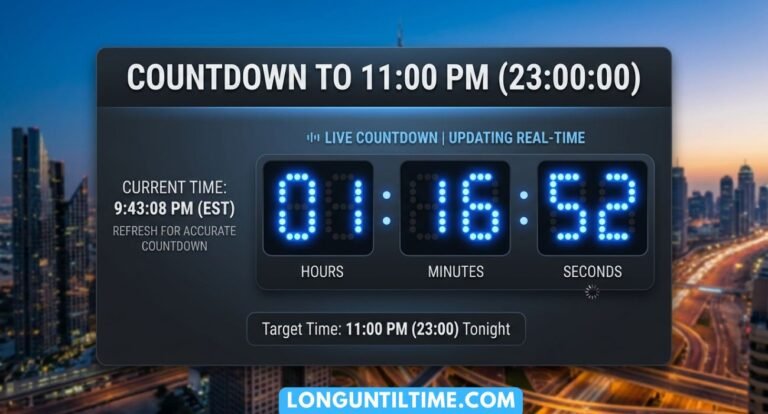
A live countdown timer can display this changing duration automatically. Instead of calculating the difference repeatedly, the timer updates as the current time moves closer to 2:30 PM.
This matters when you need an exact countdown for a meeting, appointment, class, event, work deadline, or other scheduled activity.
Ways to Calculate the Time Until 2:30 PM
There are several simple ways to find the time remaining until 2:30 PM. The best method depends on whether you want a quick mental calculation or a continuously updated answer.
Manual calculation
You can calculate the time until 2:30 PM using the current time shown on your clock.
Suppose the current time is 11:20 AM. First, calculate the time from 11:20 AM to noon. That is 40 minutes. Then add the 2 hours and 30 minutes from noon to 2:30 PM.
So:
40 minutes + 2 hours 30 minutes = 3 hours 10 minutes
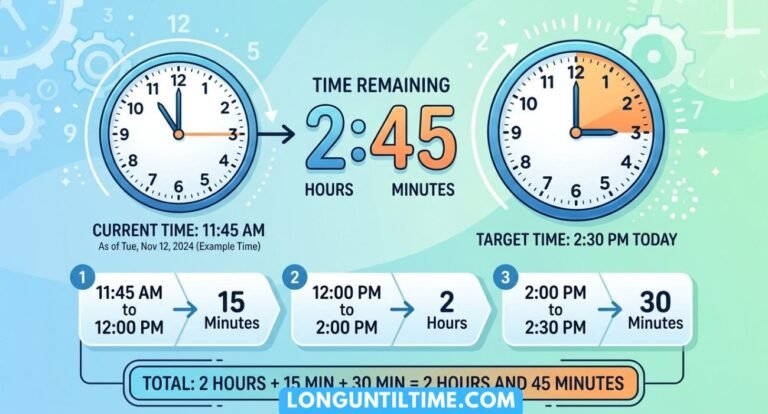
For another example, suppose it is 1:45 PM. From 1:45 PM to 2:00 PM is 15 minutes, and from 2:00 PM to 2:30 PM is another 30 minutes.
15 + 30 = 45 minutes
This method works well when the target and current time are on the same day.
If you are calculating across midnight, the process changes. For example, if it is 11:00 PM and you want the next 2:30 PM, you must include the time from 11:00 PM to midnight and then the hours from midnight to 2:30 PM.
Using a Countdown Calculator
A countdown calculator can calculate the remaining time automatically. You normally select or enter the target time, such as 2:30 PM, and the tool determines the duration from the current time.
This is useful when you want a continuously updated result instead of doing the calculation manually.
A good countdown should use the correct local date and time. If the target is specifically 2:30 PM today, the date matters because 2:30 PM occurs once each day.
For an exact live countdown, the tool also needs an accurate clock. A calculation based on an incorrect device time can produce an incorrect result.
Using a Duration Calculator
A duration calculator works by finding the difference between a starting time and an ending time.
For example, if the starting time is 10:15 AM and the ending time is 2:30 PM, the calculation is:
10:15 AM → 12:00 PM = 1 hour 45 minutes
12:00 PM → 2:30 PM = 2 hours 30 minutes
Total = 4 hours 15 minutes
Duration calculators are especially useful when the starting time includes minutes or when you need to calculate a longer period accurately.
Understanding 2:30 PM in Different Time Formats
2:30 PM is part of the 12-hour clock system commonly used in everyday American life.
In the 24-hour clock, 2:30 PM is written as 14:30.
The conversion works by adding 12 to the hour for PM times after noon:
2 + 12 = 14
So:
2:30 PM = 14:30
The distinction between 2:30 AM and 2:30 PM is important. They occur 12 hours apart.
| 12-Hour Format | 24-Hour Format | Part of Day |
|---|---|---|
| 2:30 AM | 02:30 | Early morning |
| 12:00 PM | 12:00 | Noon |
| 1:30 PM | 13:30 | Afternoon |
| 2:30 PM | 14:30 | Afternoon |
| 3:30 PM | 15:30 | Afternoon |
If you are entering a target time into a calculator, always check whether it uses AM/PM or the 24-hour format. Entering 2:30 AM instead of 2:30 PM changes the target by 12 hours.
Comparing 2:30 PM with Nearby Times
Comparing 2:30 PM with nearby times makes mental calculations easier.
For example, 2:00 PM is 30 minutes before 2:30 PM. Similarly, 2:15 PM is 15 minutes before it, while 2:45 PM is 15 minutes after it.
| Time | Difference From 2:30 PM |
|---|---|
| 2:00 PM | 30 minutes before |
| 2:15 PM | 15 minutes before |
| 2:30 PM | Target time |
| 2:45 PM | 15 minutes after |
| 3:00 PM | 30 minutes after |
This is also useful when comparing related countdown questions. If you know that there are 30 minutes until 2:30 PM, you can immediately see that 2:45 PM is 45 minutes away and 3:00 PM is 1 hour away.
Understanding these small intervals can help with appointments, breaks, class schedules, meetings, and personal deadlines.
Using a Live Countdown for Better Planning
A live countdown shows the remaining time until a selected target and updates as the seconds pass.
For example, instead of saying that there are approximately 40 minutes until 2:30 PM, a live countdown can show the changing duration in hours, minutes, and seconds.
This can be useful when the exact timing matters. Someone preparing for a 2:30 PM meeting may use a countdown to decide when to finish another task. A student may use it to manage study time before an afternoon class. Someone attending an event may use it to keep track of when they need to leave.
A live countdown is also useful because you do not need to repeat the calculation every time you check the clock.
The important point is that the countdown should use your correct local time and the correct target date. Otherwise, even a well-designed timer can show the wrong remaining duration.
Time Zones Matter More Than People Think
The phrase 2:30 PM does not identify one universal moment around the world. It identifies a local clock time.
For example, a meeting scheduled for 2:30 PM Eastern Time does not occur at the same moment as a meeting scheduled for 2:30 PM Pacific Time.
The United States spans several major time zones, including Eastern, Central, Mountain, and Pacific Time. Alaska and Hawaii also use their own time zones.
This becomes especially important for online meetings, remote work, livestreams, flights, virtual classes, and other events involving people in different locations.
Suppose someone in New York says, “The meeting starts at 2:30 PM Eastern Time.” Someone in California should not automatically enter 2:30 PM into their local calendar. The event needs to be converted to Pacific Time.
When calculating how long until 2:30 PM, first determine whose 2:30 PM you mean. If you are asking about your own afternoon schedule, your local time is usually the relevant reference.
Daylight Saving Time Can Change Everything
Daylight Saving Time affects the relationship between clocks in many parts of the United States during the year.
When Daylight Saving Time begins or ends, the local clock changes. As a result, the difference between two time zones can change depending on the date.
This matters when a countdown involves different locations rather than just your own local clock.
For example, if someone schedules an event for 2:30 PM in one U.S. time zone, a person in another time zone needs to know the applicable offset for that specific date. A simple conversion based on a fixed difference can be wrong around seasonal clock changes.
Most of the United States observes Daylight Saving Time, but there are exceptions. Hawaii does not observe it, and most of Arizona does not observe it.
For a normal local countdown to 2:30 PM, you generally only need your current local clock. Time-zone and Daylight Saving Time rules become more important when comparing locations or scheduling an event across regions.
Popular Tools That Help Track the Countdown
Different tools can help you monitor the time until 2:30 PM.
An online countdown timer is useful when you want a live display in a browser. A phone’s clock or timer can be convenient when you need something available throughout the day. A calendar application can be better when 2:30 PM represents an actual appointment or meeting rather than simply a target time.
Some tools also support seconds, dates, recurring events, and time-zone conversion. These features can be useful for more complicated schedules.
For a simple question such as how long until 2:30, you may only need your regular clock. For an important event, however, a calendar or synchronized countdown can provide additional context.
Always check that the device’s date, time, and time zone are correct. An incorrect system clock can affect the result.
See Also : How Much Longer Until 2:40 PM Today?
Productivity Benefits of Knowing the Exact Countdown
Knowing the time remaining until 2:30 PM can help you divide your available time into manageable periods.
Suppose you have three hours before a 2:30 PM deadline. Instead of treating those three hours as one large block, you can divide them between several tasks.
You might spend the first hour completing the main task, the next hour reviewing your work, and the final hour preparing for the deadline. The exact schedule depends on your needs, but the countdown gives you a clear endpoint.
The same approach works for shorter periods. If it is 2:00 PM, knowing that only 30 minutes remain can help you decide whether to start another task or finish what you are already doing.
A countdown does not automatically improve productivity, but it can make a fixed time boundary easier to see and manage.
Morning vs Afternoon Countdowns
The amount of time until 2:30 PM can vary greatly depending on when you start counting.
If it is 9:00 AM, you have 5 hours and 30 minutes. At noon, only 2 hours and 30 minutes remain. At 2:00 PM, the remaining time has dropped to 30 minutes.
| Starting Time | Time Until 2:30 PM |
|---|---|
| 8:00 AM | 6 hours 30 minutes |
| 9:00 AM | 5 hours 30 minutes |
| 10:00 AM | 4 hours 30 minutes |
| 11:00 AM | 3 hours 30 minutes |
| 12:00 PM | 2 hours 30 minutes |
| 1:00 PM | 1 hour 30 minutes |
| 2:00 PM | 30 minutes |
This difference matters when planning an entire morning around an afternoon event.
For example, a person with a 2:30 PM appointment can use the morning to complete tasks while keeping the appointment as a fixed endpoint. Someone who checks the countdown at 2:15 PM has a very different amount of available time than someone who checks it at 10:00 AM.
Choosing the Right Countdown Tool
The right tool depends on what you are trying to track.
For a quick answer, a basic clock may be enough. For a continuously changing countdown timer, use a tool that updates automatically. If the event involves people in different locations, look for time-zone support.
Accuracy is particularly important when seconds matter. The tool should have access to a reliable clock and use the correct date and time zone.
A useful countdown tool may also support both 12-hour and 24-hour formats. This reduces confusion when switching between everyday U.S. time and systems that use 24-hour notation.
For scheduled events, a calendar can be more useful than a simple countdown because it stores the event date, location, and time-zone information. For a one-time personal target, a simple countdown may be all you need.
Real-Life Examples of Counting Down to 2:30 PM
Imagine a student has a class at 2:30 PM. At 12:30 PM, the student has exactly 2 hours before class. At 2:00 PM, there are only 30 minutes.
An employee may have a meeting at 2:30 PM. If the current time is 1:45 PM, the meeting is 45 minutes away. That gives the employee a clear window for completing a short task or preparing for the meeting.
A traveler may also need to track a 2:30 PM departure. In that situation, the countdown should not be confused with the recommended arrival time. A 2:30 PM departure means the event occurs at 2:30 PM, while the traveler may need to arrive much earlier.
These examples show why the question how long until 2:30 is often connected to planning rather than simple curiosity.
Common Mistakes When Calculating How Long Until 2:30 PM
One common mistake is confusing 2:30 AM with 2:30 PM. These times are exactly 12 hours apart, so selecting the wrong one produces a very different result.
Another mistake is ignoring the minutes. If it is 1:40 PM, the answer is not simply “1 hour.” The actual duration is 50 minutes.
It is also easy to forget the date when 2:30 PM has already passed. If it is 4:00 PM and you mean the next occurrence of 2:30 PM, you are calculating toward tomorrow’s 2:30 PM.
Time zones create another possible problem. A 2:30 PM event in New York is not the same instant as a 2:30 PM event in Los Angeles.
Finally, a static calculation can become outdated quickly. If you calculate the answer at 1:00 PM and check it again at 1:20 PM, the original answer is no longer current.
How Long Until 2:30 PM on a Typical Day?
The time until 2:30 PM depends on when you start counting. If it is 10:00 AM, you have 4 hours and 30 minutes left, while at 1:30 PM, only 1 hour remains. Knowing these simple time differences can make it easier to plan work, school, appointments, and afternoon activities.
For a quick calculation, compare your current local time with 2:30 PM. Remember that the countdown keeps changing, so an answer calculated earlier may not remain accurate later in the day.
See Also : How Long Until 2:15? Simple Time Calculation Guide
How Many Minutes Until 2:30 PM?
Converting the remaining time into minutes can make a countdown easier to understand. For example, 1 hour and 30 minutes equals 90 minutes, while 30 minutes before 2:30 PM means there are exactly 30 minutes remaining.
To calculate the total minutes, multiply the remaining hours by 60 and then add the remaining minutes. This method is useful when setting timers, planning short tasks, or checking how much time remains before a 2:30 PM appointment.
How Long Until 2:30 PM From Different Starting Times?
The answer changes depending on your starting time. From 8:00 AM to 2:30 PM is 6 hours and 30 minutes, while from 12:00 PM to 2:30 PM is 2 hours and 30 minutes. These examples show why the current time is essential when calculating the countdown.
You can also use nearby times as reference points. If it is 2:00 PM, only 30 minutes remain; if it is 2:15 PM, the countdown is just 15 minutes. This makes quick mental calculations easier.
What Time Will It Be After 2:30 PM?
Once the clock reaches 2:30 PM, the next time depends on how far forward you want to count. For example, 30 minutes after 2:30 PM is 3:00 PM, while 1 hour after 2:30 PM is 3:30 PM.
Understanding the time after 2:30 PM can also help when planning meetings, breaks, appointments, and deadlines. If today’s 2:30 PM has already passed, remember that the next 2:30 PM occurs on the following day.
Quick Reference for How Long Until 2:30 PM
The following examples make it easy to estimate the remaining duration without performing a new calculation.
| Current Time | Time Until 2:30 PM |
|---|---|
| 8:00 AM | 6 hours 30 minutes |
| 9:00 AM | 5 hours 30 minutes |
| 10:00 AM | 4 hours 30 minutes |
| 11:00 AM | 3 hours 30 minutes |
| 12:00 PM | 2 hours 30 minutes |
| 12:30 PM | 2 hours |
| 1:00 PM | 1 hour 30 minutes |
| 1:30 PM | 1 hour |
| 2:00 PM | 30 minutes |
| 2:15 PM | 15 minutes |
| 2:20 PM | 10 minutes |
| 2:29 PM | 1 minute |
| 2:30 PM | 0 minutes |
These values assume the target is 2:30 PM on the same day.
Frequently Asked Questions
How long until 2:30 PM today?
The exact answer depends on your current local time. For example, if it is 1:00 PM, there are 1 hour and 30 minutes until 2:30 PM.
How long until 2:30 PM from now?
Calculate the difference between your current local time and 2:30 PM. A live countdown can provide the changing answer automatically as the seconds pass.
How long is it from 12 PM to 2:30 PM?
It is 2 hours and 30 minutes from 12:00 PM to 2:30 PM.
How long is it from 1 PM to 2:30 PM?
It is 1 hour and 30 minutes from 1:00 PM to 2:30 PM.
How many minutes are there until 2:30 PM?
The number of minutes depends on the current time. From 2:00 PM to 2:30 PM, for example, there are 30 minutes.
Is 2:30 PM afternoon or evening?
2:30 PM is generally considered afternoon. It occurs after noon and before the evening period.
What is 2:30 PM in 24-hour time?
2:30 PM is 14:30 in the 24-hour clock.
What happens if it is already past 2:30 PM?
If you mean today’s 2:30 PM, the target time has already occurred. If you want the next occurrence, calculate the time until 2:30 PM on the following day.
How many seconds are in 2 hours and 30 minutes?
There are 9,000 seconds in 2 hours and 30 minutes. Two hours contain 7,200 seconds, while 30 minutes contain 1,800 seconds.
How long is 2:30 PM from midnight?
From 12:00 AM to 2:30 PM is 14 hours and 30 minutes, or 870 minutes.
Final Thoughts
The answer to how long until 2:30 depends on the current local time. Before 2:30 PM, subtract the current time from 2:30 PM to find the remaining duration. If 2:30 PM has already passed, use the next day’s 2:30 PM when you mean the next occurrence.
Remember that 2:30 PM equals 14:30, and that hours, minutes, seconds, dates, and time zones can all affect a countdown. For a quick calculation, your clock may be enough. For an exact, continuously changing answer, a live countdown or time calculator can do the work for you.
One Comment