
What Time Was It 6 Hours Ago? How to Count Back Six Hours and Get the Day Right
To find the answer for 6 hours ago from now, take your current time, subtract six hours, and check whether the count carries you back past the start of the day. Read the result in your own local time, keep the minutes as they are, and fix the label in AM and PM if the subtraction crosses noon or midnight. At 3:00 PM, six hours ago was 9:00 AM today. At 2:30 AM, it was 8:30 PM yesterday, because the count runs back over midnight and the date change is part of the answer.
People usually ask this for a practical reason. A medication schedule may depend on when the last dose was taken, a work log may need a shift start filled in, or a timestamp may leave you working out when something happened. In each case what matters is the true elapsed time between then and now, and six hours is just long enough that guessing from memory tends to drift.
This article gives you three ways to land on the right answer: a quick reference table for common starting times, a step-by-step method with worked examples, and the minutes-based calculation a time calculator uses. You will also see how the time difference behaves on the 24-hour clock, why time zones can move the reading, and why the answer keeps the same minutes and seconds as now.
Quick Reference: The Time 6 Hours Ago
If your starting time is one of the round times below, no calculation is needed. Find it in the left column, read across, and check the Day column, because the early-morning rows belong to yesterday:
| Current Time | Time 6 Hours Ago | Day |
|---|---|---|
| 12:00 AM | 6:00 PM | Yesterday |
| 3:00 AM | 9:00 PM | Yesterday |
| 5:30 AM | 11:30 PM | Yesterday |
| 6:00 AM | 12:00 AM | Today |
| 9:00 AM | 3:00 AM | Today |
| 12:00 PM | 6:00 AM | Today |
| 3:00 PM | 9:00 AM | Today |
| 6:00 PM | 12:00 PM | Today |
| 9:00 PM | 3:00 PM | Today |
| 11:00 PM | 5:00 PM | Today |
Three patterns hold the table together. First, the minutes never move when you subtract whole hours, which is why 5:30 AM lands on 11:30 PM. Second, the Yesterday rows are exactly the starts before 6:00 AM, the only counts that run out of today. Third, 6:00 AM is the boundary case: six hours before it is 12:00 AM, the first moment of today, so it still counts as today. Counting forward works the same way in reverse, and our guide on what time is 10 hours from now shows the forward version.
Why 6 Hours Ago Is Sometimes Yesterday: The Midnight Crossing
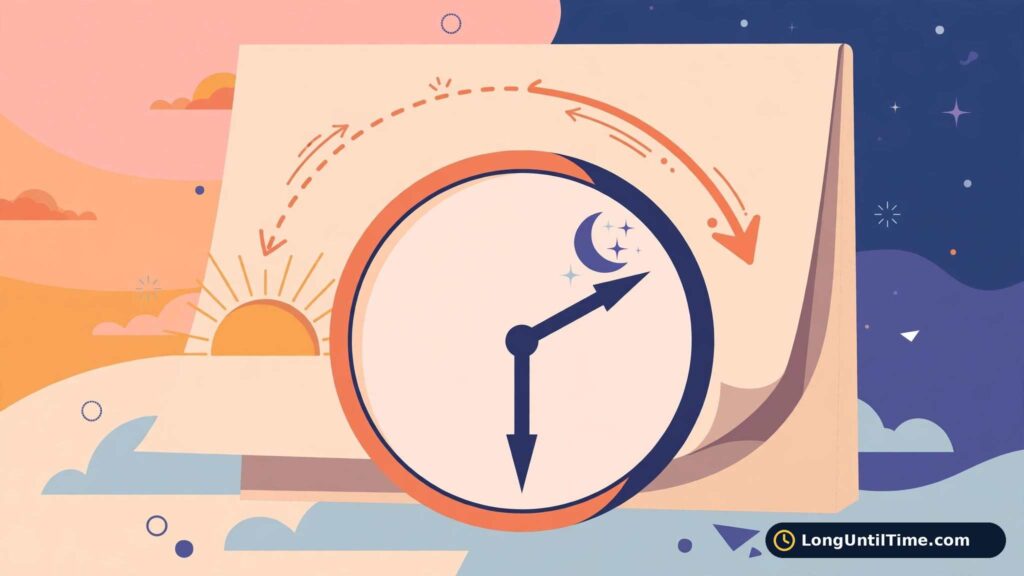
The single biggest source of wrong answers here is the day change. If it is now 2:00 AM, six hours ago was 8:00 PM, and most people get that far without trouble. Where the answer goes wrong is the label attached to it: that 8:00 PM happened yesterday evening, not earlier today, because today has only contained two hours so far. Writing “8:00 PM” without the day invites a reader to take it as tonight.
The AM and PM label needs the same care, because subtracting six hours moves the clock hand halfway around the twelve-hour face, to the numeral directly opposite. Whether the label flips depends on whether your backward path crosses a twelve o’clock boundary. Starting within six hours after noon or midnight, any time from 12:00 up to 5:59 in either half, the count crosses that boundary once, so the label flips: 4:00 PM becomes 10:00 AM, and 2:30 AM becomes 8:30 PM. Starting between 6:00 and 11:59 in either half, the count stays inside the same half, so the label stays put: 9:00 AM becomes 3:00 AM, and 9:00 PM becomes 3:00 PM.
One sanity check protects you from both errors: the answer should sit on the opposite side of the clock face from your start, and any start earlier than 6:00 AM needs the word “yesterday” on the result.
How to Calculate 6 Hours Ago
The everyday method has three moves. Subtract six from the hour, keep the minutes, then fix the label and the day: if the hour drops to zero or below, add twelve back, flip the label, and if the flip crossed midnight, mark the answer as yesterday. Here are four worked examples.
Example 1: A Simple Same-Day Subtraction (3:00 PM)
Three minus six will not work on the clock face alone, so borrow the twelve-hour cycle: 3 plus 12 is 15, and 15 minus 6 is 9. The count crossed noon, so the label flips from PM to AM, giving 9:00 AM on the same day.
Example 2: An Early-Morning Start That Crosses Midnight (2:30 AM)
From 2:30 AM, count back two and a half hours to reach midnight. That leaves three and a half hours to count into yesterday evening, landing on 8:30 PM yesterday. The minutes stayed at 30, and the day changed as the count passed midnight.
Example 3: A Start That Crosses Noon (4:00 PM)
From 4:00 PM, four hours back reaches 12:00 PM, noon itself. Two hours remain, and counting them back gives 10:00 AM on the same day. Noon is the boundary that flips the label here, just as midnight flips both the label and the day.
Example 4: The Full Minutes Method (4:10 AM)
Convert the start to minutes since midnight: 4:10 AM is 4 × 60 + 10 = 250 minutes. Subtract the 360 minutes in six hours and you get −110. A negative result signals the previous day, so add the 1,440 minutes in a full day: −110 + 1,440 = 1,330 minutes, which is 22 hours and 10 minutes, written 22:10 in 24-hour time, or 10:10 PM yesterday.
Minutes and Seconds: The Exact Moment 6 Hours Ago
Subtracting whole hours changes only the hour, never the smaller units. If it is now 7:42 and 18 seconds, then exactly six hours ago it was 1:42 and 18 seconds, because six hours is a whole number of minutes: 360 of them, or 21,600 seconds.
This matters when the question comes from a timestamp. If it is now 5:17 AM, a photo or log stamped 11:17 PM yesterday sits exactly six hours back, and the :17 is not an approximation to round away. Keep the minutes and seconds attached to the hour you calculate, and the moment you recover is the exact one the event happened.
Why Your Time Zone Can Move the Answer
Six hours ago is a single fixed moment in the past, but its clock reading depends on where the clock is. If a server or a colleague stamps an event in another zone, the reading belongs to that zone, not yours. An event logged at 9:00 PM in a zone three hours ahead of you happened at 6:00 PM on your clock, and counting back from the printed time without converting puts you three hours out.
The safe habit is to convert the timestamp into your own zone first, then subtract. There is also one calendar wrinkle: twice a year, in regions that observe daylight saving, the clocks jump forward or fall back by an hour. On those days an hour of local time is skipped or repeated, so six hours ago by the clock face can differ from six full hours of elapsed time. For an ordinary record the clock-face answer is what people want, but for a precise interval, count elapsed hours rather than labels.
Planning With a 6-Hours-Ago Answer
The most common real-world use is a timed routine. Doses, feedings, and check-ins are often set six hours apart, so knowing the exact time of the last one tells you whether the next is due, overdue, or still an hour away. If the last dose was at 1:00 PM and it is now 7:30 PM, the gap is six and a half hours, and the calculated answer proves it. For anything medical, follow the label or your clinician, and use this calculation to keep records straight.
Work records lean on the same check. A shift ending at 11:00 PM began at 5:00 PM if it ran six hours, and a delivery logged six hours ago at 4:00 AM actually arrived at 10:00 PM the night before, which changes which day’s paperwork it belongs to. The same habit scales up, and the companion piece on 12 hours from now is what time covers the half-day version. Whatever the setting, write the answer as a time and a day together.
Frequently Asked Questions
What time was it 6 hours ago?
It was six hours earlier than your current local time, with the same minutes as now. Before a 6:00 AM start, that moment fell on the previous day.
What time was it 6 hours ago from 2 AM?
Six hours before 2:00 AM was 8:00 PM yesterday. Only two of the six hours fit inside today; the other four belong to yesterday evening.
What time was it 6 hours ago from 9 PM?
Six hours before 9:00 PM was 3:00 PM today. The count stays inside the same day and PM half, so neither label nor day changes.
How many minutes is 6 hours ago?
Six hours is 360 minutes before the current moment. Converting your start to minutes since midnight and subtracting 360 is the most reliable way to calculate it.
Does 6 hours ago ever mean yesterday?
Yes, whenever your current time is earlier than 6:00 AM, the answer falls on the previous day. At 4:00 AM, for instance, six hours ago was 10:00 PM yesterday.
What was the time 6 hours ago in 24-hour format?
Subtract 6 from the hour number, and if the result is negative, add 24 and count the day as yesterday. For example, 03:00 minus six hours is 21:00 on the previous day.
Is 6 hours ago the same moment in every time zone?
The moment is the same everywhere, but its clock reading differs by zone, so the answer is not the same local time in every place. Convert any timestamp into your own zone before counting back.
How do I work out 6 hours ago without a calculator?
Subtract six from the hour, flip the AM or PM label if the count crosses noon or midnight, and add “yesterday” if it crosses midnight. Whole hours never move the minutes, so keeping them unchanged does the rest of the work.
Conclusion
Finding the time for 6 hours ago from now comes down to one subtraction and two checks. Take six hours off your current time, fix the AM or PM label if the count crossed noon or midnight, and attach yesterday whenever your start is earlier than 6:00 AM. The quick reference table settles the round hours at a glance, and the minutes method handles every other start without guesswork.
For anything that will be acted on, a dose, a log entry, a record of a past event, write the answer as a time and a day together, because the arithmetic is easy and the day is the part that slips. If you want the background on the seasonal clock shift that can bend these counts twice a year, the encyclopedia entry on daylight saving time explains how those changes work.
3 Comments