
How Long Until 6 AM? Counting Down the Night to Your Wake-Up Time
If you are asking how long until 6 am, there is no single fixed answer, because the answer depends on your current time — but the calculation takes only moments once you know the method. For most people, 6 AM is a wake-up time: the alarm for an early shift, a dawn flight, a gym session, or the answer to “how much sleep do I have left?” In your local time, the remaining time is simply the gap between now and 06:00, which is how the 24-hour clock writes 6 AM.
If 6 AM is still ahead of you — later this morning, or at the end of tonight — you count forward to it. If it has already gone by, the count rolls to tomorrow’s 6 AM instead, which is why the answer can jump from twenty minutes to nearly a full day in a single tick. Below: a quick reference table, the fix for the midnight-crossing mix-up, four worked examples, and planning advice for an early-morning target.
Quick Reference: Time Remaining Until 6 AM
If you only need the number, find your current time in the left column. Because most people ask this in the evening or during the night, this table follows that journey toward the next 6 AM.
| Current Time | Time Remaining Until 6 AM | In Minutes |
|---|---|---|
| 6:00 PM | 12 hours | 720 minutes |
| 8:00 PM | 10 hours | 600 minutes |
| 10:00 PM | 8 hours | 480 minutes |
| 11:00 PM | 7 hours | 420 minutes |
| 12:00 AM | 6 hours | 360 minutes |
| 2:00 AM | 4 hours | 240 minutes |
| 4:00 AM | 2 hours | 120 minutes |
| 5:00 AM | 1 hour | 60 minutes |
| 5:30 AM | 30 minutes | 30 minutes |
Every row follows the same pattern, and the pattern always aims at the next 6 AM, never the one already passed. 6 AM sits 360 minutes after midnight, so past midnight the remaining time is 360 minus the minutes since your day began; in the evening, add a full day first — 360 plus 1,440, minus your current minutes. A countdown timer on your phone performs that same subtraction continuously. The identical arithmetic runs the other way for afternoon targets too, as our guide to how long until 2:45 PM shows.
After 6 AM: Counting to Tomorrow’s 6 AM
Once the clock moves past 6 AM, this morning’s target is spent. Counters and alarms then aim at the next one, exactly 24 hours later, so the remaining time leaps back up:
| Current Time | Time Remaining Until the Next 6 AM | In Minutes |
|---|---|---|
| 7:00 AM | 23 hours | 1,380 minutes |
| 9:00 AM | 21 hours | 1,260 minutes |
| 12:00 PM | 18 hours | 1,080 minutes |
| 3:00 PM | 15 hours | 900 minutes |
That jump is not an error. It is the same target, one day later.
6 AM or 6 PM? The Midnight-Crossing Trap
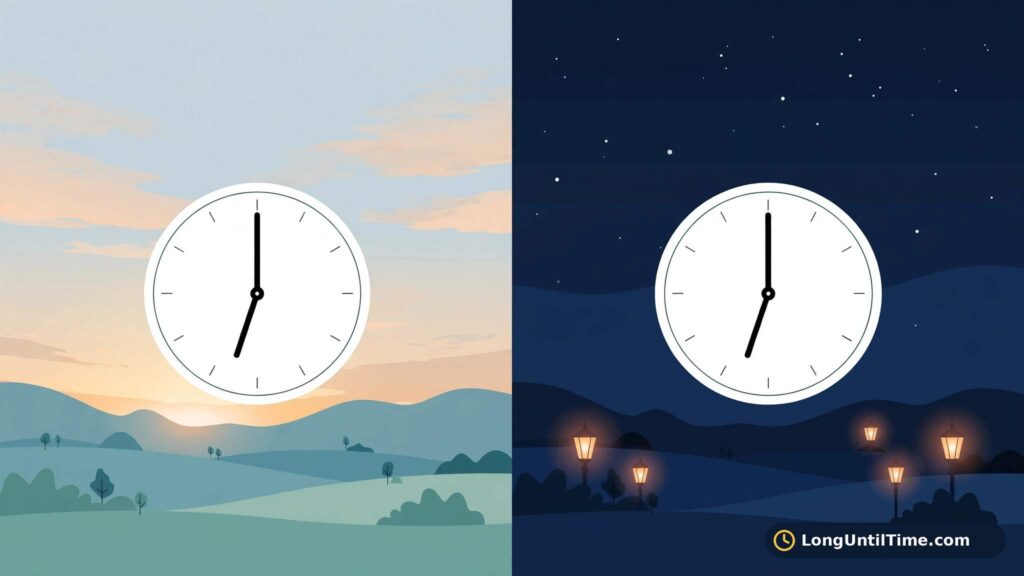
The clock shows 6:00 twice every day, and the two versions sit exactly 12 hours apart. 6 AM is the early morning, 360 minutes after midnight, while 6 PM is the evening at 1,080 minutes; the difference is 720 minutes, a full half day. The labels AM and PM are the only thing separating the two on a 12-hour clock, and a missed label is the most common reason a countdown to this target feels wrong.
The 24-hour clock removes the trap by giving each version its own number: 6 AM becomes 06:00 and 6 PM becomes 18:00, with no label left to misread. The stakes are easy to picture: at 10:00 PM, the next 6 AM is 8 hours away — the number your sleep depends on. Count toward 6 PM instead and you land on tomorrow evening, 20 hours away, with any alarm built on the wrong version off by half a day.
There is a second, quieter trap inside this one: the count from the evening crosses midnight, where the date rolls over. Forget that crossing and the arithmetic falls apart — from 10:00 PM you count 2 hours to midnight, then 6 more to 6 AM, and skipping the midnight leg undercounts badly. That is why the “how much sleep do I get?” question goes wrong so often: in bed at 11:00 PM, the honest answer is 7 hours, but only if the stretch past midnight is counted in full.
How to Calculate the Time Until 6 AM
Two methods cover every situation. For a quick estimate, count forward in chunks: whole hours first, then the leftover minutes, passing through midnight when the count starts in the evening. For an exact answer, convert both times into minutes since midnight and subtract, adding a full day — 1,440 minutes — whenever your current time falls after 6 AM on the clock. That subtraction is the whole secret: the time difference between now and the next 6 AM is all the question is asking for. Here are four worked examples.
Example 1: An Evening Start (9:30 PM)
Count forward in two chunks, through midnight. From 9:30 PM to midnight is 2 hours 30 minutes, and from midnight to 6:00 AM is another 6 hours. Together that gives 8 hours 30 minutes until 6 AM.
Example 2: After Midnight (1:20 AM)
Once you are past midnight, the count is a plain same-morning subtraction. From 1:20 AM, 360 minus 80 leaves 280 minutes, so 4 hours 40 minutes remain until 6 AM, with no date boundary left to cross.
Example 3: After the Target, Rolling to Tomorrow (7:15 AM)
At 7:15 AM, today’s 6 AM passed an hour and a quarter ago, so the target becomes tomorrow’s, and the count crosses midnight and a date change on the way. From 7:15 AM to midnight is 16 hours 45 minutes, and from midnight to 6:00 AM is 6 hours. Together that makes 22 hours 45 minutes until the next 6 AM.
Example 4: The Minutes Method (10:45 PM)
This is exactly how an online time calculator does it, and it works for any current time. First convert the target: 6 AM is 06:00 in 24-hour time, and 6 × 60 = 360 minutes after midnight. Because 10:45 PM falls after 6 AM on the clock face, add a full day to the target: 360 + 1,440 = 1,800. Then convert the current time: 10:45 PM is 22:45, and 22 × 60 + 45 = 1,365. Subtract: 1,800 − 1,365 = 435 minutes, so there are 7 hours 15 minutes until 6 AM.
The Final Stretch: Minutes and Seconds Before 6 AM
In the last few minutes, hours and whole minutes stop telling the whole story, and seconds take over. At 5:55 AM, exactly 5 minutes — 300 seconds — remain. At 5:59:30 AM, only 30 seconds are left, which is why countdown displays switch to a minutes-and-seconds readout near the end. If a shift or a flight starts at 6 AM, treat those final 300 seconds as getting-ready time, not a cushion; they vanish faster than they look on paper.
Why Your Time Zone Can Move the Answer
6 AM is a local moment, not a worldwide one, because the world is divided into time zones. When it is 6:00 AM in New York, it is still only 5:00 AM in Chicago, 4:00 AM in Denver, and 3:00 AM in Los Angeles. That matters whenever the 6 AM belongs to someone elsewhere — a flight leaving at 6 AM from a hub in another zone, or a call with an early riser across the country. Convert that 6 AM into your own local time first, then count down to it; counting toward your own unconverted 6 AM is a quiet way to wake up three hours late, or early.
Planning Around a 6 AM Target
A 6 AM target is usually planned backward from the night before, not from the morning itself. Decide what “ready” looks like at 6 AM — out of the door, logged in for an early shift, or checked in for the first flight of the day — then subtract your getting-ready time to find your real alarm, often 30 to 45 minutes earlier. Two alarms, one for that wake-up moment and one as a backup at 6 AM sharp, turn a groggy guess into two clear checkpoints.
The sleep side of the math deserves the same care. If you want eight hours of sleep before a 6 AM start, your head needs to be on the pillow by 10 PM — and counting forward from lights-out to the alarm is how you check whether a late evening is stealing an hour. Our guide on how long until 12 AM covers the other end of the night.
Frequently Asked Questions
How long until 6 AM from 10:00 PM?
There are 8 hours from 10:00 PM until 6 AM. The count crosses midnight, which is why it beats the plain difference between 10 and 6.
If I go to sleep at 11 PM, how much sleep do I get before a 6 AM alarm?
You give yourself 7 hours between lights-out at 11 PM and a 6 AM alarm. That is time in bed; drifting off takes a few minutes of it.
How long until 6 AM from midnight?
There are 6 hours from 12:00 AM until 6 AM. Midnight is the night’s cleanest starting point: the answer is simply the target’s own hour.
What is 6 AM in 24-hour time?
6 AM is 06:00 in 24-hour time. Morning hours keep their number with a leading zero, while the evening six becomes 18:00.
How many minutes after midnight is 6 AM?
6 AM falls 360 minutes after midnight. That number powers the minutes method: past midnight, subtract your own minutes since midnight from 360; before midnight, subtract from 1,800.
It is 8:00 AM now. How long until 6 AM?
There are 22 hours until the next 6 AM. Because today’s 6 AM has already passed, the count runs through the day, the evening, and tonight.
How long until 6 AM from 4:30 AM?
There are 1 hour 30 minutes from 4:30 AM until 6 AM. Both times sit inside the same morning, so no midnight crossing complicates the count.
Why does my countdown suddenly show almost a full day?
Because today’s 6 AM has already passed, the countdown has rolled over to tomorrow’s 6 AM. The jump to nearly 24 hours happens the moment the clock moves past the target.
Conclusion
Working out how long until 6 am comes down to one habit: compare your current time with 06:00, the 24-hour form of 6 AM, and never lose track of midnight along the way. Count forward in chunks for a quick estimate, or subtract your minutes since midnight from 360 — adding a full day whenever you start from the evening or after the target — for an exact answer. From the evening, remember the two legs: the hours to midnight, then the hours from midnight to six.
For anything that matters — a shift, a flight, a full night of sleep — do the small calculation once in the evening, set the alarm, and let the clock-watching go. Readers who love this quiet hour can browse the encyclopedia entry on dawn, the first light that 6 AM so often arrives with.




2 Comments