
How Long Until 4:30 PM? Simple Time Guide, Examples & Calculator
If you are asking How Long Until 4:30 PM, the exact answer depends on the current time and your time zone. For example, if it is 2:00 PM, there are 2 hours and 30 minutes until 4:30 PM. If it is 4:00 PM, only 30 minutes remain.
If 4:30 PM has already passed, you normally need to calculate the time until 4:30 PM the next day. This makes the date just as important as the clock time.
This guide explains how to calculate the time difference, convert 4:30 PM into other time formats, handle minutes and seconds, understand AM and PM, and avoid common mistakes. The examples use simple times so you can work out the answer quickly.
How Long Until 4:30 PM?
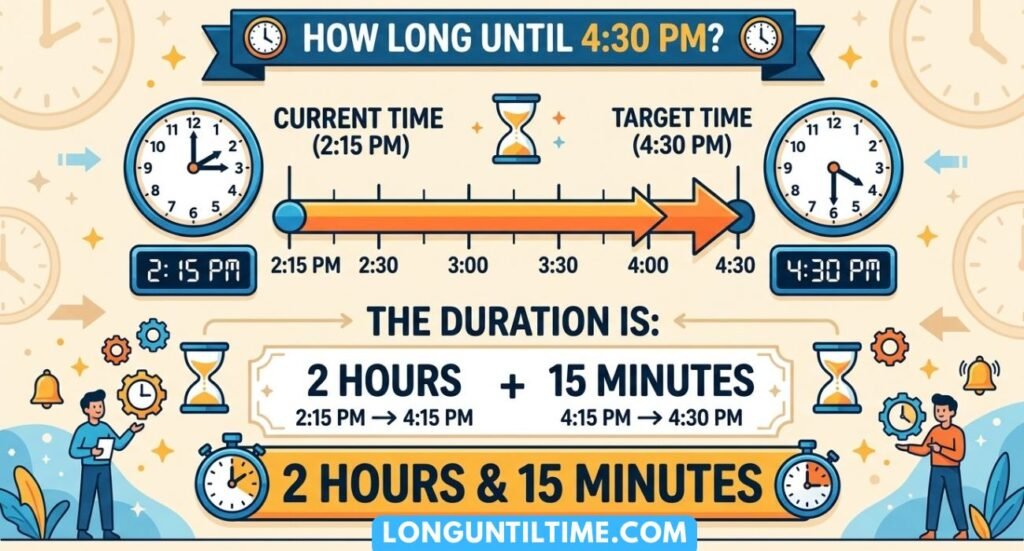
There is no single answer to how long until 4:30 PM because the remaining time changes every minute.
The basic calculation is:
Time remaining = 4:30 PM − current time
For example, if your local time is 1:00 PM, the calculation is:
4:30 PM − 1:00 PM = 3 hours 30 minutes
If it is 3:30 PM:
4:30 PM − 3:30 PM = 1 hour
If it is 4:15 PM:
4:30 PM − 4:15 PM = 15 minutes
Once the clock reaches 4:30 PM, the remaining time is zero. After 4:30 PM, the next occurrence is generally 4:30 PM on the following day.
Quick Reference
| Current Time | Time Until 4:30 PM |
|---|---|
| 12:00 PM | 4 hours 30 minutes |
| 1:00 PM | 3 hours 30 minutes |
| 1:30 PM | 3 hours |
| 2:00 PM | 2 hours 30 minutes |
| 2:30 PM | 2 hours |
| 3:00 PM | 1 hour 30 minutes |
| 3:30 PM | 1 hour |
| 4:00 PM | 30 minutes |
| 4:15 PM | 15 minutes |
| 4:29 PM | 1 minute |
| 4:30 PM | 0 minutes |
These examples assume that the current time and 4:30 PM are on the same day and in the same time zone.
1. Meaning / Definition
How Long Until 4:30 PM asks for the amount of time between the current moment and 4:30 PM.
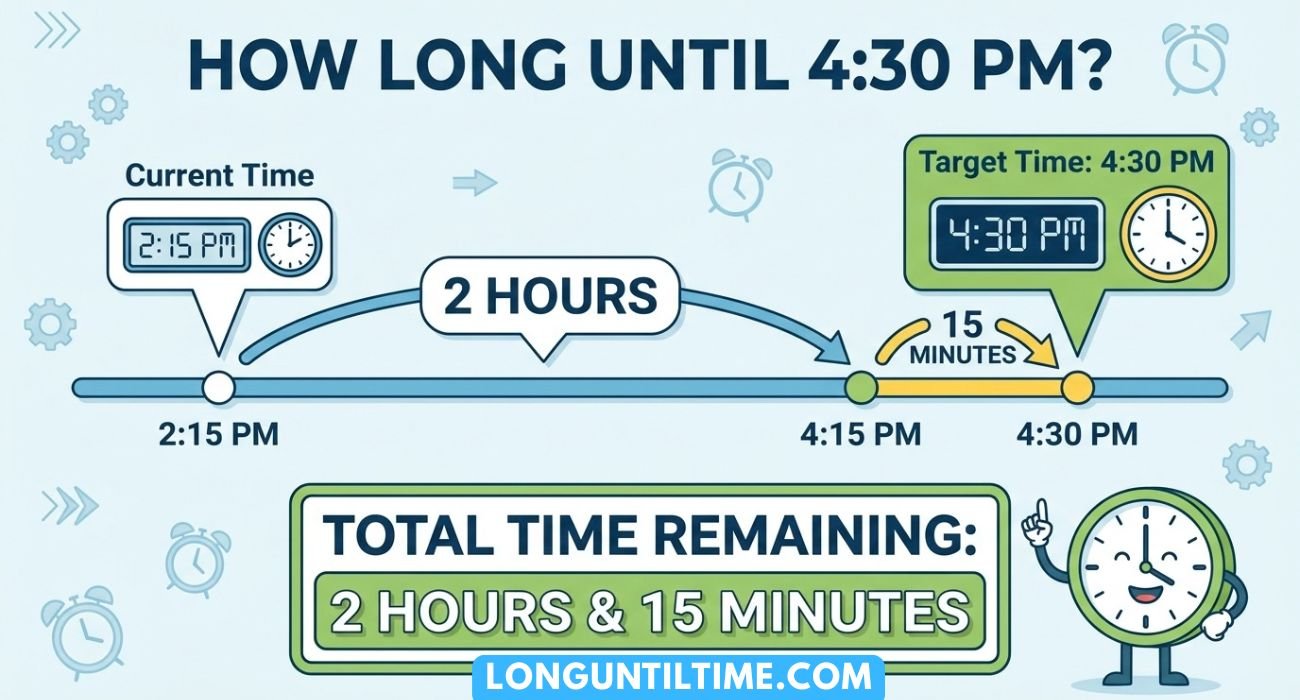
The phrase can refer to hours, minutes, or even seconds. If it is 2:15 PM, for example, the answer is 2 hours and 15 minutes. If it is 4:29 PM, the answer is only 1 minute.
The target time, 4:30 PM, is a specific point on the clock. The current time is the starting point. The time difference between those two points gives the answer.
This is different from asking what time it will be after a certain number of hours. “How long until 4:30 PM?” works backward from a fixed target time to find the remaining duration.
2. Meaning in Simple Words
In simple words, how long until 4:30 PM means:
“How much time is left before the clock reaches 4:30 PM?”
The answer changes as the day moves forward. At 12:00 PM, there are 4 hours and 30 minutes left. At 3:00 PM, there are only 1 hour and 30 minutes left.
You can also hear people say “How long till 4:30 PM?” or “How much time until 4:30?” These expressions usually mean the same thing when the intended target is clear.
Quick Answer
If the current time is before 4:30 PM, subtract the current time from 4:30 PM.
For example:
2:00 PM → 2 hours 30 minutes until 4:30 PM.
3:00 PM → 1 hour 30 minutes until 4:30 PM.
4:00 PM → 30 minutes until 4:30 PM.
4:30 PM → 0 minutes.
If the current time is after 4:30 PM, calculate the duration until 4:30 PM on the next day.
3. Real-Life Examples
Knowing the time remaining until 4:30 PM can be useful for everyday schedules. A target time may represent an appointment, school activity, work deadline, bus departure, online meeting, or personal reminder.
Example 1: Planning an Appointment
Suppose you have an appointment at 4:30 PM and your current time is 2:00 PM.
The calculation is:
4:30 PM − 2:00 PM = 2 hours 30 minutes
That gives you 2 hours and 30 minutes before the appointment. You can use that period to prepare, travel, or finish another task.
If travel takes 45 minutes, you would also need to consider that separately. The countdown to the appointment does not automatically tell you when to leave.
Example 2: Waiting for School to End
Imagine a school activity ends at 4:30 PM and it is currently 3:15 PM.
From 3:15 PM to 4:15 PM is 1 hour. From 4:15 PM to 4:30 PM is another 15 minutes.
So:
3:15 PM → 4:30 PM = 1 hour 15 minutes
This is a simple example of why including the minutes matters.
Example 3: Preparing for Work
Suppose you have a work deadline at 4:30 PM and the current time is 1:30 PM.
From 1:30 PM to 4:30 PM is exactly 3 hours.
You can divide those three hours into smaller tasks, but the actual time remaining until the deadline stays based on the clock.
At 2:30 PM, only 2 hours remain. At 3:30 PM, only 1 hour remains.
Example 4: Cooking Dinner
Suppose you want to start preparing dinner at 3:30 PM and use 4:30 PM as a target time.
The difference is:
4:30 PM − 3:30 PM = 1 hour
That gives you a one-hour window. If the current time changes to 4:00 PM, only 30 minutes remain.
This shows why a countdown is dynamic rather than a fixed number.
Example 5: Catching a Bus
Imagine a bus is scheduled for 4:30 PM and the current time is 3:45 PM.
From 3:45 PM to 4:30 PM is 45 minutes.
However, the countdown alone does not tell you whether you have enough time to reach the stop. You also need to consider walking, driving, traffic, parking, or other travel factors.
Example 6: Online Meeting
Suppose an online meeting is scheduled for 4:30 PM and your current time is 3:00 PM.
There are 1 hour 30 minutes until the meeting.
If the meeting organizer uses another time zone, make sure you know which time zone the meeting time refers to. A meeting listed as 4:30 PM Eastern Time does not occur at 4:30 PM local time everywhere in the United States.
Example 7: When 4:30 PM Has Passed
Suppose it is 5:00 PM.
Today’s 4:30 PM has already passed, so the next 4:30 PM is tomorrow.
From 5:00 PM to midnight is 7 hours. From midnight to 4:30 PM the next day is 16 hours 30 minutes.
Therefore:
7 hours + 16 hours 30 minutes = 23 hours 30 minutes
So at 5:00 PM, there are 23 hours 30 minutes until the next 4:30 PM.
4. Synonyms and Related Terms
People use several different phrases when searching for the same basic information. Common variations include “how long till 4:30 PM,” “how much time until 4:30 PM,” “how many hours until 4:30 PM,” “time remaining until 4:30 PM,” and “4:30 PM countdown.”
The wording may change, but the calculation is still based on the difference between the current time and the target time.
A countdown timer is useful when you want the remaining duration to update continuously. A time calculator can also calculate the difference between two specified times.
AM vs. PM
AM and PM are essential when calculating the time until 4:30.
4:30 AM and 4:30 PM are 12 hours apart. They are not interchangeable.
In the 24-hour clock:
4:30 AM = 04:30
4:30 PM = 16:30
Therefore, if you are asking about an afternoon appointment or deadline at 4:30 PM, the corresponding 24-hour time is 16:30.
Confusing AM and PM can create a 12-hour error in your calculation.
5. When to Use
The question How Long Until 4:30 PM can be useful whenever 4:30 PM is connected to a planned activity or deadline.
Use it for appointments
If you have an appointment at 4:30 PM, calculating the remaining time tells you how long you have before it begins. You can then compare that time with your preparation and travel needs.
Use it for work
A 4:30 PM target can represent a deadline, shift ending, meeting, report submission, or another work event. Checking the remaining time can help you organize tasks before the target.
Use it for school
Students and parents may use 4:30 PM as a reference for classes, activities, tutoring, sports, or pickup times.
For example, if it is 3:30 PM, exactly 1 hour remains until 4:30 PM.
Use it for travel
A 4:30 PM departure or arrival time requires an accurate countdown. However, remember that the time until the scheduled event is different from the travel time needed to reach the destination.
Use it for reminders
You might set a reminder for 4:30 PM to call someone, complete a task, take a break, start an activity, or attend a meeting.
Use it for countdowns
A live countdown is helpful when the target time is approaching. Unlike a fixed calculation, a live timer continues to decrease as seconds pass.
Use it for daily planning
Knowing how much time remains until 4:30 PM can help you decide what tasks fit into the remaining afternoon.
For example, if you have 3 hours remaining, you might have time for several tasks. If only 20 minutes remain, you may need to choose a smaller task.
How to Calculate the Time Until 4:30 PM
The basic formula is:
Time until 4:30 PM = 4:30 PM − current time
The calculation is straightforward when the current time is before 4:30 PM. It requires an extra step when the current time has already passed 4:30 PM.
If the current time is before 4:30 PM
Subtract the current time from 4:30 PM.
For example:
Current time: 2:45 PM
Target time: 4:30 PM
From 2:45 PM to 3:45 PM = 1 hour.
From 3:45 PM to 4:30 PM = 45 minutes.
Therefore:
2:45 PM → 4:30 PM = 1 hour 45 minutes
Another easy method is to convert both times into minutes after noon.
2:45 PM is 165 minutes after noon.
4:30 PM is 270 minutes after noon.
270 − 165 = 105 minutes.
105 minutes equals 1 hour 45 minutes.
If the current time is after 4:30 PM
If today’s 4:30 PM has passed, the next occurrence is usually tomorrow.
Suppose the current time is 6:00 PM.
From 6:00 PM to midnight = 6 hours.
From midnight to 4:30 PM = 16 hours 30 minutes.
Therefore:
6 hours + 16 hours 30 minutes = 22 hours 30 minutes
So there are 22 hours and 30 minutes until the next 4:30 PM.
If the current time is exactly 4:30 PM
If the clock reads exactly 4:30 PM, the time remaining is:
0 hours, 0 minutes, and 0 seconds
The target has arrived.
If you are using a countdown timer, it reaches zero at the target moment.
See Also : How Long Until 12 PM? Calculate the Time Until Noon
6. When NOT to Use
There are situations where a simple fixed calculation can give the wrong impression. The target time needs to be interpreted together with the date, location, and current clock time.
Do not ignore the date
A clock time alone does not always identify a unique event.
For example, if someone says an appointment is at 4:30 PM and it is already 6:00 PM, you need to know whether they mean today’s appointment or tomorrow’s.
For a repeating daily event, the next occurrence is normally tomorrow. For a one-time event, the actual calendar date determines whether the event has already passed.
Do not confuse AM and PM
Always check whether the target is 4:30 AM or 4:30 PM.
If the intended time is 4:30 PM, using 4:30 AM changes the target by 12 hours.
Do not ignore time zones
A scheduled event can have a different local clock time depending on its location.
For example, 4:30 PM Eastern Time and 4:30 PM Pacific Time occur at different moments. If you are joining an online meeting or following a remote schedule, check the stated time zone.
Do not assume the answer stays the same
The answer to how long until 4:30 PM changes continuously.
If there are 2 hours remaining at 2:30 PM, there will be 1 hour remaining at 3:30 PM.
A calculation is tied to the exact moment when it was made.
Do not use a fixed answer for a live countdown
A statement such as “there are 30 minutes until 4:30 PM” is only accurate when the current time supports it.
At 4:10 PM, 20 minutes remain. At 4:20 PM, only 10 minutes remain.
For a live event, use the current time or an updating countdown timer instead of relying on an old calculation.
7. Common Mistakes
Mistake 1: Subtracting the wrong hour
A common error is to focus only on the hour number and overlook the minutes.
For example, from 2:40 PM to 4:30 PM is not 2 hours. The correct answer is 1 hour 50 minutes.
The safest approach is to account for both hours and minutes.
Mistake 2: Forgetting the minutes
Suppose it is 3:15 PM.
From 3:15 PM to 4:15 PM is 1 hour, and another 15 minutes takes you to 4:30 PM.
Therefore, the correct answer is 1 hour 15 minutes, not 1 hour.
Mistake 3: Treating 4:30 PM as 4:30 AM
The two times are separated by 12 hours.
4:30 AM is early morning, while 4:30 PM is afternoon.
In 24-hour time, they are 04:30 and 16:30 respectively.
Mistake 4: Forgetting tomorrow
If it is already 5:00 PM, today’s 4:30 PM is over.
You cannot simply treat the target as a time later on the same afternoon. You must move the target to the next occurrence if the question is about the next 4:30 PM.
Mistake 5: Using the wrong time zone
If an event takes place in another location, the displayed time may use that location’s time zone.
This matters especially for online meetings, flights, remote work, and events involving people in different parts of the United States.
Mistake 6: Rounding the answer
Rounding can remove useful information.
If the exact difference is 1 hour 45 minutes, saying “about 2 hours” may be acceptable for a rough estimate, but it is not the exact answer.
For appointments and deadlines, the exact hours and minutes are usually more useful.
Mistake 7: Confusing elapsed time with remaining time
Elapsed time tells you how much time has passed since a starting point.
Remaining time tells you how much time is left before a target.
For example, if an activity began at 2:00 PM and the target is 4:30 PM, 2 hours 30 minutes is the total period between those times. If it is currently 3:30 PM, only 1 hour remains until 4:30 PM.
8. Comparison with Similar Terms
4:30 PM in Different Formats
The same time can be written in several ways.
| Format | Representation |
|---|---|
| 12-hour clock | 4:30 PM |
| 24-hour clock | 16:30 |
| Spoken form | Four-thirty in the afternoon |
| Minutes after noon | 270 minutes |
The 12-hour format uses AM and PM, while the 24-hour format counts from 00:00 through 23:59.
Converting 4:30 PM to 16:30 can make calculations easier because there is no AM/PM ambiguity.
Understanding the Calculation With More Examples
Here are several examples of the time until 4:30 PM when the target is later on the same day:
| Current Time | Calculation | Time Until 4:30 PM |
|---|---|---|
| 12:00 PM | 12:00 → 4:30 | 4 hours 30 minutes |
| 12:30 PM | 12:30 → 4:30 | 4 hours |
| 1:15 PM | 1:15 → 4:30 | 3 hours 15 minutes |
| 1:45 PM | 1:45 → 4:30 | 2 hours 45 minutes |
| 2:15 PM | 2:15 → 4:30 | 2 hours 15 minutes |
| 2:45 PM | 2:45 → 4:30 | 1 hour 45 minutes |
| 3:15 PM | 3:15 → 4:30 | 1 hour 15 minutes |
| 3:45 PM | 3:45 → 4:30 | 45 minutes |
| 4:00 PM | 4:00 → 4:30 | 30 minutes |
| 4:15 PM | 4:15 → 4:30 | 15 minutes |
| 4:29 PM | 4:29 → 4:30 | 1 minute |
| 4:30 PM | Target reached | 0 minutes |
These examples show why the answer cannot be a permanent number. Every minute changes the remaining duration.
What If It Is 4:31 PM?
At 4:31 PM, today’s 4:30 PM has already passed by 1 minute.
If you want to know the time until the next 4:30 PM, the target moves to tomorrow.
From 4:31 PM today to 4:31 PM tomorrow is 24 hours. The next 4:30 PM occurs one minute before that.
Therefore, under a normal 24-hour day:
4:31 PM → next 4:30 PM = 23 hours 59 minutes
What If It Is Midnight?
Midnight is 12:00 AM and marks the beginning of a new calendar day.
From 12:00 AM to 4:30 PM is:
16 hours 30 minutes
This can be calculated by separating the period into two parts:
12:00 AM → 12:00 PM = 12 hours
12:00 PM → 4:30 PM = 4 hours 30 minutes
Total:
12 hours + 4 hours 30 minutes = 16 hours 30 minutes
What If It Is Noon?
Noon is 12:00 PM.
From noon to 4:30 PM:
4:30 PM − 12:00 PM = 4 hours 30 minutes
This is an especially useful reference because 4:30 PM is 270 minutes after noon.
See Also : How Long Until 12 PM? Calculate the Time Until Noon
How Many Minutes Until 4:30 PM?
If you need the answer entirely in minutes, convert the hours into minutes first.
Since:
1 hour = 60 minutes
4 hours 30 minutes equals:
4 × 60 + 30 = 270 minutes
So from 12:00 PM to 4:30 PM there are 270 minutes.
For a different starting time, subtract the starting time from 4:30 PM in minutes. For example, from 3:00 PM to 4:30 PM:
1 hour 30 minutes = 90 minutes
From 4:15 PM to 4:30 PM:
15 minutes
This approach is useful when a scheduling system, timer, or calculator asks for a duration in minutes instead of hours and minutes.
How Many Seconds Until 4:30 PM?
A precise countdown can also be expressed in seconds.
There are 60 seconds in a minute and 60 minutes in an hour, so:
1 hour = 3,600 seconds
From 3:30 PM to 4:30 PM:
1 hour = 3,600 seconds
From 4:00 PM to 4:30 PM:
30 minutes = 1,800 seconds
For a live countdown, the number of seconds changes continuously. This is why an exact result requires the current time, including seconds, if second-level precision matters.
4:30 PM and Time Zones
A target time such as 4:30 PM only describes a clock time. When people are in different locations, the associated time zone matters.
The United States spans multiple time zones, including Eastern, Central, Mountain, Pacific, Alaska, and Hawaii-Aleutian time zones. Some locations also observe daylight saving time while others do not.
For example, an event scheduled for 4:30 PM in one U.S. time zone may occur at a different clock time in another. When calculating the countdown to a remote event, first identify the event’s time zone and then compare it with your current local time.
For a simple local question such as “How long until 4:30 PM?” you normally use the current time where you are and today’s 4:30 PM in that same location.
How a Time Calculator Helps
A time calculator can make the calculation easier when you need an exact result.
For a same-day target, enter the current time as the starting point and 4:30 PM as the ending point. The calculator can then return the difference in hours, minutes, and sometimes seconds.
A calculator is particularly useful when the times include unusual minutes, such as 1:37 PM or 3:48 PM, because manual subtraction can be more prone to errors.
However, a calculator still needs the correct inputs. If you enter 4:30 AM instead of 4:30 PM, choose the wrong date, or use the wrong time zone, the resulting answer will also be wrong.
How Long Until 4:30 PM Tomorrow?
If today’s 4:30 PM has already passed, the next target is often tomorrow at 4:30 PM.
For example, if it is 7:00 PM today, calculate the time from 7:00 PM to midnight and then from midnight to 4:30 PM tomorrow.
7:00 PM → midnight = 5 hours
Midnight → 4:30 PM = 16 hours 30 minutes
Total:
21 hours 30 minutes
So at 7:00 PM, there are 21 hours 30 minutes until 4:30 PM tomorrow.
How Long Until 4:30 PM on a Typical Day?
The time until 4:30 PM depends entirely on the current clock time. For example, if it is 1:30 PM, there are 3 hours remaining, while 3:45 PM leaves only 45 minutes. Using the current time makes the calculation accurate and avoids relying on a fixed answer.
A simple way to calculate the difference is to count forward from the current time until 4:30 PM. When the minutes do not line up exactly, break the calculation into hours and minutes. This makes it easier to find the exact time difference without rounding.
What Time Will It Be After 4:30 PM?
Once the clock reaches 4:30 PM, the target time has arrived. If you are asking what happens after that, you can add the desired number of hours or minutes to 4:30 PM. For example, one hour after 4:30 PM is 5:30 PM, while two hours after it is 6:30 PM.
This can be useful when planning tasks around a fixed afternoon schedule. If 4:30 PM is a meeting time, for example, knowing the times before and after it can help you organize the rest of your day without confusing elapsed time with remaining time.
How Long Is 4:30 PM From Other Common Times?
Comparing 4:30 PM with familiar times makes the calculation easier to understand. From 12:00 PM to 4:30 PM is 4 hours 30 minutes, from 2:00 PM to 4:30 PM is 2 hours 30 minutes, and from 3:00 PM to 4:30 PM is 1 hour 30 minutes.
As the clock gets closer to 4:30 PM, the remaining period becomes shorter. At 4:00 PM, only 30 minutes remain, and at 4:15 PM, only 15 minutes are left. These examples are useful when checking a countdown timer or planning an afternoon schedule.
Why Exact Time Matters for a 4:30 PM Countdown
An exact current time gives you a more accurate answer than a general estimate. Saying that there are about two hours until 4:30 PM may be useful for rough planning, but if it is actually 2:35 PM, the precise remaining time is 1 hour 55 minutes.
Exact calculations become even more useful for appointments, transportation, deadlines, and online meetings. When seconds matter, the calculation should also include the current seconds and the correct time zone, especially when the 4:30 PM event is scheduled for someone in another location.
Frequently Asked Questions
How long until 4:30 PM?
It depends on the current time. For example, at 2:00 PM, there are 2 hours 30 minutes until 4:30 PM.
How long till 4:30 PM?
“How long till 4:30 PM?” means the same basic thing as “How long until 4:30 PM?” Subtract the current time from 4:30 PM when the target is later that day.
How many hours until 4:30 PM?
The number of hours depends on the current time. At 1:00 PM, there are 3 hours 30 minutes; at 3:00 PM, there are 1 hour 30 minutes.
How long is it from 2 PM to 4:30 PM?
The difference is 2 hours 30 minutes.
How long is it from 3 PM to 4:30 PM?
The difference is 1 hour 30 minutes, or 90 minutes.
How long is it from 4 PM to 4:30 PM?
There are 30 minutes between 4:00 PM and 4:30 PM.
What time is 4:30 PM in 24-hour time?
4:30 PM is 16:30 in the 24-hour clock.
What happens if it is already 4:30 PM?
The remaining time for that day’s target is zero. If you mean the next occurrence, the next 4:30 PM is tomorrow.
What happens if it is after 4:30 PM?
If you are asking about the next daily occurrence, move the target to 4:30 PM on the following day and calculate the duration from the current time.
How many minutes are there until 4:30 PM from noon?
From 12:00 PM to 4:30 PM there are 270 minutes, which equals 4 hours 30 minutes.
Is 4:30 PM afternoon or evening?
4:30 PM is generally considered afternoon. The exact way people describe the period can vary in everyday speech, but 4:30 PM is an afternoon clock time.
Is 4:30 PM the same as 16:30?
Yes. 4:30 PM and 16:30 represent the same time in the 12-hour and 24-hour clock systems.
Does the time zone affect how long until 4:30 PM?
Yes, when the 4:30 PM event is tied to a particular location or time zone. A 4:30 PM event in one time zone can occur at a different local clock time elsewhere.
Conclusion
The answer to How Long Until 4:30 PM depends on the current time, date, and, when relevant, the time zone. If it is before 4:30 PM, subtract the current time from 4:30 PM. If it is exactly 4:30 PM, no time remains. If 4:30 PM has already passed and you mean the next occurrence, calculate the time until 4:30 PM tomorrow.
Remember that 1 hour equals 60 minutes, and accurate calculations should include both hours and minutes. For example, 2:45 PM is 1 hour 45 minutes before 4:30 PM, while 4:15 PM is only 15 minutes away.
Whether you are checking an appointment, planning work, preparing for school, tracking travel, or using a countdown timer, the most useful answer always starts with the current local time.
3 Comments