
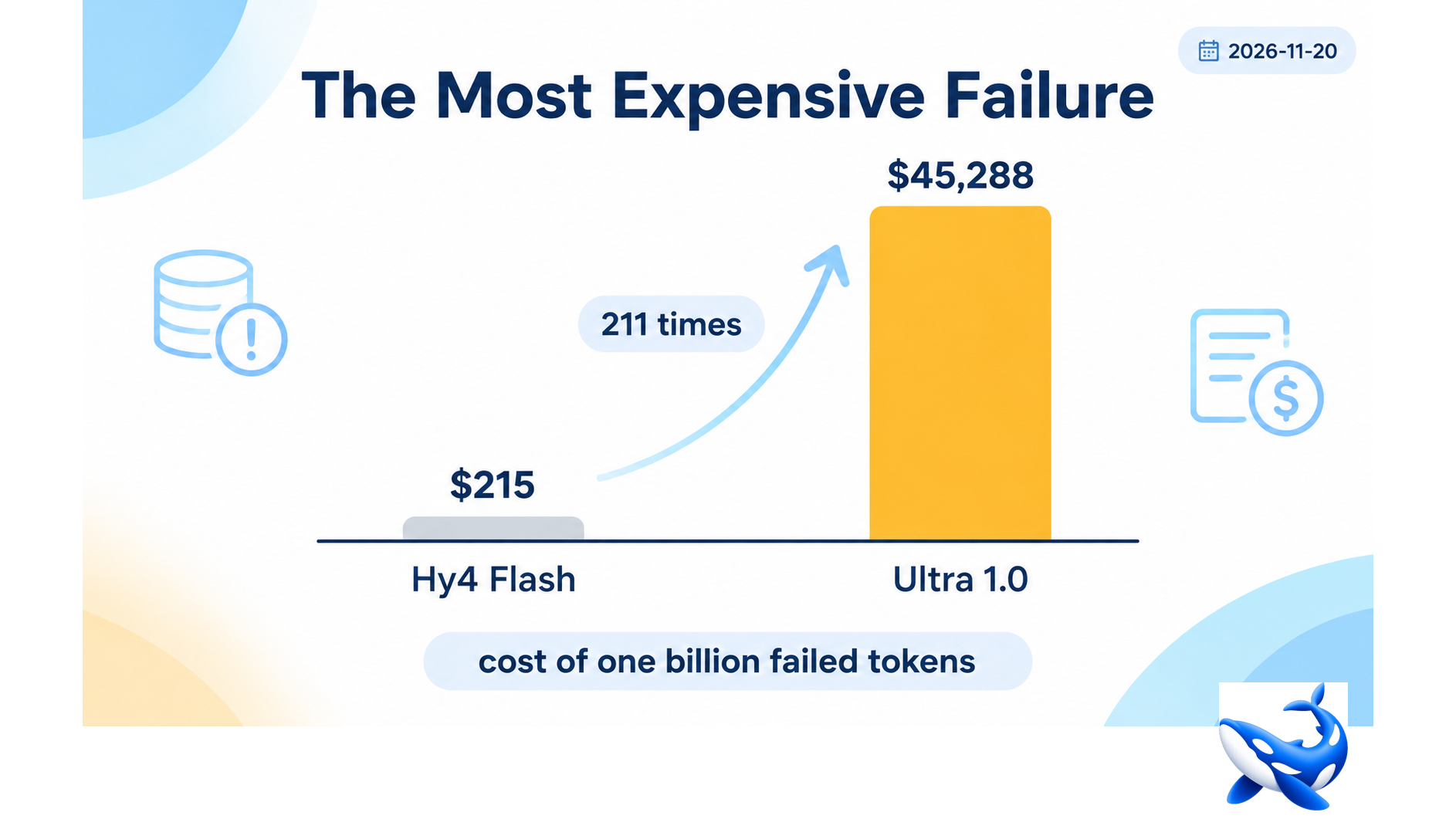
OrcaCyber Ultra 1.0: $45,288 of Failed Tokens per Billion
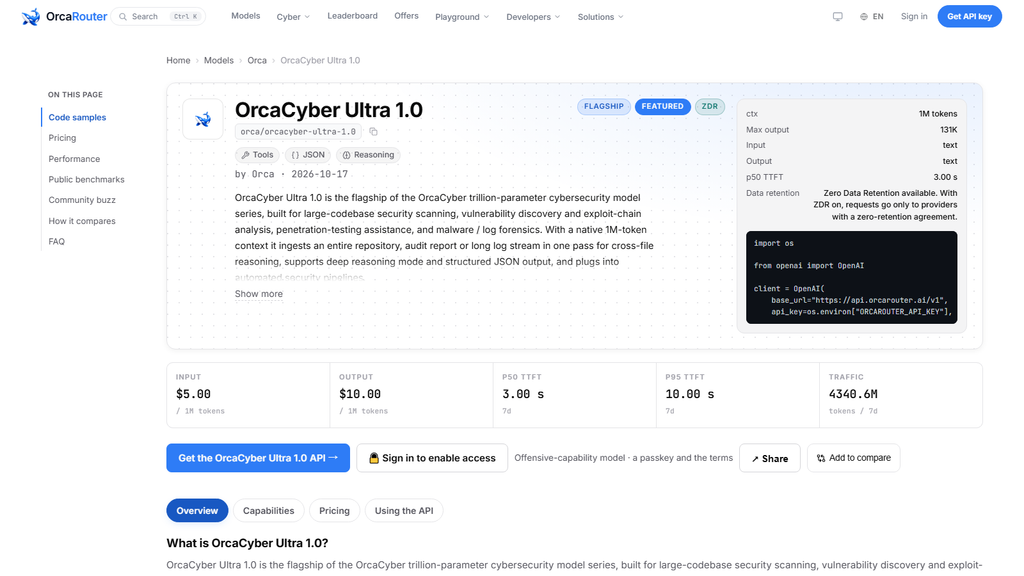
Forty-five thousand dollars is what a billion tokens’ worth of failure costs on this card, and the cheapest card in the tier charges $215 for the same billion. OrcaRouter publishes the rate and the price that multiply into it. Both are on OrcaCyber Ultra 1.0 error rate: a 0.72% error rate on a $6.25 blend.
The failure table
| card | err % | blend | fail $/billion |
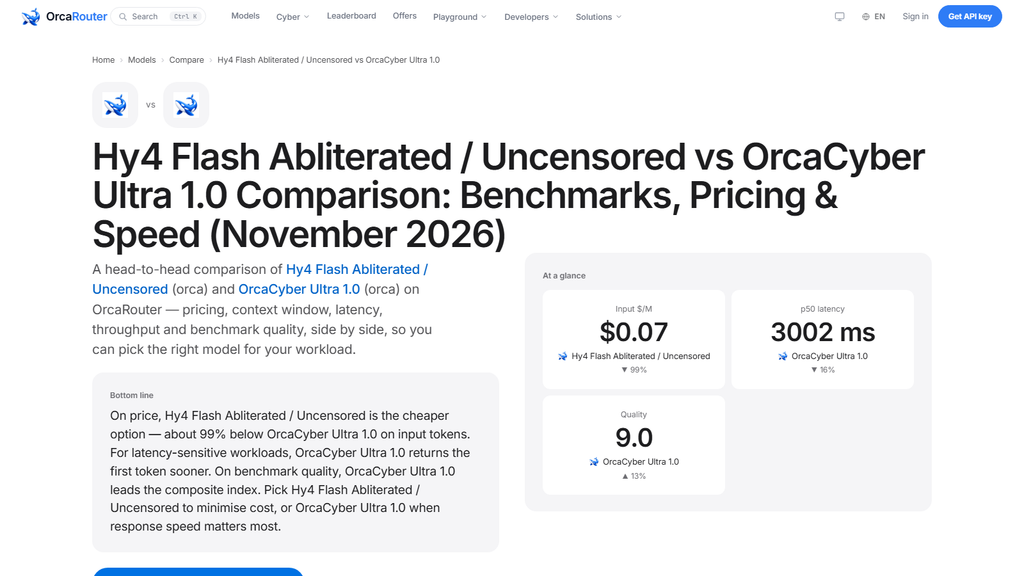
| Hy4 Flash | 0.17 % | $0.1228 | $215 |
| Hy4 | 0.10 % | $1.0000 | $1,031 |
| Flash 1.0 | 0.17 % | $1.0000 | $1,684 |
| MiniMax M3.1 Flash | 0.18 % | $1.0000 | $1,794 |
| Zero 1.5 | 0.09 % | $4.1250 | $3,517 |
| Zero 1.0 | 0.09 % | $4.1250 | $3,790 |
| MiMo V2.6 Flash | 0.42 % | $1.0000 | $4,209 |
| GLM 5.3 Flash | 0.44 % | $1.0000 | $4,425 |
| K3.1 Pro | 0.19 % | $2.7500 | $5,180 |
| GLM 5.3 | 0.44 % | $3.5000 | $15,428 |
| Qwen3.8 Flash Next | 1.60 % | $1.0000 | $15,972 |
| Ultra 1.0 | 0.72 % | $6.2500 | $45,288 |
The column is the error rate applied to a billion tokens and priced at the card’s own blend. It is a maximum, because a failed request is not billed for output it never generated, and the blend assumes a 3:1 input-to-output mix — so the figure is an upper bound on a worst-case mix rather than a measured loss.
Even as an upper bound the ordering is informative. The card’s error rate, 0.72%, is only the third-highest in the tier. What puts it first is the multiplier: $6.25 is 51× Hy4 Flash’s $0.1228.
So the cost of failure here is almost entirely a price effect rather than a reliability effect.
Decomposing the two factors
The failure cost is rate × price. Holding the rate at the tier median of 0.44% and varying the price:
| blend | fail $/billion at 0.44% |
| $0.1228 | $540 |
| $1.0000 | $4,400 |
| $2.7500 | $12,100 |
| $4.1250 | $18,150 |
| $6.2500 | $27,500 |
And holding the price at this card’s $6.25 and varying the rate:
| err % | fail $/billion at $6.25 |
| 0.09 | $5,663 |
| 0.19 | $11,875 |
| 0.44 | $27,500 |
| 0.72 | $45,288 |
| 1.60 | $100,000 |
Both factors matter, and the price factor dominates across the range the tier spans. A card at the tier’s worst error rate on a band price lands at $16,000; a card at the tier’s best error rate on this card’s price lands at $5,331.
Which is to say: on this tier, a buyer choosing a cheap card for its low error rate is optimising the smaller of two multipliers. The card’s own price does more to a failure bill than its reliability does.
What 0.72% costs in absolute terms
Applied to the 4.20 billion tokens this card served in seven days, 0.72% is 30.4 million failed tokens — the third-largest absolute failure volume in the tier, behind Flash 1.0’s 61.8 million and K3.1 Pro’s 45.6 million.
| card | 7-day tokens | err % | failed tokens |
| Flash 1.0 | 36.72 B | 0.17 | 61.8 M |
| K3.1 Pro | 24.23 B | 0.19 | 45.6 M |
| Ultra 1.0 | 4.20 B | 0.72 | 30.4 M |
| GLM 5.3 | 6.37 B | 0.44 | 28.1 M |
| GLM 5.3 Flash | 5.42 B | 0.44 | 24.0 M |
| Qwen3.8 Flash Next | 1.44 B | 1.60 | 23.1 M |
| Zero 1.5 | 19.51 B | 0.09 | 16.6 M |
| Hy4 | 12.79 B | 0.10 | 13.2 M |
| MiniMax M3.1 Flash | 1.71 B | 0.18 | 3.1 M |
| Hy4 Flash | 1.01 B | 0.17 | 1.8 M |
| Zero 1.0 | 1.47 B | 0.09 | 1.4 M |
| MiMo V2.6 Flash | 0.31 B | 0.42 | 1.3 M |
Thirty million tokens of failure in a week on a card charging $6.25 a million is a headline number, and the card’s traffic is a fifth of K3.1 Pro’s, so the rate is doing the work here rather than the volume.
The distinction between the two views is worth keeping. Per billion tokens this card is the worst in the tier by a factor of 2.8. On the absolute weekly figure it is the third worst, behind two cards with error rates a quarter of its own.
The retry that makes it worse
A retry re-sends the input. On this card a full-window re-read at $5.00 per million is $5.24, and a warm one at $0.75 is $0.79.
| quantity | cold | warm |
| full-window prefix | $5.2429 | $0.7864 |
| 17 failures in 10,000 calls | $89.13 | $13.37 |
| 100 failures in 10,000 calls | $524.29 | $78.64 |
At 0.72%, a hundred failures in ten thousand calls is the expected count — and retrying each one once costs $524 cold or $79 warm. That is more than the input cost of the ten thousand successful calls.
The published cache ratio of 15% is what makes the warm figure possible, and it is worth using here more than on any band card: the absolute saving per retry is $4.46, against $0.68 on Flash 1.0 and $0.07 on Hy4 Flash.
So the practical mitigation on this card is not to reduce the error rate — a buyer cannot — but to keep the prefix warm. It turns a $524 retry bill into a $79 one on the same failure count.
Reading the 0.72% against the 6.25
The failure bill is a product of two published numbers, and the published values make the decomposition unusually clear.
| card | err % | blend | fail $/billion |
| Ultra 1.0 | 0.72 % | $6.2500 | $45,288 |
| GLM 5.3 | 0.44 % | $3.5000 | $15,428 |
| K3.1 Pro | 0.19 % | $2.7500 | $5,180 |
| GLM 5.3 Flash | 0.44 % | $1.0000 | $4,425 |
| Flash 1.0 | 0.17 % | $1.0000 | $1,684 |
Reading down the rate column, the card’s 0.72% is second-highest. Reading down the bill column, it is first by a factor of nearly three over the next row.
The gap between those two positions is entirely the blend. GLM 5.3 at 0.44% pays $15,428 per billion because it charges $3.50; this card at 0.72% pays $45,288 because it charges $6.25.
So on this tier a card’s error rate is the smaller half of its failure arithmetic, and a buyer who shops on reliability alone is optimising a multiplier that ranges across a factor of eighteen while the price multiplier ranges across a factor of fifty-one.
Both ranges are published. Neither requires inference, and the ordering they produce is the ordering in the table above.
The absolute weekly exposure is the figure a finance team will want beside the per-billion one. Thirty point four million failed tokens at a $6.25 blend is $190 in upper-bound failure cost over seven days, on a card whose total bill was $26,242. So failure is under a percent of this card’s spend, which is the right frame for the 0.72%: on a bill this size the rate is small in money and large only in proportion.
The other half of the mitigation is the one that does not involve the buyer at all: the rate itself is the vendor’s, published weekly, and a buyer can only watch it rather than change it. That is why the warm-prefix lever, which is under the buyer’s control, is the one worth building.
OrcaCyber Ultra 1.0 costs $45,288 per billion tokens of failure — 211× the tier’s cheapest and 9× the next-highest — from a 0.72% error rate and a $6.25 blend. Its rate is only third-highest in the tier; the multiplier is what puts it first.
Applied to its 4.20 billion-token week that is 30.1 million failed tokens, third-largest in absolute terms behind two cards with error rates a quarter of its own. On this tier a card’s price moves a failure bill further than its reliability does, and a warm prefix turns a $524 retry bill into a $79 one.
Sourcing note: the error rate, price rows, cache rate, throughput, token volume and latency percentiles are read from the OrcaCyber Ultra 1.0 model API and card page on orcarouter.ai on 2026-11-20, with traffic, latency and error rates being OrcaRouter production telemetry for the seven days to that date. The failure arithmetic, blends, retry costs and cross-card tables are our own, computed at a 3:1 input-to-output mix; failure-dollar figures are upper bounds because a failed request is not billed for output it never produced. OrcaCyber Ultra 1.0 is a post-trained model. No competitor product is named or compared. Checked 2026-11-20.