

How Long Until 1:30? The Early-Afternoon Mark With an Identical Twin
If you are asking how long until 1:30, the honest first step is pinning down which 1:30 you mean, because the clock shows that reading twice a day. This article treats the target as 1:30 PM — the early-afternoon moment just after lunch, when classes resume and the post-lunch dip sets in. Everything below counts toward that reading, so fix the facts now: in your local time, 1:30 PM is 13:30 on the 24-hour clock, which is 810 minutes after midnight, and the wait is simply the gap between that number and your current time.
If 1:30 PM is still ahead of you today, you count forward to it. If it has already gone by, the count rolls to tomorrow’s 1:30 PM instead, which is why the answer can jump from minutes to nearly a full day in a single tick. If the 1:30 you mean is the night one, the method stays the same — only the target number changes. Below: a quick reference table, the twin-target fix, four worked examples, and advice for planning around the hour the afternoon begins.
Quick Reference: Time Remaining Until 1:30 PM
If you only need the number, find your current time in the left column. This table covers times before 1:30 PM, when the target falls today.
| Current Time | Time Remaining Until 1:30 PM | In Minutes |
|---|---|---|
| 12:00 AM | 13 hours 30 minutes | 810 minutes |
| 6:00 AM | 7 hours 30 minutes | 450 minutes |
| 8:00 AM | 5 hours 30 minutes | 330 minutes |
| 9:30 AM | 4 hours | 240 minutes |
| 10:00 AM | 3 hours 30 minutes | 210 minutes |
| 11:00 AM | 2 hours 30 minutes | 150 minutes |
| 12:00 PM | 1 hour 30 minutes | 90 minutes |
| 12:30 PM | 1 hour | 60 minutes |
| 1:00 PM | 30 minutes | 30 minutes |
| 1:15 PM | 15 minutes | 15 minutes |
Every row follows the same pattern. 1:30 PM sits 810 minutes after midnight, so the remaining time is always 810 minus the minutes already passed since your day began. A countdown timer on your phone performs that same subtraction as the minutes tick away. The pattern also runs through the middle of the day: our guide to how long until 12:30 pm covers the lunch-hour mark one hour before this one.
After 1:30 PM: Counting to Tomorrow’s 1:30 PM
Once the clock moves past 1:30 PM, today’s target is spent, and counters aim at the next one — exactly 24 hours later — so the remaining time leaps back up:
| Current Time | Time Remaining Until the Next 1:30 PM | In Minutes |
|---|---|---|
| 2:00 PM | 23 hours 30 minutes | 1,410 minutes |
| 4:30 PM | 21 hours | 1,260 minutes |
| 8:00 PM | 17 hours 30 minutes | 1,050 minutes |
| 11:45 PM | 13 hours 45 minutes | 825 minutes |
That jump is not an error. It is the same target, one day later.
1:30 AM or 1:30 PM? The Target With a Twin
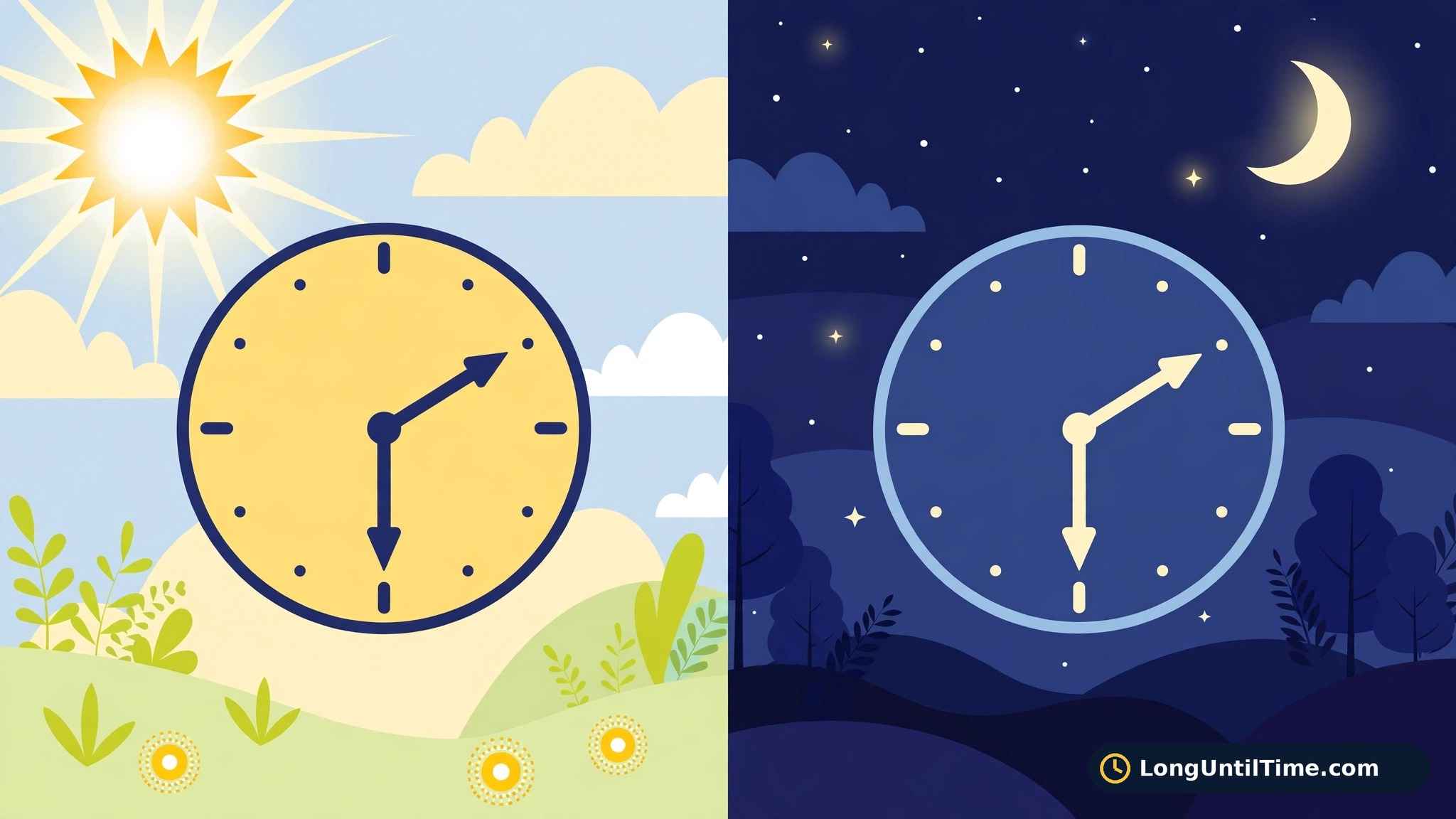
Most target times are only slightly ambiguous. This one is ambiguous by design: 1:30 happens twice a day, and the two versions sit exactly 12 hours apart. 1:30 AM is the middle of the night, 90 minutes after midnight, while 1:30 PM is early afternoon at 810 minutes after midnight; the difference is 720 minutes, a full half day. The labels AM and PM are the only thing separating the two on a 12-hour clock, and a bare “1:30” carries neither.
That is why a bare-1:30 counter quietly decides for you: it aims at the next occurrence, whichever comes first. At 10:00 AM, the next 1:30 is the afternoon one, 3 hours 30 minutes away. At 10:00 PM, the same question points at 1:30 AM instead — also 3 hours 30 minutes away. At 12:45 AM, a next-occurrence counter gives you 45 minutes — it is counting to the night reading — while the afternoon 1:30 PM you might have meant is 12 hours 45 minutes away. Same words, three different waits, and none of the counters is wrong — the question was simply under-specified.
This article fixes the afternoon reading because that is the one the searches behind “how long until 1:30” are overwhelmingly about: a class, an appointment, a pickup, or the end of a lunch break. The 24-hour clock settles the matter completely, because it gives each twin its own number — 01:30 and 13:30 — with no label left to drop. When the stakes matter, writing 13:30 removes the twin from the sentence entirely.
If You Actually Mean 1:30 AM
The method is identical; only the target number changes. Swap 810 for 90 and subtract the same way: before 1:30 AM, the remaining time is 90 minus your minutes since midnight; after it, the count rolls to tomorrow’s 1:30 AM — 1,440 minus your current minutes, plus 90. Worked once, at 11:20 PM: 1,440 − 1,400 = 40 minutes left in the day, and 40 + 90 = 130, so there are 2 hours 10 minutes until 1:30 AM. Any row of this article’s tables can be rebuilt for the night target with that single swap.
How to Calculate the Time Until 1:30 PM
Two methods cover every situation. For a quick estimate, count forward in chunks: whole hours first, then the leftover minutes. For an exact answer, convert both times into minutes since midnight and subtract. That subtraction is the whole secret: the time difference between now and 1:30 PM is all the question is really asking for. Here are four worked examples.
Example 1: An Ordinary Morning (9:15 AM)
Count forward in two chunks: 9:15 AM to 12:15 PM is 3 hours, and 12:15 PM to 1:30 PM is another 1 hour 15 minutes — 4 hours 15 minutes in total until 1:30 PM.
Example 2: Inside the Final Hour (12:52 PM)
Inside the last hour, minutes do all the work: from 12:52 PM, 8 minutes reach the top of the hour and 30 more reach 1:30 PM, so 38 minutes remain.
Example 3: After the Target, Rolling to Tomorrow (3:45 PM)
At 3:45 PM, today’s 1:30 PM passed more than two hours ago, so the target becomes tomorrow’s, and the count crosses midnight and a date change on the way. From 3:45 PM to midnight is 8 hours 15 minutes, and from midnight to 1:30 PM the next day is 13 hours 30 minutes. Together that makes 21 hours 45 minutes.
Example 4: The Minutes Method (10:47 AM)
This is exactly how an online time calculator does it, and it works for any current time. First convert the target: 1:30 PM is 13:30 in 24-hour time, and 13 × 60 + 30 = 810 minutes after midnight. Then convert the current time: 10:47 AM is 647 minutes. Subtract: 810 − 647 = 163 minutes, and 163 minutes is 2 hours with 43 minutes left over, so there are 2 hours 43 minutes until 1:30 PM.
The Final Stretch: Minutes and Seconds Before 1:30 PM
In the last few minutes, hours and whole minutes stop telling the whole story, and seconds take over. At 1:25 PM, exactly 5 minutes — 300 seconds — remain. At 1:29:30 PM, only 30 seconds are left, which is why countdown displays switch to a minutes-and-seconds readout near the end. If a class starts at 1:30 PM, treat those final 300 seconds as working time rather than a cushion; they are where “I have the whole lunch break” turns into “I am late back.”
Why Your Time Zone Can Move the Answer
1:30 PM is a local moment, not a worldwide one, because the world is divided into time zones. An online class set for 1:30 PM in Chicago takes place at 2:30 PM on a clock in New York, 12:30 PM in Denver, and 11:30 AM in Los Angeles. If an event lives in another zone, convert its start into your local time first and count down to that; counting toward the unconverted 1:30 is a quiet way to arrive an hour or two off.
Planning Around a 1:30 PM Target
A 1:30 PM target sits in the hinge between lunch and the real afternoon. It is when classes and meetings resume, when appointments booked “after lunch” actually begin, and when the post-lunch dip makes the first task back feel heavier than it is. Work backward from the target rather than forward from now: decide what “ready” looks like at 1:30 PM — back at your desk, in the classroom, through the appointment door — then subtract your travel or wrap-up time to find your real deadline, often 10 to 20 minutes earlier than the target itself.
Setting two timers, one for the target and one for that earlier real deadline, turns a drifting lunch break into two clear checkpoints. The same habit carries through the afternoon: our guide to how long until 1:50 pm covers the mark twenty minutes after this one, and working through it there will make the minutes method stick.
Frequently Asked Questions
How long until 1:30 PM from noon?
There are 90 minutes — 1 hour 30 minutes — from 12:00 PM until 1:30 PM. A noon start is tidy for this target: a standard lunch hour plus half an hour.
It is 2:15 PM now. How long until 1:30?
For this article’s target, there are 23 hours 15 minutes until the next 1:30 PM, because today’s has already passed. Notice the twin at work: a bare-1:30 counter at 2:15 PM would aim at 1:30 AM, only 11 hours 15 minutes away.
What is 1:30 PM in 24-hour time?
1:30 PM is 13:30 in 24-hour time. Its night twin, 1:30 AM, is written 01:30, so the two readings never share a number in this format.
How many minutes after midnight is 1:30 PM?
1:30 PM falls 810 minutes after midnight. That single number powers the minutes method: subtract your own minutes since midnight from 810 for the time remaining.
How long is it from 1:30 AM to 1:30 PM?
There are 12 hours between the two versions of 1:30. They sit half a day apart, which is why a missing label throws this countdown off by more than almost any other.
Why does the same question give two different answers?
Because 1:30 happens twice a day, once in the night and once in the afternoon, and counters silently aim at whichever occurrence comes next. The question is not wrong — it is unfinished until a label completes it.
Conclusion
Working out how long until 1:30 comes down to two habits: fix the target, then do the subtraction. Confirm you mean 13:30 — the 24-hour form of 1:30 PM, 810 minutes after midnight — then count forward in chunks for a quick estimate, or subtract your minutes since midnight from 810 for an exact answer. If the afternoon reading has already passed, aim at tomorrow’s instead; if it was the night reading you wanted, swap the target to 90 minutes and use the same subtraction untouched.
For anything that matters — a class starting, an appointment across town, a call after lunch — settle the label once, do the small calculation, set a timer, and let the clock-watching go. Readers who know this slot’s sleepy weight can browse the encyclopedia entry on the nap, the short rest the post-lunch dip keeps recommending and the 1:30 PM schedule keeps refusing.

One Comment