How Long Until 1:50 PM? The Ten to Two Mark Before the Two O’Clock Block
If you are asking how long until 1:50 pm, there is no single fixed answer, because the answer depends on your current time — but the calculation takes only seconds once you know the method. This article treats the target as 1:50 PM, the early-afternoon moment most people mean: ten minutes before two, when long lunches finally end and classes and meetings let out ahead of the 2:00 block. In your local time, the remaining time is simply the gap between now and 13:50, which is how the 24-hour clock writes 1:50 PM.
If 1:50 PM is still ahead of you today, you count forward to it. If it has already gone by, the count rolls to tomorrow’s 1:50 PM instead, which is why the answer can jump from ten minutes to nearly a full day in a single tick. Below you will find a quick reference table, the fix for the 1:50 AM mix-up, the ten-to-two spoken shortcut, four worked examples, and advice for planning around the let-out that happens just before two.
Quick Reference: Time Remaining Until 1:50 PM
If you only need the number, find your current time in the left column. This table covers times before 1:50 PM, when the target falls later today.
| Current Time | Time Remaining Until 1:50 PM | In Minutes |
|---|---|---|
| 12:00 AM | 13 hours 50 minutes | 830 minutes |
| 6:00 AM | 7 hours 50 minutes | 470 minutes |
| 8:00 AM | 5 hours 50 minutes | 350 minutes |
| 9:30 AM | 4 hours 20 minutes | 260 minutes |
| 11:00 AM | 2 hours 50 minutes | 170 minutes |
| 12:00 PM | 1 hour 50 minutes | 110 minutes |
| 12:30 PM | 1 hour 20 minutes | 80 minutes |
| 1:00 PM | 50 minutes | 50 minutes |
| 1:15 PM | 35 minutes | 35 minutes |
| 1:30 PM | 20 minutes | 20 minutes |
Every row follows the same pattern. 1:50 PM sits 830 minutes after midnight, so the remaining time is always 830 minus the minutes already passed since your day began. A countdown timer on your phone performs that same subtraction as the minutes tick away. The pattern also runs five minutes forward: our guide to how long until 1:55 pm picks the count up at the mark five minutes after this one, where the early afternoon settles into its next slot.
After 1:50 PM: Counting to Tomorrow’s 1:50 PM
Once the clock moves past 1:50 PM, today’s target is spent. Counters and reminders then aim at the next one, which falls exactly 24 hours after today’s, so the remaining time leaps back up:
| Current Time | Time Remaining Until the Next 1:50 PM | In Minutes |
|---|---|---|
| 2:00 PM | 23 hours 50 minutes | 1,430 minutes |
| 4:00 PM | 21 hours 50 minutes | 1,310 minutes |
| 7:00 PM | 18 hours 50 minutes | 1,130 minutes |
| 10:30 PM | 15 hours 20 minutes | 920 minutes |
That jump is not an error. It is the same target, one day later.
1:50 PM or 1:50 AM? The Ten-to-Two Trap
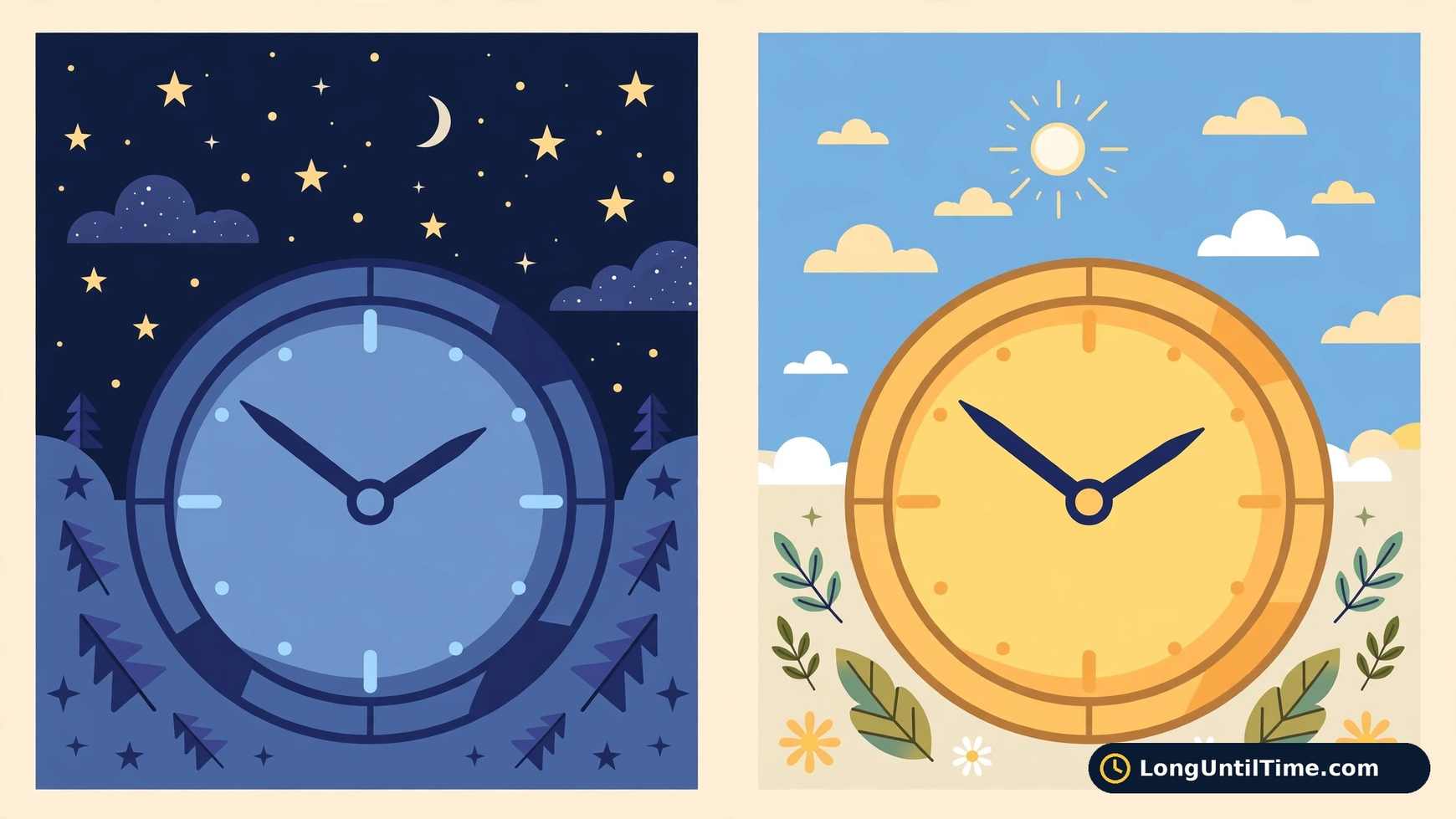
The clock shows 1:50 twice every day, and the two versions sit exactly 12 hours apart. 1:50 AM is a deep-sleep hour, 110 minutes after midnight, while 1:50 PM is early afternoon at 830 minutes after midnight; the difference between them is 720 minutes, a full half day. The labels AM and PM are the only thing separating the two on a 12-hour clock, and a missed label is the most common reason a countdown to this target feels wrong.
The 24-hour clock removes the trap by giving each version its own number: 1:50 AM becomes 01:50 and 1:50 PM becomes 13:50, with no label left to misread. The stakes are easy to picture. At 10:00 AM, the next 1:50 PM is 3 hours 50 minutes away, but if you silently counted toward 1:50 AM instead, you would land on tomorrow’s small hours, 15 hours 50 minutes away — and any alarm or reminder built on the wrong version fires half a day off.
The Ten-to-Two Shortcut — and the Ten-Past Slip
There is also a spoken way to hear this target. In everyday speech, 1:50 is ten to two: the minute hand stands ten minutes short of the 2. That framing is handy, but it carries its own trap — ten to two sounds dangerously close to ten past one, which is 1:10, a full forty minutes earlier. If someone tells you a class lets out at ten to two and you write down ten past one, you will be standing in the corridor forty minutes before anyone else arrives. When the phrase decides a pickup or a meeting, repeat the digits back — one-five-zero — before you set the timer.
How to Calculate the Time Until 1:50 PM
Two methods cover every situation. For a quick estimate, count forward in chunks: whole hours first, then the leftover minutes. For an exact answer, convert both times into minutes since midnight and subtract. That subtraction is the whole secret: the time difference between now and 1:50 PM is all the question is really asking for. Here are four worked examples, one for each situation you are likely to meet.
Example 1: An Ordinary Morning (9:25 AM)
Count forward in two chunks. From 9:25 AM to 12:25 PM is 3 hours, and from 12:25 PM to 1:50 PM is another 1 hour 25 minutes. Added together, that gives 4 hours 25 minutes until 1:50 PM.
Example 2: Inside the Final Hour (1:37 PM)
Once you are inside the last hour, minutes do all the work. Subtract the minutes directly: 50 − 37 = 13, so 13 minutes remain until 1:50 PM, with no hour boundary left to cross.
Example 3: After the Target, Rolling to Tomorrow (5:40 PM)
At 5:40 PM, today’s 1:50 PM passed nearly four hours ago, so the target becomes tomorrow’s, and the count crosses midnight and a date change on the way. From 5:40 PM to midnight is 6 hours 20 minutes, and from midnight to 1:50 PM the next day is 13 hours 50 minutes. Together that makes 20 hours 10 minutes until the next 1:50 PM.
Example 4: The Minutes Method (11:12 AM)
This is exactly how an online time calculator does it, and it works for any current time. First convert the target: 1:50 PM is 13:50 in 24-hour time, and 13 × 60 + 50 = 830 minutes after midnight. Then convert the current time: 11:12 AM is 11 × 60 + 12 = 672 minutes. Subtract: 830 − 672 = 158 minutes, and 158 minutes is 2 hours with 38 minutes left over, so there are 2 hours 38 minutes until 1:50 PM.
The Final Stretch: Minutes and Seconds Before 1:50 PM
In the last few minutes, hours and whole minutes stop telling the whole story, and seconds take over. At 1:45 PM, exactly 5 minutes — 300 seconds — remain. At 1:49:30 PM, only 30 seconds are left, which is why countdown displays switch to a minutes-and-seconds readout near the end. If a pickup or a let-out sits at 1:50 PM, treat those final 300 seconds as working time rather than a cushion; they vanish faster than they look on paper.
Why Your Time Zone Can Move the Answer
1:50 PM is a local moment, not a worldwide one, because the world is divided into time zones. A video call booked for 1:50 PM in Chicago takes place at 2:50 PM on a clock in New York, 12:50 PM in Denver, and 11:50 AM in Los Angeles. If an event lives in another zone, convert its start into your local time first and count down to the converted time; counting toward the unconverted 1:50 is a quiet way to arrive an hour or two off.
Planning Around a 1:50 PM Target
A 1:50 target is a hinge point in the early afternoon. It is when the long lunch finally winds down, when classes and meetings let out just before the hour, and when everything intended for the two o’clock block has to be ready to go. Work backward from the target rather than forward from now: decide what “ready” looks like at 1:50 PM — out of the cafeteria, back at your desk, or in the room where the next session starts — then subtract your travel or preparation time to find your real deadline, which is often 10 or 15 minutes earlier than the target itself.
Setting two timers, one for the target and one for that earlier real deadline, turns a vague early-afternoon drift into two clear checkpoints. The same backward habit works for the top of the hour itself: our guide to how long until 2 pm covers the block this target is setting up, and a second pass at it there will make the minutes method stick.
Frequently Asked Questions
How long until 1:50 PM from noon?
There are 1 hour 50 minutes from 12:00 PM until 1:50 PM. A noon start is tidy for this target, because the answer is the target itself read back as a duration.
How many minutes are left at 1:30 PM?
Exactly 20 minutes remain between 1:30 PM and 1:50 PM. Both times sit inside the same hour, so the count is one short fixed gap with nothing left to convert.
It is 2:15 PM now. How long until 1:50 PM?
There are 23 hours 35 minutes until the next 1:50 PM. Because today’s 1:50 PM has already passed, the count runs through tonight and into tomorrow afternoon.
What is 1:50 PM in 24-hour time?
1:50 PM is 13:50 in 24-hour time. Add 12 to the hour for any time after noon, and the AM/PM label disappears entirely.
How many minutes after midnight is 1:50 PM?
1:50 PM falls 830 minutes after midnight. That single number powers the minutes method: subtract your own minutes since midnight from 830 to get the time remaining.
How long until 1:50 PM from 9:00 AM?
There are 4 hours 50 minutes from 9:00 AM until 1:50 PM. Morning starts like this one produce the longest same-day counts most people will ever need for this target.
Is 1:50 PM the same as ten to two?
Yes, 1:50 PM is ten to two, falling ten minutes before 2:00 PM. The phrase counts up toward the next hour instead of down from the last, which is why it is so easily confused with ten past one.
Why does my countdown suddenly show almost a full day?
Because today’s 1:50 PM has already passed, so the countdown has rolled over to tomorrow’s 1:50 PM. The jump from a few minutes to nearly 24 hours happens the moment the clock moves past the target.
Conclusion
Working out how long until 1:50 pm comes down to one habit: compare your current time with 13:50, the 24-hour form of 1:50 PM. Count forward in chunks for a quick estimate, or subtract your minutes since midnight from 830 for an exact answer, and if the target has already passed, aim at tomorrow’s 1:50 PM instead. When the reference point in your head is the spoken clock, the ten-to-two shortcut — ten minutes before 2:00 PM — gets you the same answer by feel.
For anything that matters — a let-out, a lunch return, the start of the two o’clock block — do the small calculation once, set a timer, and let the clock-watching go. Anyone timing the school-day shuffle at this hour can browse the encyclopedia entry on recess for the history of the scheduled break that shapes so many school afternoons.