
How Long Until 3pm? Find the Exact Time Remaining Until 3:00 PM
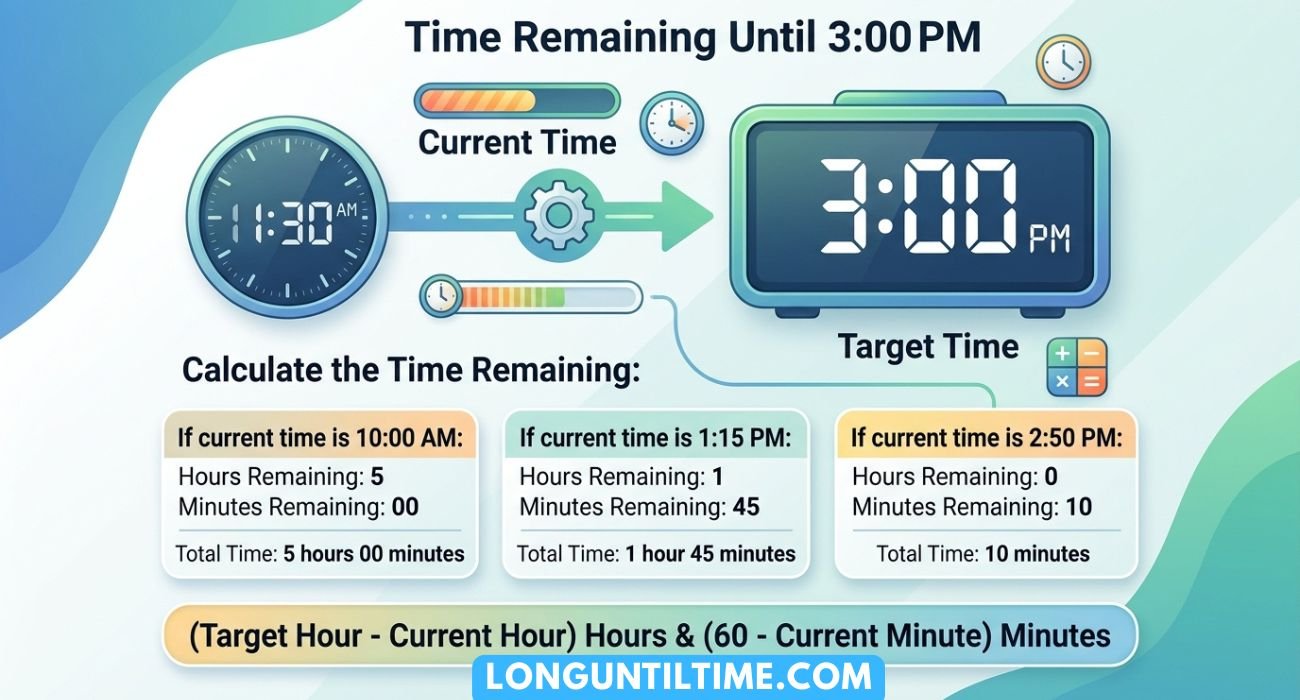
If you’re wondering how long until 3pm, the exact answer depends on your current local time. If it is 1:00 PM, there are 2 hours left. At 2:30 PM, there are 30 minutes left. At 2:59 PM, only 1 minute remains.
The calculation is simple: compare the current time with 3:00 PM, also written as 15:00 on a 24-hour clock. If 3 PM has already passed, the next 3 PM is tomorrow.
This guide explains how to calculate the time until 3 PM, convert the remaining time into hours, minutes, or seconds, understand time zones, use countdown timers, and make the afternoon milestone useful for planning your day.
Why Do So Many People Wonder: How Long Until 3:00 PM?
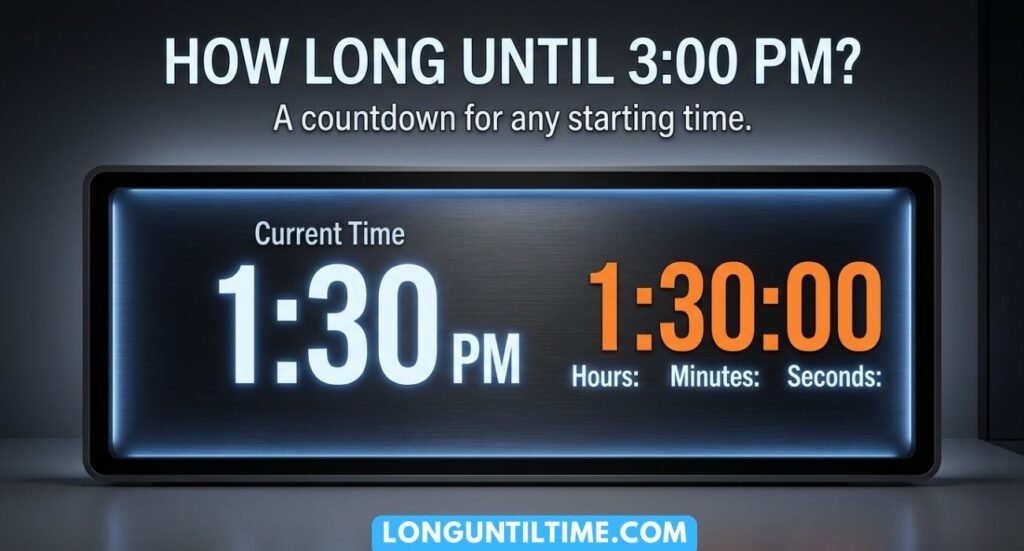
Three o’clock in the afternoon is a familiar milestone in many daily schedules. Someone may be waiting for a meeting, finishing a work task, preparing for an appointment, leaving for an event, or simply wondering how much of the afternoon remains.
The question “how long until 3 PM?” is slightly different from simply asking for the current time. A clock tells you where you are in the day, while a countdown to 3 PM tells you how much time remains before a specific point.
For example, imagine that the current time is 12:45 PM. Looking at the clock tells you it is 12:45. Calculating the difference tells you that you have 2 hours and 15 minutes until 3 PM.
The same idea applies when someone asks, “How long till 3?” or “How much longer until 3 PM?” These are all ways of asking for the same basic time difference.
Understanding the Countdown to 3 PM
A countdown to 3 PM measures the amount of time between the present moment and 3:00 PM.
There are three common ways to express that remaining time:
Hours: useful when several hours remain.
Minutes: useful when the target is relatively close.
Seconds: useful when precise timing matters.
For example, if the current time is 1:20 PM:
3:00 PM − 1:20 PM = 1 hour 40 minutes
That same duration is:
100 minutes
or:
6,000 seconds
The target itself does not change. What changes is the amount of time remaining as the clock moves forward.
It is also useful to distinguish 3 PM from 3 AM. 3 PM occurs in the afternoon, while 3 AM occurs during the early morning. On a 24-hour clock, 3 PM is represented as 15:00.
If the current time is before 3 PM, the calculation normally concerns today’s 3 PM. If the current time is already after 3 PM, you need to decide whether you mean the time since today’s 3 PM or the countdown to tomorrow’s 3 PM.
How Long Until 3:00 PM Today Depends on the Current Time
There is no single answer to how long until 3:00 PM today because the answer changes continuously.
Here are some simple examples:
| Current Time | Time Until 3:00 PM |
| 8:00 AM | 7 hours |
| 9:00 AM | 6 hours |
| 10:00 AM | 5 hours |
| 11:00 AM | 4 hours |
| 12:00 PM | 3 hours |
| 12:30 PM | 2 hours 30 minutes |
| 1:00 PM | 2 hours |
| 1:30 PM | 1 hour 30 minutes |
| 2:00 PM | 1 hour |
| 2:15 PM | 45 minutes |
| 2:30 PM | 30 minutes |
| 2:45 PM | 15 minutes |
| 2:59 PM | 1 minute |
| 3:00 PM | 0 minutes |
These values are examples rather than a live countdown. The exact answer depends on the time shown by your clock when you check it.
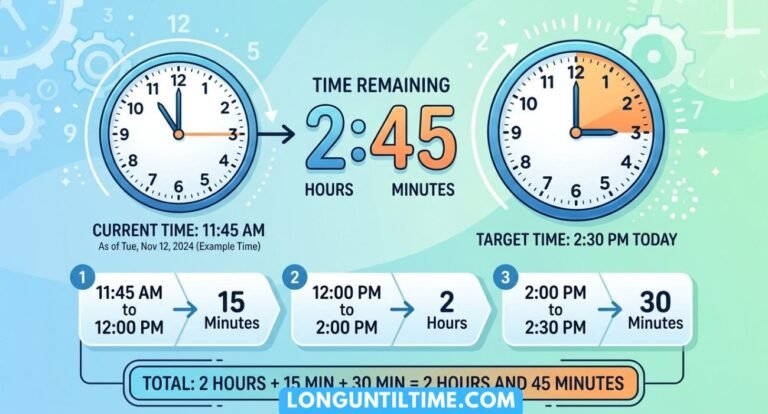
For instance, if it is 10:35 AM, you can count from 10:35 AM to 11:35 AM for one hour, then from 11:35 AM to 3:00 PM for another 3 hours and 25 minutes. That gives a total of 4 hours 25 minutes.
What If It Is Already After 3 PM?
If today’s 3 PM has already passed, asking how long until 3pm usually means the next occurrence of 3 PM.
For example:
| Current Time | Time Until Next 3 PM |
| 4:00 PM | 23 hours |
| 5:00 PM | 22 hours |
| 6:00 PM | 21 hours |
| 8:00 PM | 19 hours |
| 10:00 PM | 17 hours |
| 11:00 PM | 16 hours |
| 12:00 AM | 15 hours |
| 6:00 AM | 9 hours |
| 10:00 AM | 5 hours |
| 2:00 PM | 1 hour |
The key is the date change. Once 3 PM has passed, the next 3 PM is on the following calendar day.
The Mathematics Behind a Time Difference
Calculating the time until 3 PM becomes especially easy if you convert the current time into minutes after midnight.
There are 1,440 minutes in a day, and 3 PM occurs 900 minutes after midnight.
So, when the current time is before 3 PM:
Minutes until 3 PM = 900 − current minutes after midnight
Suppose it is 11:30 AM.
11:30 AM is:
11 × 60 + 30 = 690 minutes after midnight.
Therefore:
900 − 690 = 210 minutes.
And:
210 minutes = 3 hours 30 minutes.
So there are 3 hours and 30 minutes until 3 PM.
Another example is 2:40 PM.
2:40 PM is 14 hours and 40 minutes after midnight:
14 × 60 + 40 = 880 minutes.
Then:
900 − 880 = 20 minutes.
Therefore, there are 20 minutes until 3 PM.
The basic time relationships are straightforward:
1 hour = 60 minutes
1 minute = 60 seconds
1 hour = 3,600 seconds
This method is particularly useful for a time calculator, a digital countdown, or a program that needs to determine the exact difference between two timestamps.
Popular Countdown Times Around 3 PM
People don’t always need to know only the exact moment of 3 PM. They may also use nearby times as planning checkpoints.
For example, 2 PM marks one hour before 3 PM. At 2:30 PM, only half an hour remains. At 2:45 PM, there are just 15 minutes left.
These smaller milestones can make a long afternoon easier to understand. Instead of thinking, “I still have several hours,” someone can divide the afternoon into smaller periods and focus on what needs to happen before each checkpoint.
A 3 PM countdown can therefore be useful even when the actual event is not exactly at 3 PM. The target provides a fixed point against which the rest of the afternoon can be measured.
Best Tools for Tracking the Time Until 3 PM
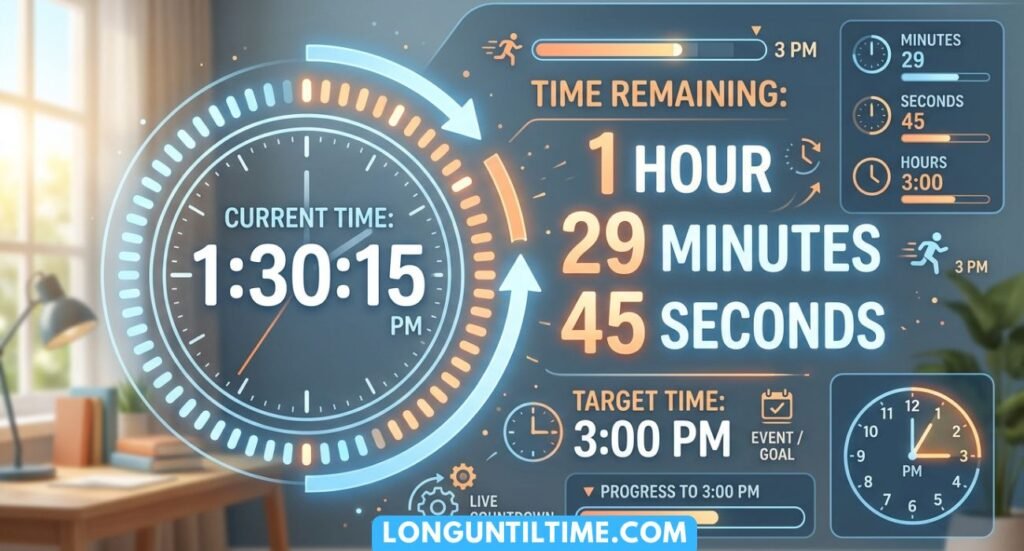
The simplest way to track the remaining time is to use a clock and calculate the difference yourself. However, a countdown timer is more convenient when you want the remaining time to update automatically.
A web-based timer can display hours, minutes, and seconds and update as the target approaches. Smartphone clock applications can provide similar functionality, while calendar applications are useful when 3 PM represents a future appointment or event.
For important schedules, a calendar reminder can be more useful than a countdown alone. A countdown tells you how much time remains, while a reminder can notify you before the event begins.
The most useful tool depends on what you are trying to accomplish. If you are simply curious about the remaining time, a live countdown is convenient. If you have an appointment at 3 PM, a calendar alert may be better because you can also account for preparation and travel time.
How Long Until 3 PM and Productivity
A fixed afternoon time can become a useful productivity checkpoint.
Suppose you have three hours until 3 PM. Rather than treating those three hours as one large block, you could divide them into focused work periods. You might spend the first hour on an important task, the next hour on a second task, and the final hour reviewing unfinished work.
The countdown gives you a clear endpoint.
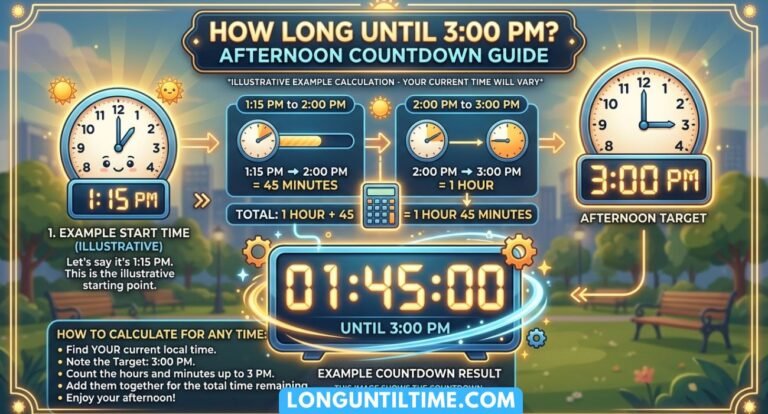
For example, if it is 1:15 PM and you need to finish something by 3 PM, you have 1 hour 45 minutes available. That does not necessarily mean you should work for the entire 105 minutes. You may need some of that time for checking your work, saving files, sending an email, or preparing for what comes next.
This is where a productivity timer can be helpful. Instead of repeatedly checking the clock, you can assign a specific task to a defined period.
A 3 PM deadline can also help with prioritization. When there is limited time remaining, focus on the work that must be completed rather than starting several new tasks that cannot realistically be finished.
Scheduling Around 3:00 PM
When an event starts at 3 PM, the important question may not be how long until 3 PM. It may be how much preparation time do I need before 3 PM?
Imagine an appointment begins at 3:00 PM and takes 25 minutes to reach. You may also need 10 minutes to get ready. Instead of treating 3 PM as the point when preparation begins, you should work backward from the scheduled start time.
If you need 10 minutes to prepare and 25 minutes to travel, you need at least 35 minutes before leaving for the appointment. Adding a reasonable buffer gives you additional protection against unexpected delays.
This same principle works for meetings, school activities, interviews, errands, online events, and work deadlines.
Planning an Appointment at 3 PM
For a 3 PM appointment, identify the actual start time first. Then work backward to account for preparation, travel, and any buffer you need.
For an online meeting, travel may not be relevant, but checking your connection, opening the meeting application, and getting your materials ready may still take time.
For an in-person appointment, traffic or transportation delays can make the difference between arriving comfortably and arriving late.
The countdown to 3 PM is therefore most useful when it is combined with the time required to prepare for the event.
Planning Work Before a 3 PM Deadline
A deadline at 3 PM should be treated as a finish point, not necessarily the moment when you stop working and begin checking everything.
If you have 90 minutes remaining, you might reserve the final 10 or 15 minutes for reviewing the result. That leaves less working time, but it gives you an opportunity to catch mistakes before the deadline.
The closer the deadline becomes, the more valuable clear prioritization becomes.
Cultural Rituals of Afternoon Time
Three o’clock occupies an interesting place in the daily rhythm of the afternoon. It can fall around the time people take an afternoon break, have a snack or coffee, finish a school period, attend a meeting, or begin thinking about the end of the workday.
These routines are not universal. Workplaces, schools, families, and individuals follow different schedules. Still, familiar time markers such as noon, 3 PM, and 5 PM can make a day easier to organize mentally.
For someone watching the clock during a long afternoon, 3 PM may represent a meaningful checkpoint rather than simply another number on a clock.
That is one reason searches such as how long until 3 PM can be useful even when the calculation itself is simple.
Waiting Is More Emotional Than Mathematical
The mathematical answer to a countdown is objective, but the experience of waiting is not always the same.
Thirty minutes can feel short when you are absorbed in a task. The same thirty minutes can feel much longer when you are waiting for an appointment, an important message, or the end of a work period.
Constantly checking a clock can also make your attention stay focused on the passage of time. A better approach during an ordinary wait is often to give yourself a small task or activity rather than watching every minute disappear.
The actual time difference does not change because you are busy or bored. What changes is your perception of the interval.
That distinction matters when using a countdown. A timer can tell you exactly how much time remains, but it cannot determine how quickly that period will feel.
How Digital Countdown Systems Work
A digital countdown is essentially a comparison between two points in time: the current moment and a target moment.
The system first determines the current timestamp. It then determines the timestamp for 3 PM and subtracts the current value from the target value.
The remaining duration is then divided into familiar units.
For example, if the calculation produces 5,250 seconds:
5,250 ÷ 3,600 = 1 hour with some seconds remaining.
The remaining seconds can then be converted into minutes and seconds, producing:
1 hour 27 minutes 30 seconds
The display can refresh periodically so that the number continues to decrease.
A reliable countdown also needs to handle the user’s local time, date, and time zone correctly. If the target is 3 PM in one location and the user is somewhere else, the two clocks may not show the same local time.
Why Countdown Timers Update Every Second
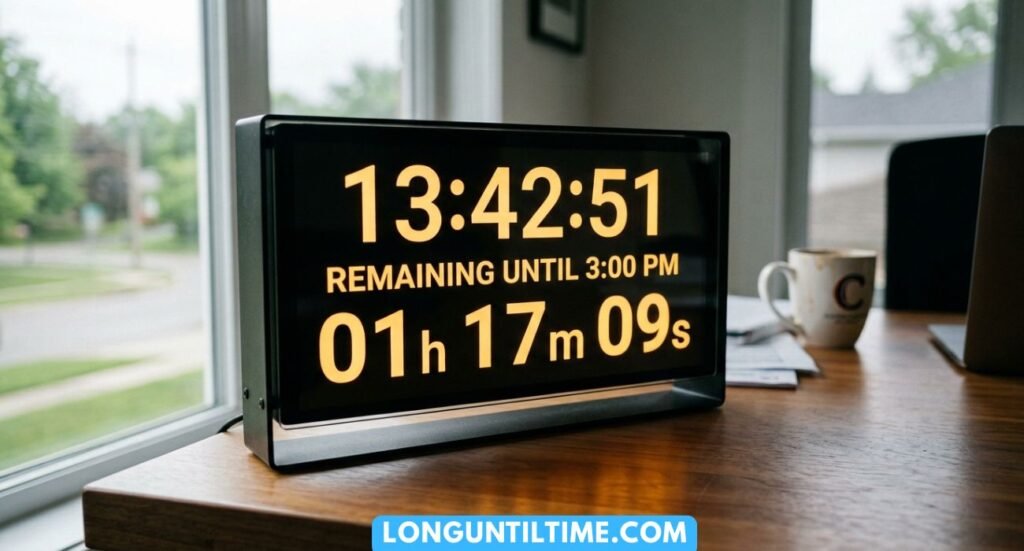
Most ordinary countdown displays update once per second because seconds are precise enough for everyday use while remaining easy to read.
The underlying computer can work with more precise timestamps, but the visible timer may simply show whole seconds.
This also explains why a timer can sometimes appear to remain on a number for a moment before changing. The display is a human-friendly representation of continuously changing time.
What Happens When the Countdown Reaches Zero?
When the countdown reaches 3:00 PM, the remaining duration becomes zero.
Depending on the tool, the timer may stop, display that the target time has arrived, trigger an alert, or begin counting toward another target.
For a recurring daily 3 PM countdown, the system can simply establish the next day’s 3 PM as the new target after today’s target has passed.
Everyday Situations Where a 3 PM Countdown Helps
A countdown to 3 PM can be useful in many ordinary situations. Someone might use it to track the time before a work deadline, prepare for an appointment, organize study time, plan an afternoon activity, or determine when to leave for an event.
It can also help when several activities need to fit into the same afternoon. If you know that you have two hours until 3 PM, you can estimate which tasks are realistic within that window.
For example, if you need to complete three tasks before 3 PM and each takes approximately 30 minutes, you have 90 minutes of estimated work. If you currently have only 60 minutes left, the countdown immediately reveals that something needs to be shortened, postponed, or reprioritized.
This makes a simple online timer more than a clock. It can become a small planning tool.
How Time Until 3 PM Fits Into Your Afternoon Routine
Knowing how long until 3 PM can help you divide your afternoon into smaller, more manageable periods. Instead of looking at the entire day as one long stretch, you can use 3 PM as a clear checkpoint for work, study, errands, or personal tasks. For example, if you have two hours remaining, you can decide which tasks realistically fit into that window.
This approach is especially useful when several things need your attention before the afternoon milestone. A simple time countdown can remind you when it is time to move from one task to another without constantly checking the clock. The goal is not to fill every remaining minute, but to understand how much usable time you actually have.
What to Do When You Have Less Than an Hour Until 3 PM
When there are only 30, 20, or 10 minutes until 3 PM, the best approach is usually to choose a task that matches the amount of time available. Starting something that requires an hour when only 20 minutes remain can create unnecessary pressure. Instead, use the remaining time for a smaller task, quick review, preparation, or a short break.
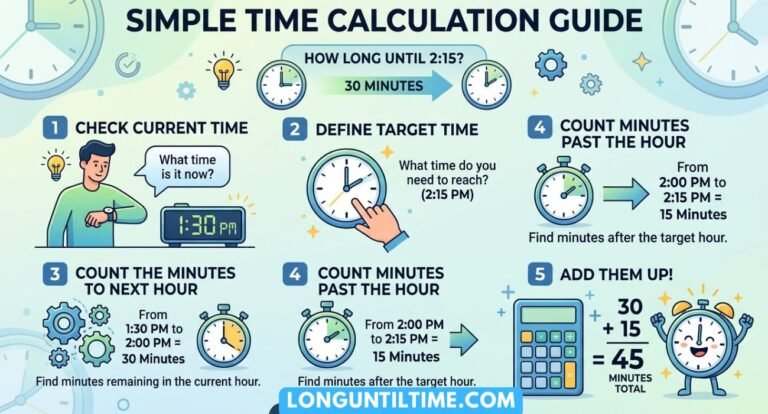
For example, if it is 2:30 PM, you have 30 minutes until 3 PM. At 2:45 PM, you have only 15 minutes. Thinking in these smaller intervals makes the countdown easier to use because you can match your plans to the actual amount of time left.
How to Stay Accurate When Counting Down to 3 PM
A manual calculation is usually enough when you only need an approximate answer, but a digital countdown timer is more convenient when you need the remaining time to update automatically. The timer should use your current local time and the correct date so that the target of 3 PM is interpreted correctly.
This becomes particularly important when dealing with different time zones, daylight-saving changes, or an event involving people in different locations. For a simple personal countdown, your device’s clock is usually the easiest reference. For an important scheduled event, however, it is worth confirming the time zone and date before relying on the countdown.
Frequently Asked Questions
How long is 7 AM to 3 PM?
7 AM to 3 PM is 8 hours. That equals 480 minutes or 28,800 seconds.
How long is it until 3 PM?
It depends on the current time. For example, if it is 1 PM, there are 2 hours until 3 PM.
How many minutes is 3 PM?
3 PM is 900 minutes after midnight. On a 24-hour clock, 3 PM is written as 15:00.
How long until 3 AM?
It depends on the current time. If it is 10 PM, there are 5 hours until 3 AM the next day.
Conclusion
Knowing How Long Until 3pm helps you plan your afternoon with ease. The exact time depends on your current local time. Before 3 PM, you can find the remaining time by comparing the current clock time with 3:00 PM. You can express the result in hours, minutes, or seconds. A countdown timer can also show the time left in real time.
3 PM can serve as a useful point for work, study, meetings, appointments, and daily tasks. Remember that time keeps moving, so the countdown changes every second. If 3 PM has already passed, the next 3 PM comes the following day. Use the correct time zone and local clock for accurate results.
2 Comments