
How Long Until 2:30 PM? Countdown Timer & Exact Time Remaining
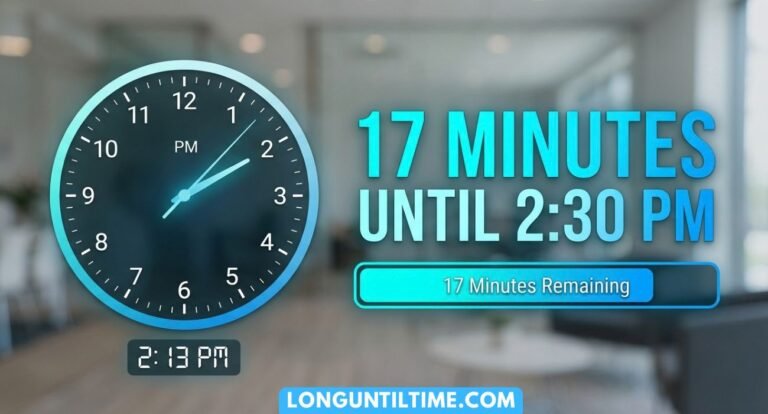
How long until 2:30 PM? The answer depends on your current local time. If it is 2:00 PM, you have 30 minutes left. If it is 1:30 PM, you have one hour. If it is already past 2:30 PM, the target time has passed for today.
To calculate the time remaining, subtract your current time from 2:30 PM. You can do this manually, check a digital clock, or use an online countdown timer that displays the remaining hours, minutes, and seconds.
Knowing how much time remains until 2:30 PM can help you prepare for an afternoon meeting, finish a school assignment, plan a work break, or arrive on time for an appointment. This guide explains how to calculate the exact time difference, use countdown tools, manage your schedule, and handle situations when 2:30 PM has already passed.
How Long Until 2:30 PM? Understanding the Basics
The phrase “How Long Until 2:30 PM?” asks how much time remains between the current moment and 2:30 in the afternoon. The answer changes continuously because every passing second brings you closer to the target time.
For example, at 12:30 PM, you have two hours remaining. At 1:30 PM, you have one hour left. At 2:15 PM, only 15 minutes remain. These calculations assume that all times refer to the same local time zone and the same afternoon.
The 12-hour clock divides the day into two periods: AM and PM. The time 2:30 AM occurs during the early morning, while 2:30 PM occurs during the afternoon. This difference matters because confusing AM and PM can lead to incorrect calculations or missed appointments.
A countdown timer measures the duration between the current time and a future target. Depending on the tool, it may display the remaining time as hours and minutes, total minutes, or a running display of hours, minutes, and seconds.
What Does “How Long Until 2:30 PM” Mean?
It means finding the amount of time between now and 2:30 PM. You need two pieces of information: the current local time and the target time.
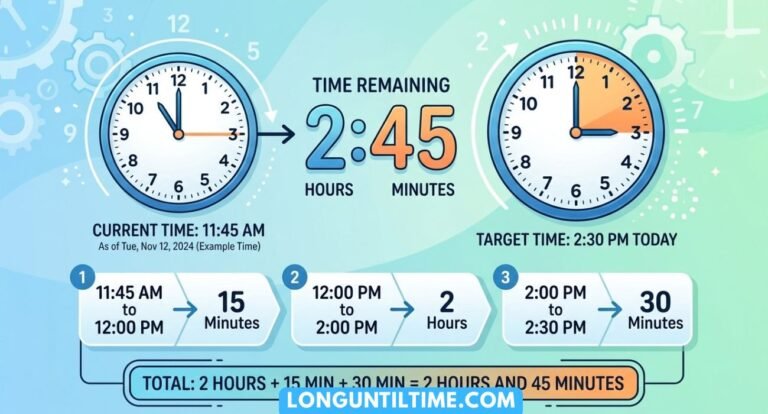
Suppose your clock shows 11:45 AM. The time from 11:45 AM to 12:00 PM is 15 minutes. From noon to 2:30 PM is another two hours and 30 minutes. Adding these periods gives you 2 hours and 45 minutes until 2:30 PM.
The same method works for any current time before the target. You simply calculate the difference between the two times.
Is 2:30 PM in the Afternoon or at Night?
2:30 PM is an afternoon time. It uses the PM designation in the 12-hour clock system.
The equivalent time in the 24-hour clock is 14:30. This format is commonly used in transportation schedules, workplaces, digital systems, and international settings.
Here is a quick comparison:
| Time format | Representation |
|---|---|
| 12-hour clock | 2:30 PM |
| 24-hour clock | 14:30 |
| Minutes after noon | 150 minutes |
| Seconds after noon | 9,000 seconds |
Understanding these formats helps you read schedules correctly and avoid confusing afternoon appointments with early-morning events.
Why Does the Time Remaining Change Every Minute?
The remaining time decreases as the clock moves forward. If you have 20 minutes left at 2:10 PM, you will have 19 minutes left at 2:11 PM.
A live countdown updates this difference automatically. A manual calculation, however, gives you the answer only for the moment when you perform it. If you need an exact, continuously changing result, use a countdown tool that updates against a reliable clock.
How Long Until 2:30 PM Using Manual Time Calculation
You do not need a special app to calculate how long until 2:30 PM. A normal clock and simple subtraction are enough.
The basic formula is:
Remaining time = Target time − Current time
For this calculation, the target time is 2:30 PM. First, check your local clock. Then determine how many hours and minutes separate the current time from the target.
For example, if it is 1:00 PM, you have one hour and 30 minutes remaining. If it is 2:00 PM, you have 30 minutes remaining. If it is 2:20 PM, you have only 10 minutes left.
The Simple Formula for Calculating Time Until 2:30 PM
One easy method is to convert both times into minutes after midnight.
2:30 PM equals 14 hours and 30 minutes after midnight.
In minutes, that becomes:
14 × 60 + 30 = 870 minutes.
Suppose the current time is 1:15 PM. That equals 13 × 60 + 15, or 795 minutes after midnight.
Subtract the current time from the target:
870 − 795 = 75 minutes.
Therefore, at 1:15 PM, 75 minutes, or 1 hour and 15 minutes, remain until 2:30 PM.
This method is especially useful when the current time includes unusual minute values or when you want to check your answer mathematically.
How to Calculate Minutes Until 2:30 PM
When the current time falls within the same hour as the target, the calculation is straightforward.
For example, at 2:05 PM, subtract five minutes from the target’s 30-minute mark:
30 − 5 = 25 minutes.
At 2:18 PM, the difference is 12 minutes. At 2:29 PM, the difference is just one minute.
If the current time falls in an earlier hour, calculate the minutes to the next hour first, then add the minutes from that hour to 2:30 PM.
For instance, at 1:40 PM, 20 minutes remain until 2:00 PM. Another 30 minutes separate 2:00 PM and 2:30 PM. The total is 50 minutes.
How to Calculate Hours and Minutes Until 2:30 PM
When more than an hour remains, separate the calculation into manageable parts.
Suppose it is 11:50 AM. There are 10 minutes until noon, followed by two hours and 30 minutes until 2:30 PM. The total is two hours and 40 minutes.
The following table provides more examples.
| Current time | Time remaining until 2:30 PM |
|---|---|
| 9:30 AM | 5 hours |
| 10:00 AM | 4 hours 30 minutes |
| 11:45 AM | 2 hours 45 minutes |
| 12:00 PM | 2 hours 30 minutes |
| 12:45 PM | 1 hour 45 minutes |
| 1:00 PM | 1 hour 30 minutes |
| 1:30 PM | 1 hour |
| 2:00 PM | 30 minutes |
| 2:15 PM | 15 minutes |
| 2:25 PM | 5 minutes |
| 2:29 PM | 1 minute |
These values assume the current time is on the same day and before 2:30 PM.
What If It Is Already Past 2:30 PM?
If the current time is later than 2:30 PM, there is no time remaining until that day’s target. The target has already passed.
For example, if it is 3:00 PM, 30 minutes have passed since 2:30 PM. If it is 4:00 PM, the target passed 90 minutes earlier.
If you mean the next occurrence of 2:30 PM, you must calculate the time until tomorrow’s target. At 3:00 PM, that means waiting 23 hours and 30 minutes.
This distinction is important when setting reminders, planning recurring activities, or using a countdown timer that automatically moves to the next day.
Why People Search “How Long Until 2:30 PM”
People search for the time remaining until 2:30 PM for many practical reasons. A specific time can mark the beginning of a meeting, the end of a class, a scheduled break, or an appointment that requires preparation.
A quick calculation helps people decide what they can realistically accomplish before the target arrives. Instead of repeatedly checking the clock, they can plan their remaining time and focus on the next task.
Work Meetings and Afternoon Appointments
Many workplaces schedule meetings and calls during the afternoon. Knowing how long until 2:30 PM helps employees decide when to review documents, finish a report, or prepare questions for a discussion.
For example, someone with a meeting at 2:30 PM who checks the clock at 1:45 PM has 45 minutes available. They might spend 25 minutes reviewing their notes and reserve the final 20 minutes for preparation or unexpected tasks.
The same calculation applies to doctor’s appointments, service visits, interviews, and scheduled phone calls. A countdown provides a clear deadline for preparation.
School, Study, and Daily Schedules
Students may need to know how long until a class begins, a study session ends, or an extracurricular activity starts. Teachers and school staff can also use the target time to organize lessons and transitions.
If a student has a study period ending at 2:30 PM and the current time is 1:50 PM, the student has 40 minutes left. That information makes it easier to choose an assignment that fits the available time.
A simple time calculator can also help students understand elapsed time, practice subtraction, and convert hours into minutes.
Personal Plans and Everyday Reminders
People also use afternoon countdowns to organize errands, transportation, deliveries, and personal activities. Someone waiting for a pickup scheduled for 2:30 PM may use the remaining time to finish another task or get ready to leave.
A countdown can be useful when several activities depend on one another. If an appointment begins at 2:30 PM and travel takes 20 minutes, leaving at 2:00 PM provides a 10-minute buffer before the appointment, assuming the journey takes the expected time.
The key is to use the countdown as a planning aid rather than treating it as a guarantee that everything will happen on schedule.
Best Tools to Check the Time Until 2:30 PM
Several tools can help you check the time remaining until 2:30 PM. The best option depends on whether you need a quick estimate, a live display, or a reminder that alerts you when the target arrives.
An online countdown timer is useful when you want to see the remaining duration on a computer or phone. A built-in clock app is often more convenient when you want an alarm or notification. A time calculator works well when you need to compare two times without running a live countdown.
Online Countdown Timers
An online countdown timer measures the interval between the current time and a chosen target. Some tools display the result in hours, minutes, and seconds, while others offer alarms, full-screen displays, or custom countdowns.
For a reliable result, choose the correct date and time zone if the tool asks for them. Check whether the timer uses your device’s clock or a server-based time reference, particularly when precision matters.
If the tool does not automatically identify your local time, enter the target correctly. A timer set to 2:30 AM instead of 2:30 PM will produce a completely different result.
Smartphone Clock Apps and Digital Clocks
Most smartphones provide a clock app with alarms and timers. You can set an alarm for 2:30 PM to receive an alert when the time arrives.
A standard countdown timer may require you to enter a duration rather than a clock time. For example, if it is 2:00 PM, setting a 30-minute timer will take you to 2:30 PM. If you set the same duration at 1:45 PM, however, it will end at 2:15 PM.
This difference matters because a countdown timer measures a duration, while an alarm is usually tied to a specific clock time.
Calendar and Reminder Applications
Calendar apps are useful when 2:30 PM represents a meeting or appointment. You can create an event, set a reminder, and receive a notification before the event begins.
A calendar is generally better than a standalone timer for events that occur on a future date or repeat regularly. A countdown can show the remaining duration, while a calendar helps you manage the event itself.
For important appointments, use both if helpful: a calendar reminder for notification and a countdown for tracking the remaining time.
How Long Until 2:30 PM and Better Time Management
Knowing how much time remains until 2:30 PM can help you make better decisions about your schedule. A clear deadline encourages you to divide available time into realistic tasks instead of trying to do everything at once.
For example, if it is 1:30 PM, you have one hour before 2:30 PM. You could spend 35 minutes completing a report, 10 minutes checking your work, and 15 minutes preparing for your next activity. The plan fits within the available hour, provided you do not need extra time for interruptions.
A countdown is most useful when you connect it to a specific task. Simply watching seconds disappear does not improve productivity on its own. The benefit comes from deciding what to do before the target arrives.
Divide the Remaining Time Into Smaller Tasks
Suppose you have 45 minutes left before a 2:30 PM appointment. Instead of treating the entire period as one block, assign time to separate activities.
You might spend 20 minutes finishing a document, 10 minutes reviewing the appointment details, and 15 minutes getting ready or preparing to leave. This approach makes the available time easier to manage.
Always leave some flexibility when a task could take longer than expected. A plan that uses every available minute may fail if a phone call, technical issue, or other interruption occurs.
Use a Countdown to Stay Focused
A countdown can serve as a visible reminder to stay on task. If you have 25 minutes before 2:30 PM, you can focus on one manageable activity until the time runs out.
This is similar to a productivity timer, in which a person works for a fixed period before taking a break or switching tasks. The target time provides a natural stopping point.
However, choose a duration that suits the task. Complex work may require more time, while a short administrative task may fit comfortably into a 10-minute window.
Avoid Planning More Than the Time Allows
A countdown shows how much time is available, but it cannot determine how much work you can complete. The time required depends on the task, your experience, and possible interruptions.
If it is 2:00 PM, you have 30 minutes until 2:30 PM. That may be enough to answer emails or review a short document, but it may not be enough to complete a large project.
Estimate the work before starting. If the task is too large, divide it into smaller steps and choose the portion you can finish before the deadline.
How Long Until 2:30 PM in Your Daily Routine
The target time can fit into many everyday schedules. For some people, 2:30 PM marks the end of a work block. For others, it is the start of an appointment, a class, a pickup, or a planned break.
Using a fixed time as a reference helps you connect your current activity with what comes next. You can estimate when to stop working, when to prepare, and whether you have enough time for a short task.
Consider someone who finishes lunch at 1:00 PM and has an appointment at 2:30 PM. They have 90 minutes between the two times. If they need 20 minutes to travel, they should account for that journey before deciding how much other work to complete.
The same idea applies to household tasks. If you want to finish cleaning before 2:30 PM and the current time is 1:45 PM, you have 45 minutes. You can prioritize the most important rooms instead of attempting every task.
Planning Around Afternoon Deadlines
A deadline at 2:30 PM gives you a clear point at which to finish or pause an activity. Work backward from the target to determine when each step should begin.
For example, if a presentation needs 30 minutes of preparation and you want five minutes to check the equipment, start at least 35 minutes before the presentation. If the presentation begins at 2:30 PM, preparation should begin by 1:55 PM.
Add extra time when the task depends on travel, other people, or technology. A countdown helps you track time, but a realistic schedule also accounts for uncertainty.
Using 2:30 PM as a Daily Checkpoint
You can use 2:30 PM as a checkpoint to review what you have completed and decide what needs attention next.
At that time, ask yourself whether the current task is finished, whether a deadline has changed, and what should happen during the rest of the afternoon. This habit can help you adjust your plan before small delays become larger problems.
The checkpoint does not need to be a formal meeting or a long review. A brief look at your schedule may be enough to identify the next priority.
The Psychology of Waiting
Waiting for a specific time can feel different depending on what you are doing. When you are engaged in an enjoyable activity, the time may seem to pass quickly. When you are anxious about an appointment or eager for an event to begin, each minute may feel longer.
A countdown makes the remaining time visible. This can reduce uncertainty because you know how long you have to wait, although it may also draw your attention to the passing seconds.
For example, someone waiting for a job interview at 2:30 PM may repeatedly check the clock. If the current time is 2:10 PM, they know they have 20 minutes left. Using that time to review their notes or take a few calm breaths may feel more useful than checking the clock every few seconds.
Why Waiting Can Feel Longer Than It Is
The experience of waiting is not always the same as the measured duration. A short wait can feel frustrating when you have nothing to do, while a longer period may feel brief when you are focused on an interesting task.
This is why having a simple activity can help. You might organize your notes, read a short article, prepare your workspace, or listen to something appropriate for the situation.
The goal is not to make the clock move faster. It is to use the waiting period in a way that feels worthwhile.
How a Visible Countdown Can Help
A countdown provides a clear endpoint. Instead of wondering how long remains, you can see the difference between the current time and 2:30 PM.
This can be useful when waiting for a scheduled event or completing a task with a firm deadline. However, if watching the timer makes you more distracted, check it only occasionally and focus on the activity in front of you.
Productivity Tips While Waiting Until 2:30 PM
The best way to use the time before 2:30 PM depends on how much time remains and what you need to accomplish. A 10-minute window calls for a different plan than a two-hour window.
If you have plenty of time, you can work on a larger task. If the target is close, choose something short that you can finish without rushing.
For example, at 1:00 PM, you have 90 minutes until 2:30 PM. You could complete a focused work session, take a short break, and prepare for your next commitment. At 2:20 PM, however, you have only 10 minutes, so checking your schedule or gathering the materials you need may be more realistic.
Choose Tasks That Fit the Available Time
Estimate the time required before you begin. A task that usually takes 15 minutes is a reasonable choice when you have 20 minutes remaining, provided you leave a little room for unexpected delays.
If you have only five minutes, avoid starting a complicated task that may be difficult to stop. Instead, complete a small action, such as organizing files, reviewing a short list, or preparing for the next activity.
Matching the task to the available time helps reduce unnecessary pressure.
Use Short Focus Sessions
You can set a short work period and use the target time as your final deadline. For instance, if it is 2:00 PM, you might work for 20 minutes and reserve the remaining 10 minutes for review or preparation.
This approach is helpful when you need to finish a small task before a meeting or appointment. Make sure the work period ends early enough to allow you to switch activities.
Prepare for the Next Activity
The final few minutes before 2:30 PM are often better suited to preparation than to beginning something new. You can check meeting links, gather documents, confirm an address, or make sure you have everything needed for an appointment.
Preparation is especially helpful when the next activity requires travel or a change of location. If you need to leave by 2:30 PM, do not treat that time as the appointment’s start time unless the schedule specifically allows it.
Countdown Tools That Make Life Easier
Countdown tools simplify time tracking by calculating the difference between the current time and a target automatically. They are particularly useful when you want to monitor a deadline without repeatedly doing mental arithmetic.
An online countdown clock may show the remaining duration in hours, minutes, and seconds. Some tools also let you choose a date, set a title, or display the countdown in full-screen mode.
The most important factor is correct setup. Enter 2:30 PM rather than 2:30 AM, confirm the date, and use the intended time zone. If the countdown is for an event tomorrow, selecting today’s date will produce the wrong result.
Countdown Timer vs. Stopwatch
A countdown timer moves toward a set endpoint. A stopwatch measures how much time has elapsed since you started it.
If you want to know how long until 2:30 PM, a countdown timer is usually the better choice. If you want to measure how long a meeting or task lasts, a stopwatch is more suitable.
Some apps offer both functions, so you can use the same application for different time-tracking needs.
Choosing a Reliable Countdown Tool
A useful countdown tool should display the target time clearly, handle AM and PM correctly, and update the remaining duration without requiring repeated manual calculations.
For scheduled events, look for options to select a date and time zone. For reminders, choose a tool that supports alerts or notifications if that feature is available.
Remember that the countdown’s accuracy depends on its clock source, settings, and connection to the intended target. If the event is important, verify the scheduled time against the original calendar invitation or appointment details. The same approach also works for a nearby target, such as time until 2:40 pm.
Manual vs. Automatic Time Calculators
Manual calculations and automatic time calculators both help you determine how long until 2:30 PM. The main difference is how the result is produced and how often it updates.
Manual calculations are useful when you need a quick answer or want to understand the arithmetic. Automatic tools are more convenient when you need a running countdown or want to compare times across dates.
| Feature | Manual calculation | Automatic calculator |
|---|---|---|
| Setup | Check the current time and subtract | Enter or select the target time |
| Speed | Quick for simple differences | Usually quick after setup |
| Live updates | No | Often available with countdown tools |
| Complex calculations | Requires careful arithmetic | Can handle many date and time inputs |
| Risk of error | Possible subtraction or AM/PM mistakes | Possible incorrect settings or clock issues |
| Best use | Simple estimates and learning | Repeated checks and live countdowns |
When Manual Calculation Is Better
Manual calculation is practical when the target is later on the same afternoon and you need only a simple estimate. If it is 2:10 PM, you can immediately see that 20 minutes remain.
It also helps you understand how time conversion works. You can learn to convert hours into minutes, subtract the current time, and handle a calculation that crosses the hour.
When an Automatic Calculator Is Better
An automatic calculator is helpful when you want the remaining time displayed continuously or when the target occurs on a future date. It can also reduce arithmetic mistakes when a calculation involves several hours, midnight, or different time zones.
However, an automatic tool is only as reliable as its inputs. Selecting the wrong date, choosing the wrong AM/PM period, or using an incorrect time zone can still produce a misleading result.
Real-Life Examples
The easiest way to understand how long until 2:30 PM is to compare different starting times. The examples below assume the current time and target use the same local time zone and refer to the same day unless stated otherwise.
Example 1: 1:30 PM
If the current time is 1:30 PM, how long until 2:30 PM?
The difference is exactly one hour. The minutes are the same in both times, so you only need to subtract 1 from 2 in the hour position.
Answer: 1 hour, or 60 minutes.
This is useful if you have an appointment at 2:30 PM and want to plan the next hour. You could complete a task, review your schedule, and prepare for the appointment before the target arrives.
Example 2: 2:10 PM
If it is 2:10 PM, only 20 minutes remain until 2:30 PM.
Subtract the current minute value from the target minute value:
30 − 10 = 20 minutes.
Answer: 20 minutes, or 1,200 seconds.
This short period may be enough to review meeting notes, gather materials, or finish a small task. It is usually better to avoid starting a long activity that cannot be completed or paused easily.
Example 3: 2:25 PM
At 2:25 PM, the target is only five minutes away.
Subtract 25 minutes from the target’s 30-minute mark:
30 − 25 = 5 minutes.
Answer: 5 minutes, or 300 seconds.
This is a good time to save your work, open the required meeting link, or prepare for an appointment. If you need to travel somewhere, make sure you have already accounted for the journey.
Example 4: 2:29 PM
At 2:29 PM, just one minute remains until 2:30 PM.
The difference is:
30 − 29 = 1 minute.
Answer: 1 minute, or 60 seconds.
A live countdown may show the seconds passing during this final minute. If the event starts exactly at 2:30 PM, prepare before the clock reaches the target rather than waiting until the last second.
Example 5: 3:00 PM
At 3:00 PM, 2:30 PM has already passed by 30 minutes.
The calculation is:
3:00 PM − 2:30 PM = 30 minutes elapsed.
Answer: 30 minutes have passed since today’s 2:30 PM.
If you want to know how long until the next 2:30 PM tomorrow, the answer is 23 hours and 30 minutes, assuming the same local time zone and no clock change overnight.
This example shows why you should clarify whether you mean the time remaining until today’s target or until the next occurrence of that time.
How Time Zones Affect the Countdown to 2:30 PM
The time remaining until 2:30 PM depends on the location whose clock you are using. A person in New York and a person in Los Angeles may see different local times at the same moment, so their countdowns to 2:30 PM local time will differ.
The United States spans several time zones, including Eastern, Central, Mountain, and Pacific. Alaska and Hawaii also use their own local time zones. Daylight Saving Time changes the relationship between some of these zones during parts of the year.
If a meeting invitation specifies 2:30 PM Eastern Time, do not automatically treat it as 2:30 PM in your own location. Check the time zone attached to the event and convert it if necessary.
For a local afternoon appointment, use your current local time and the local target of 2:30 PM. For a remote meeting, use the event’s stated time zone to avoid joining too early or too late.
Does Daylight Saving Time Change the Answer?
Daylight Saving Time can affect the relationship between local clocks and other time zones. In areas that observe it, clocks generally move forward in spring and back in autumn.
For a countdown to 2:30 PM later on the same ordinary day, simple subtraction usually works as expected. For events on another date, especially around a clock change, the exact elapsed duration may differ from a calculation that assumes every calendar day has the same number of hours.
When scheduling a future event, use a calendar or time-zone-aware tool that accounts for the relevant date and location.
Frequently Asked Questions
How many minutes are left until 2:30 PM?
The number of minutes depends on the current time. At 2:00 PM, 30 minutes remain. At 2:15 PM, 15 minutes remain, and at 2:25 PM, five minutes remain.
How many hours are there until 2:30 PM from noon?
There are 2 hours and 30 minutes from 12:00 PM to 2:30 PM. This equals 150 minutes or 9,000 seconds.
How long until 2:30 PM if it is 1:45 PM?
There are 45 minutes until 2:30 PM. You have 15 minutes until 2:00 PM and another 30 minutes until the target.
What time is 30 minutes before 2:30 PM?
Thirty minutes before 2:30 PM is 2:00 PM. You can find this by subtracting 30 minutes from the target time.
What if it is already 2:30 PM?
If it is exactly 2:30 PM, the target has arrived and the remaining time is zero. If it is later, today’s target has passed. You can calculate the time until tomorrow’s 2:30 PM if you need the next occurrence.
Is 2:30 PM the same as 14:30?
Yes. In the 24-hour clock, 2:30 PM is written as 14:30. The 24-hour format avoids the need to distinguish between AM and PM.
Can I use my phone to count down to 2:30 PM?
Yes. You can use an alarm, a countdown app, or an online timer. An alarm is convenient for receiving a notification at 2:30 PM, while a live countdown shows how much time remains.
Why does my countdown timer show a different result?
A countdown may use a different time zone, an incorrect target date, or a clock that differs slightly from your device’s clock. Check the AM/PM setting, target date, and time zone. If the event is important, verify the time against the original schedule.
How do I calculate the time until 2:30 PM in seconds?
First calculate the remaining hours and minutes. Convert hours to seconds by multiplying by 3,600 and minutes to seconds by multiplying by 60, then add the results. For example, 10 minutes equals 600 seconds.
Conclusion
Knowing how long until 2:30 PM helps you plan meetings, manage deadlines, prepare for appointments, and make better use of your afternoon. The exact answer depends on your current local time: at 1:30 PM, one hour remains; at 2:10 PM, 20 minutes remain; and at 2:29 PM, only one minute remains.
To calculate the time manually, subtract the current time from 2:30 PM. For a continuously updated result, use a reliable countdown timer or clock app and check the correct time zone when necessary.
The simplest approach is to check your local clock, calculate the remaining time, and choose a task that fits the time available. If 2:30 PM has already passed, decide whether you need the elapsed time since today’s target or the countdown until tomorrow’s 2:30 PM.
Readers can also browse the encyclopedia entry on the minute for more on the unit that countdowns are built from.