
What Time Was It 5 Hours Ago? Five Steps Back, and a Label That Hinges on the Start
If you are asking what time was it 5 hours ago, the count in your own local time has three moving parts: take your current time, move the hour numeral back five steps, and keep the minutes exactly as they are. The AM and PM label and the day then follow rules of their own, because five hours can cross noon or midnight, yet is far less than a full day. At 9:20 PM, five hours ago was 4:20 PM today; at 2:40 AM, it was 9:40 PM yesterday — a small-hours start reaches back into the evening before.
People usually ask this with a complete span behind them: a worker checking when a shift started, a patient timing a dose, a parent working out when a short sleep began. Either way the trap is the same: the count runs the wrong way around the dial, or the label gets flipped on habit, and the answer moves by hours.
This article gives you three ways to land on the answer: a quick reference table, a step-by-step method, and the minutes-based calculation a time calculator uses. You will also see why the time difference leaves the smaller units untouched, why time zones can move the reading, and why the answer keeps the same seconds as now.
Quick Reference: What 5 Hours Ago Was
Find your starting time in the left column and read across. These nine rows stay on today’s date; the starts before 5:00 AM sit in their own block below, because their answers fall yesterday.
| Current Time | Time 5 Hours Ago | Day |
|---|---|---|
| 5:00 AM | 12:00 AM | Today |
| 7:00 AM | 2:00 AM | Today |
| 9:30 AM | 4:30 AM | Today |
| 12:00 PM | 7:00 AM | Today |
| 2:00 PM | 9:00 AM | Today |
| 5:00 PM | 12:00 PM | Today |
| 7:00 PM | 2:00 PM | Today |
| 9:45 PM | 4:45 PM | Today |
| 11:30 PM | 6:30 PM | Today |
Three patterns hold the table together. First, the numeral drops by five — 9 becomes 4, and 2 becomes 9 as the count wraps past 12 — with the minutes untouched. Second, the day boundary sits at 5:00 AM: starts from then onward keep today’s date, while anything earlier borrows yesterday’s evening. Third, the label follows the start’s position in its half — the first five hours flip it, the rest keep it — the pattern most answers get wrong, covered below. The same thinking stretches further: our guide on 15 hours ago covers the fifteen-hour version, where the numeral drops three and the day splits at 3:00 PM.
Before 5:00 AM: The Answers That Fall Yesterday
Only the small hours work this way: a start before 5:00 AM has under five hours of today behind it, so the count ends in yesterday’s evening:
| Current Time | Time 5 Hours Ago | Day |
|---|---|---|
| 12:00 AM | 7:00 PM | Yesterday |
| 2:00 AM | 9:00 PM | Yesterday |
| 4:30 AM | 11:30 PM | Yesterday |
5 Hours Ago: The Label Flips Only in the First Five Hours of a Half
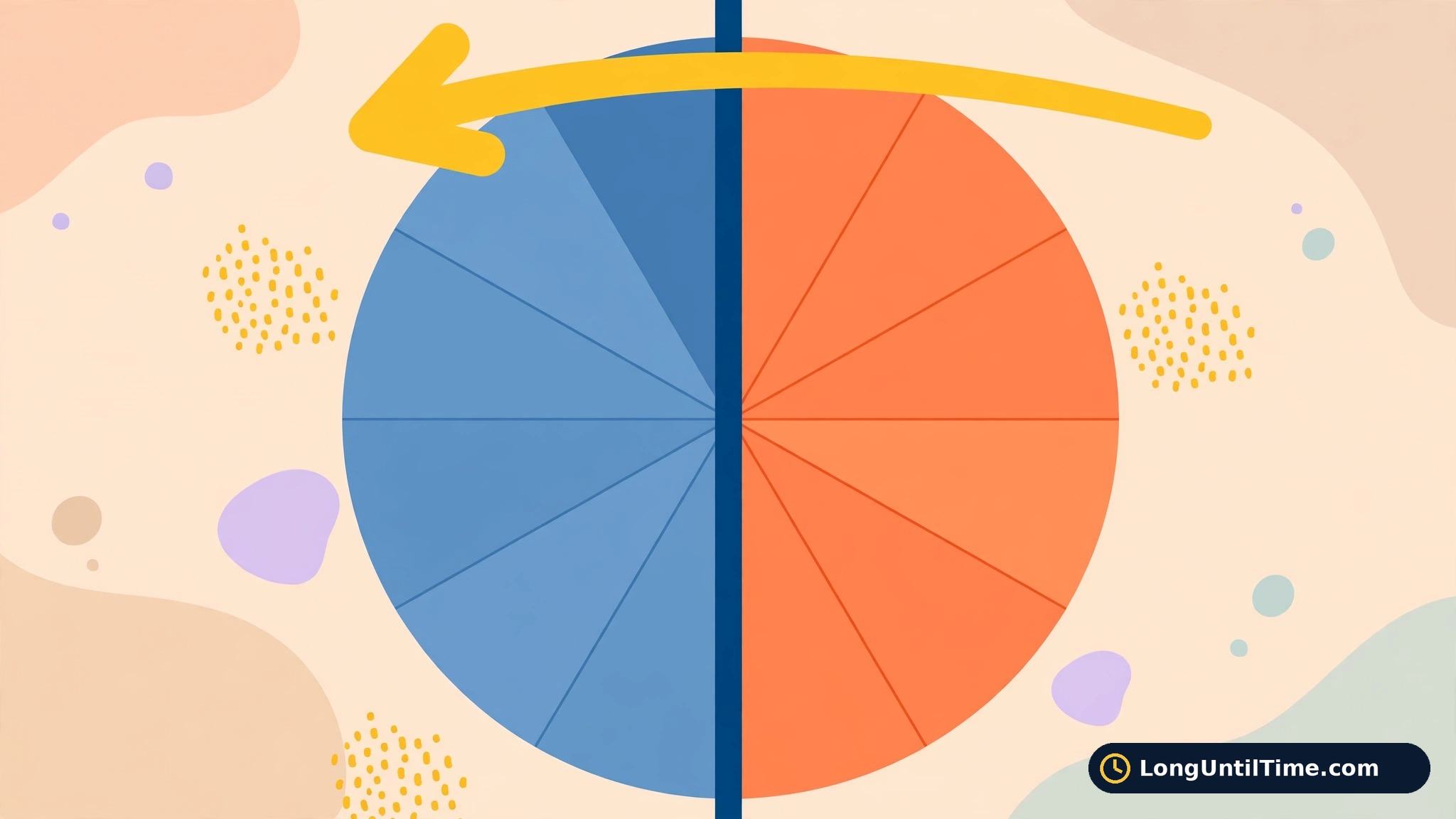
The twelve-hour version teaches a tidy rule — same numbers, flip the label — and five hours invites you to borrow half of it: keep the minutes, but flip the label too. Here the flip is only sometimes right, because five hours is less than half a day, and whether the count crosses a boundary depends on where it starts.
Think of each half of the day as a twelve-hour block, and ask where your start sits inside it. If the start falls in the first five hours of its half — the 12, 1, 2, 3, or 4 o’clock hours — counting back five crosses the boundary into the opposite half, and the label flips. If it falls at 5:00 or later, the count stays inside the same half, and the label survives.
So at 1:00 PM, five hours ago was 8:00 AM today — flipped, because the start sits early in its half. At 10:00 AM it was 5:00 AM today — kept, because the start sits late in its half. The classic error flips on habit at 10:00 AM and writes 5:00 PM: still in the future today, and seventeen hours back yesterday — not five either way. The reverse error trusts the kept label at 3:00 AM (truly 10:00 PM yesterday) as proof it never moves, then keeps it at 1:00 PM, where the true answer, 8:00 AM today, has flipped.
The Forward-Counting Slip
The other classic error runs the count the wrong way: adding five hours instead of subtracting. At 6:00 PM, a forward count lands on 11:00 PM and calls it five hours ago, when the true answer is 1:00 PM — ten hours apart, because plus five and minus five sit on opposite sides of now. One check protects you: apart from small-hours starts, whose answers legitimately read later on the dial, a correct answer always reads earlier than the start.
The 24-Hour Form
On a 24-hour clock the label question disappears: subtract 5 from the hour, and if the result is negative, add 24 and count the day as yesterday. So 17:45 becomes 12:45 the same day, while 02:15 becomes 21:15 yesterday.
How to Calculate 5 Hours Ago
The everyday method: move the numeral back five steps, wrapping past 12, keep the minutes, then run the label and day checks above. Four worked examples follow.
Example 1: An Ordinary Morning Start (9:40 AM)
The numeral drops five, from 9 to 4, the minutes stay at 40, and because the start sits at 5:00 or later in its half, the label holds: five hours ago was 4:40 AM today.
Example 2: The Boundary, 4:59 AM vs 5:00 AM
One minute of start time changes both the day and the label. From 4:59 AM, five hours ago was 11:59 PM yesterday — inside the first five hours of its half, so the label flips and the day runs out entirely. From 5:00 AM, the same subtraction lands on 12:00 AM today: the first start with a full five hours of today behind it, and the first whose label stays put.
Example 3: Crossing Noon (3:30 PM)
At 3:30 PM, the count crosses the noon line going back. Drop the numeral five, from 3 to 10, and flip the label — the start sits in the first five hours of its half: five hours ago was 10:30 AM today.
Example 4: The Full Minutes Method (8:47 PM)
Convert the start to minutes since midnight: 8:47 PM is 20 × 60 + 47 = 1,247 minutes. Subtract the 300 minutes in five hours: 947, which is 15:47 in 24-hour time, or 3:47 PM today. The positive result keeps today’s date — that sign check is the heart of the method, because a negative result sends the answer into yesterday.
Minutes and Seconds: The Exact Moment 5 Hours Ago
Subtracting whole hours changes only the hour, never the smaller units. If it is now 6:24 and 10 seconds in the evening, five hours ago it was 1:24 and 10 seconds in the afternoon, because five hours is a whole number of minutes: 300 of them, or 18,000 seconds.
This matters with timestamps: a photo or a log stamped 1:24 PM today sits exactly five hours before a 6:24 PM now, and the :24 is not an approximation to round away.
Why Your Time Zone Can Move the Answer
Five hours ago is one fixed moment, but its clock reading depends on where the clock is. An event logged at 11:00 PM in a zone five hours ahead happened at 6:00 PM on your clock: counting back from that reading gives 1:00 PM, while counting back from the printed 11:00 PM gives 6:00 PM — five hours out.
Convert the timestamp into your own zone first, then subtract. One wrinkle: where daylight saving is observed, an hour of local time is skipped or repeated twice a year, and on those days the clock-face answer can differ by an hour from five full elapsed hours — count elapsed hours rather than labels.
Planning With a 5-Hours-Ago Answer
Shift work runs on this span. A worker checked at 2:00 AM who has been on shift five hours started at 9:00 PM yesterday — and the day matters as much as the hour in the log. Medication timing asks it too: a dose taken at 1:15 PM is five hours old at 6:15 PM, and even-gap schedules stand or fall on that count.
Sleep too: if it is now 11:00 PM and you fell asleep five hours ago, your sleep began at 6:00 PM. The same habit stretches to the half-day span: the companion piece on 12 hours ago covers the twelve-hour version, where the numeral stays still and only the label moves.
Frequently Asked Questions
What time was it 5 hours ago?
It was five hours before now: the numeral sits five steps lower, the minutes unchanged, and yesterday only when the current time is before 5:00 AM. The label check then decides between AM and PM.
Is 5 hours ago always the same day?
No — starts before 5:00 AM land in yesterday’s evening. 5:00 AM is the boundary: from 5:00 AM itself, the answer is 12:00 AM today.
Does the AM or PM label always change 5 hours back?
No — starts in the first five hours of a half day, the 12, 1, 2, 3, and 4 o’clock hours, flip their label. From 5:00 onward in either half, it stays the same.
How many minutes is 5 hours ago?
Five hours is 300 minutes back, or 18,000 seconds. Converting your start to minutes since midnight and subtracting 300 is the most reliable method.
What was the time 5 hours ago in 24-hour format?
Subtract 5 from the hour number, and if the result is negative, add 24 and count the day as yesterday. So 21:10 becomes 16:10 the same day, while 03:10 becomes 22:10 the previous day.
How do I work out 5 hours ago without a calculator?
Move the numeral five steps back, wrapping past 12, and keep the minutes. Flip the label only if your start sits in the first five hours of its half, and attach yesterday whenever it is before 5:00 AM.
Conclusion
Finding the time for 5 hours ago comes down to one subtraction and two checks. Move the numeral back five and keep the minutes; flip the label only when your start sits in the first five hours of its half, keep it otherwise; then attach yesterday for any start before 5:00 AM, today from 5:00 AM onward. The table settles common starts at a glance, and the minutes method handles the rest without guesswork.
For anything that will be acted on — a shift log, a dose schedule, a message timeline — write the answer as a time and a day together, because the arithmetic is easy and the day is the part that slips. Five hours holds a work stretch or a short night of sleep, and in both cases the value of the answer is knowing exactly which end of the span you stand on.




One Comment