
What Time Was It 15 Hours Ago? Three Numbers Back, a Label That Only Sometimes Flips
If you are asking what time was it 15 hours ago, the count in your own local time has three moving parts: take your current time, move the hour numeral back three, and keep the minutes exactly as they are. The AM and PM label and the day then follow rules of their own, because fifteen hours is more than half a day but less than a full one. At 6:10 PM, fifteen hours ago was 3:10 AM today; at 9:00 AM, it was 6:00 PM yesterday, because a morning start reaches back past midnight into the day before.
People usually ask this with a long span behind them. A traveler who has just landed wants to place a departure, a dose, or a message from the other end of the trip. Someone partway through a fifteen-hour fast wants to know when the window opened; anyone awake far too long is asking when the day started. In each case the trap is the same: the span borrows the twelve-hour habit — flip the label, keep the numbers — and that habit is only half right here.
This article gives you three ways to land on the answer: a quick reference table, a step-by-step method, and the minutes-based calculation a time calculator uses. You will also see why the time difference leaves the smaller units untouched, why time zones can move the reading, and why the answer keeps the same seconds as now.
Quick Reference: What 15 Hours Ago Was
Find your starting time in the left column, read across, and check the day column, because only the last three rows stay on today’s date:
| Current Time | 15 Hours Ago Was | Same Day or Day Before |
|---|---|---|
| 12:00 AM | 9:00 AM | Day Before |
| 3:00 AM | 12:00 PM | Day Before |
| 6:00 AM | 3:00 PM | Day Before |
| 9:30 AM | 6:30 PM | Day Before |
| 12:00 PM | 9:00 PM | Day Before |
| 2:59 PM | 11:59 PM | Day Before |
| 3:00 PM | 12:00 AM | Same Day |
| 6:00 PM | 3:00 AM | Same Day |
| 9:45 PM | 6:45 AM | Same Day |
Three patterns hold the table together. First, the numeral always drops by three — fifteen is twelve plus three — with the minutes untouched. Second, the day splits at 3:00 PM: earlier starts have fewer than fifteen hours of today behind them, so the answer lands yesterday, while later starts stay today. Third, the label is the irregular one: the 12:00 AM, 12:00 PM, and 2:59 PM rows keep their starting label, while the 3:00 AM and 6:00 PM rows flip theirs — the pattern most answers get wrong, covered below. The same thinking shrinks to the neighboring span: our guide on 12 hours ago covers the half-day version, where the numeral stays still and only the label moves.
15 Hours Ago: Why the Label Flips Only Sometimes
The twelve-hour version teaches a tidy rule — same numbers, flip the label — and fifteen hours invites you to borrow it. Doing so produces a confident wrong answer, because fifteen hours is twelve plus three, not a clean half day, and the extra three change everything about the label.
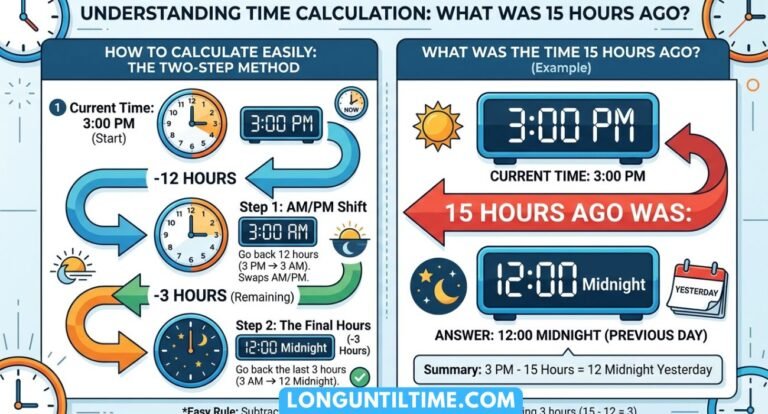
Work it in the two steps the number itself suggests. The twelve-hour step always flips the label, landing on the same numeral in the opposite half of the day. The three-hour step then moves the numeral back three — and only sometimes touches the label. If your start sits in the first three hours of its half of the day — the 12, 1, or 2 o’clock hours — those extra hours cross back over the line the first step crossed, and the label flips back to where it began. From any later start, they stay inside the opposite half, and the flipped label stands.
So at 1:00 PM, fifteen hours ago was 10:00 PM yesterday, the label it started with, while at 11:00 AM it was 8:00 PM yesterday, flipped as the habit expects. The classic error is flipping at 1:00 PM anyway and writing 10:00 AM yesterday: that moment is not fifteen hours back but twenty-seven, a full half day too far. The reverse error trusts the kept label at 12:30 AM (truly 9:30 AM yesterday) as proof the label never moves, then keeps it at 11:00 PM, where the true answer, 8:00 AM today, has flipped.
One check protects you: in the first three hours of a half, expect the label to survive; from 3:00 onward, expect it to flip — and settle the day separately, yesterday before 3:00 PM, today from 3:00 PM onward.
How to Calculate 15 Hours Ago
The everyday method follows the split: move the numeral back three, wrapping past 12 where needed, keep the minutes, then run the label and day checks above. From a 24-hour clock reading, subtract 15 from the hour; if the result is negative, add 24 and count the day as yesterday. Here are four worked examples.
Example 1: A Morning Start Landing Yesterday Evening (8:40 AM)
Only eight hours and forty minutes of today exist at 8:40 AM, so the count finishes yesterday evening. The numeral drops three, from 8 to 5, and because the start sits past the first three hours of its half, the label flips: fifteen hours ago was 5:40 PM yesterday.
Example 2: An Evening Start That Stays Today (7:30 PM)
At 7:30 PM, more than fifteen hours of today lie behind you, so the count never leaves the date. Drop the numeral three, from 7 to 4, and flip the label: fifteen hours ago was 4:30 AM today.
Example 3: The Boundary, 2:59 PM vs 3:00 PM
One minute of start time changes both the day and the label. From 2:59 PM, fifteen hours ago was 11:59 PM yesterday — the numeral drops to 11 and the label survives, because the start sits inside the first three hours of the afternoon half. From 3:00 PM, the same subtraction lands on 12:00 AM today: the first start with a full fifteen hours of today behind it, and the first afternoon start whose label flips.
Example 4: The Full Minutes Method (10:12 AM)
Convert the start to minutes since midnight: 10:12 AM is 10 × 60 + 12 = 612 minutes. Subtract the 900 minutes in fifteen hours and you get −288. A negative result signals the previous day, so add a full day’s 1,440 minutes: −288 + 1,440 = 1,152, which is 19:12 in 24-hour time, or 7:12 PM yesterday.
Minutes and Seconds: The Exact Moment 15 Hours Ago
Subtracting whole hours changes only the hour, never the smaller units. If it is now 4:42 and 30 seconds in the afternoon, fifteen hours ago it was 1:42 and 30 seconds in the morning, because fifteen hours is a whole number of minutes: 900 of them, or 54,000 seconds.
This matters with timestamps: if it is now 4:42 PM, a log stamped 1:42 AM today sits exactly fifteen hours back, and the :42 is not an approximation to round away.
Why Your Time Zone Can Move the Answer
Fifteen hours ago is a single fixed moment, but its clock reading depends on where the clock is. An event logged at 11:00 PM in a zone five hours ahead of you happened at 6:00 PM on your clock: counting back from that reading gives 3:00 AM today, while counting back from the printed 11:00 PM gives 8:00 AM — five hours out.
Convert the timestamp into your own zone first, then subtract. One calendar wrinkle: where daylight saving is observed, the clocks jump twice a year and an hour of local time is skipped or repeated. On those days, the clock-face answer can differ by an hour from fifteen full elapsed hours, so count elapsed hours rather than labels.
Planning With a 15-Hours-Ago Answer
Fasting windows are the everyday home of this span. A fifteen-hour fast that ends at 8:00 AM began at 5:00 PM yesterday, and getting that start wrong by a label quietly adds or steals hours from the fast. Sleep runs on the same arithmetic: if it is now 10:00 PM and you have been awake for fifteen hours, you woke at 7:00 AM today.
Fifteen hours is a common long-haul flying time, and on landing the question is about a departure, a dose, or a message sent from the other end — all elapsed-time questions, answered by the subtraction above once every reading sits on one clock. Work logs ask it too: an incident reported at 6:00 PM may need matching against a camera stamp from 3:00 AM that morning. The same habit extends one hour further, and the companion piece on 16 hours ago covers the sixteen-hour span, where the numeral drops four instead of three.
Frequently Asked Questions
What time was it 15 hours ago?
It was fifteen hours before now: the hour numeral sits three lower, the minutes are unchanged, and the answer falls yesterday unless the current time is 3:00 PM or later. The label check then decides between AM and PM.
Is 15 hours ago always yesterday?
No, starts at or after 3:00 PM stay on the same day. 3:00 PM is the first moment with a full fifteen hours of today behind it.
Does the AM or PM label always change 15 hours back?
No — starts in the first three hours of a half day, the 12, 1, and 2 o’clock hours, keep their label. From 3:00 onward in either half, it flips.
How many minutes is 15 hours ago?
Fifteen hours is 900 minutes before the current moment, or 54,000 seconds. Converting your start to minutes since midnight and subtracting 900 is the most reliable method.
What was the time 15 hours ago in 24-hour format?
Subtract 15 from the hour number, and if the result is negative, add 24 and count the day as yesterday. For example, 20:30 becomes 05:30 on the same day, while 09:15 becomes 18:15 on the previous day.
How do I work out 15 hours ago without a calculator?
Subtract twelve hours first — same numeral, flipped label — then move three more hours back; if those cross noon or midnight, the label flips back. Attach yesterday whenever your start is before 3:00 PM.
Conclusion
Finding the time for 15 hours ago comes down to one subtraction and two checks. Move the numeral back three and keep the minutes; keep the label only when your start sits in the first three hours of its half, flip it otherwise; then attach yesterday for any start before 3:00 PM, today from 3:00 PM onward. The quick reference table settles common starts at a glance, and the minutes method handles the rest without guesswork.
For anything that will be acted on — a fasting window, a flight connection, a log entry — write the answer as a time and a day together, because the arithmetic is easy and the day is the part that slips. The span is a familiar one to long-haul travelers, and the jet lag waiting at the far end of a fifteen-hour flight is the body’s own reminder that clock readings and elapsed hours are different things.



One Comment