
How Long Until 2:20 PM? The Twenty Past Mark in the Heart of the Afternoon
If you are asking how long until 2:20 pm, there is no single fixed answer, because the answer depends on your current time — but the calculation takes only seconds once you know the method. This article treats the target as 2:20 PM, the mid-afternoon moment most people mean: an appointment after the 2:15 restart, a class in its second half, or an errand that must land before the half-hour mark. In your local time, the remaining time is simply the gap between now and 14:20, which is how the 24-hour clock writes 2:20 PM.
If 2:20 PM is still ahead of you today, you count forward to it. If it has already gone by, the count rolls to tomorrow’s 2:20 PM instead, which is why the answer can jump from five minutes to nearly a full day in a single tick. Below you will find a quick reference table, the fix for the 2:20 AM mix-up, the twenty-past-two shortcut, four worked examples, and planning advice for the mid-afternoon appointment block.
Quick Reference: Time Remaining Until 2:20 PM
If you only need the number, find your current time in the left column. This table covers times before 2:20 PM, when the target falls later today.
| Current Time | Time Remaining Until 2:20 PM | In Minutes |
|---|---|---|
| 6:00 AM | 8 hours 20 minutes | 500 minutes |
| 8:00 AM | 6 hours 20 minutes | 380 minutes |
| 9:30 AM | 4 hours 50 minutes | 290 minutes |
| 11:00 AM | 3 hours 20 minutes | 200 minutes |
| 12:00 PM | 2 hours 20 minutes | 140 minutes |
| 1:00 PM | 1 hour 20 minutes | 80 minutes |
| 1:40 PM | 40 minutes | 40 minutes |
| 2:00 PM | 20 minutes | 20 minutes |
| 2:10 PM | 10 minutes | 10 minutes |
| 2:15 PM | 5 minutes | 5 minutes |
Every row follows the same pattern. 2:20 PM sits 860 minutes after midnight, so the remaining time is always 860 minus the minutes already passed since your day began. A countdown timer on your phone performs that same subtraction as the minutes tick away. The same pattern runs five minutes earlier too, as our guide to how long until 2:15 pm shows for the restart mark just before it.
After 2:20 PM: Counting to Tomorrow’s 2:20 PM
Once the clock moves past 2:20 PM, today’s target is spent. Counters and reminders then aim at the next one, which falls exactly 24 hours after today’s, so the remaining time leaps back up:
| Current Time | Time Remaining Until the Next 2:20 PM | In Minutes |
|---|---|---|
| 3:00 PM | 23 hours 20 minutes | 1,400 minutes |
| 5:30 PM | 20 hours 50 minutes | 1,250 minutes |
| 8:00 PM | 18 hours 20 minutes | 1,100 minutes |
| 10:45 PM | 15 hours 35 minutes | 935 minutes |
That jump is not an error. It is the same target, one day later.
2:20 PM or 2:20 AM? The Twenty-Past Trap
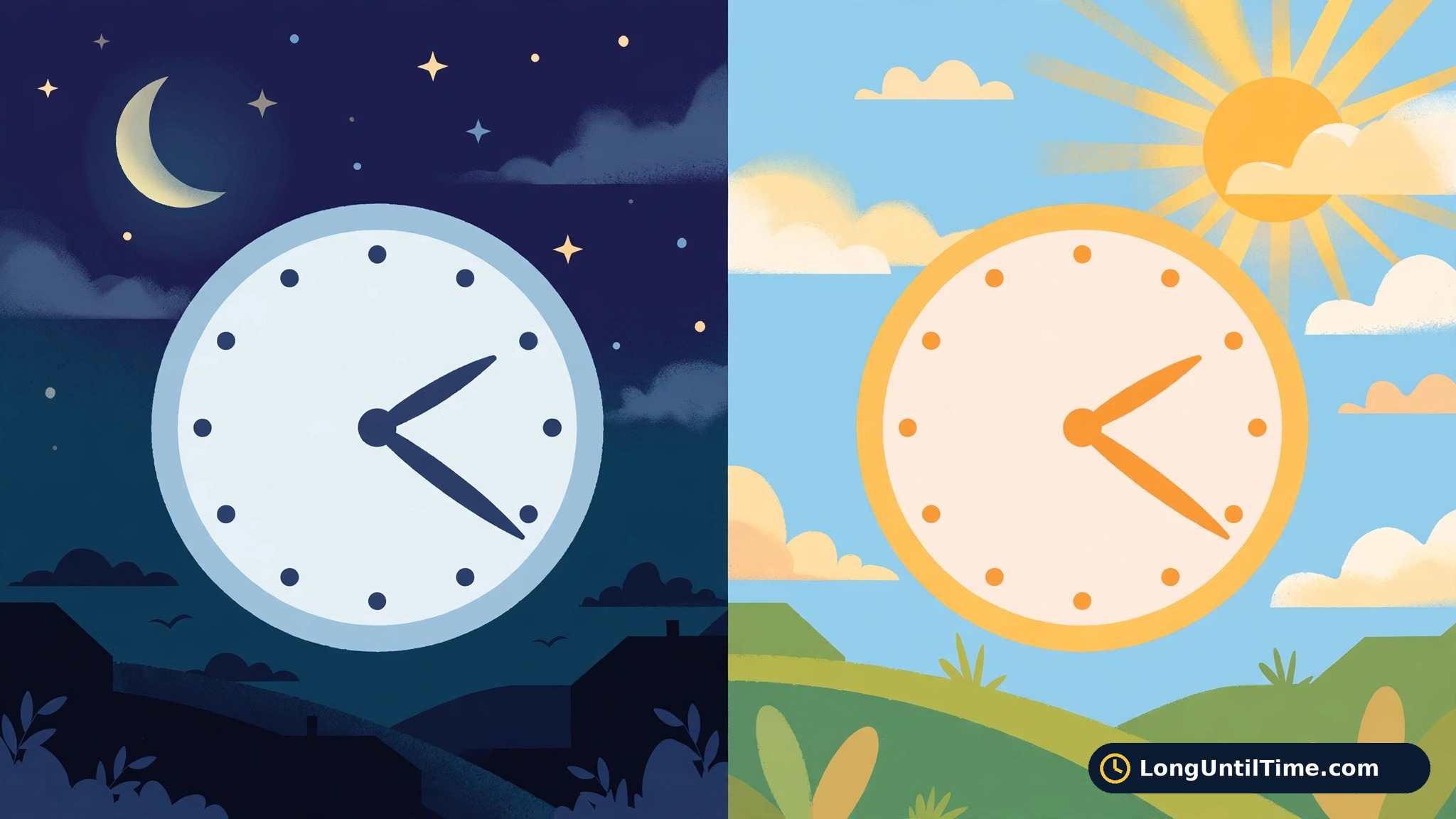
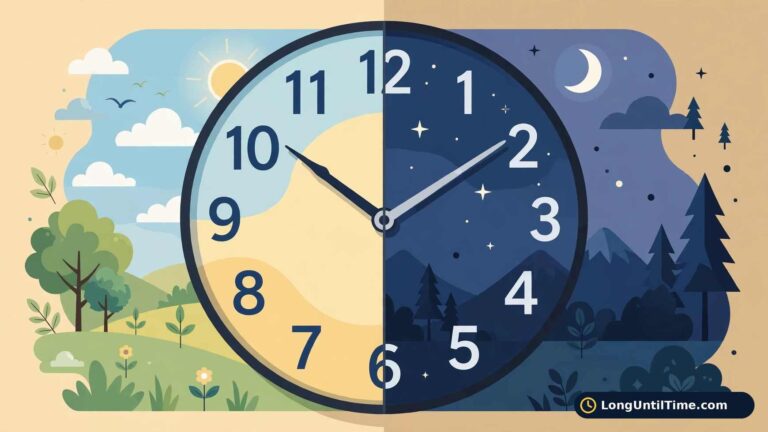
The clock shows 2:20 twice every day, and the two versions sit exactly 12 hours apart. 2:20 AM is a deep-sleep hour, 140 minutes after midnight, while 2:20 PM is mid-afternoon at 860 minutes after midnight; the difference between them is 720 minutes, a full half day. The labels AM and PM are the only thing separating the two on a 12-hour clock, and a missed label is the most common reason a countdown to this target feels wrong.
The 24-hour clock removes the trap by giving each version its own number: 2:20 AM becomes 02:20 and 2:20 PM becomes 14:20, with no label left to misread. The stakes are easy to picture. At 10:00 AM, the next 2:20 PM is 4 hours 20 minutes away, but if you silently counted toward 2:20 AM instead, you would land on tomorrow morning, 16 hours 20 minutes away — and any alarm or reminder built on the wrong version fires half a day off.
The Twenty-Past Shortcut — and the Twenty-To Slip
This target carries a second trap that lives in speech rather than on the clock face. Said aloud, 2:20 is twenty past two: twenty minutes after the hour. Its near-twin is twenty to two, which is 1:40 — twenty minutes before the hour instead of after it. The two phrases differ by a single small word, yet the times sit a full 40 minutes apart. Hear “twenty to two” when someone meant twenty past, and at 1:00 PM you would plan around a target 40 minutes away when the real one is 1 hour 20 minutes off. When a spoken time matters, repeat it back in plain numbers — “two twenty” — first.
How to Calculate the Time Until 2:20 PM
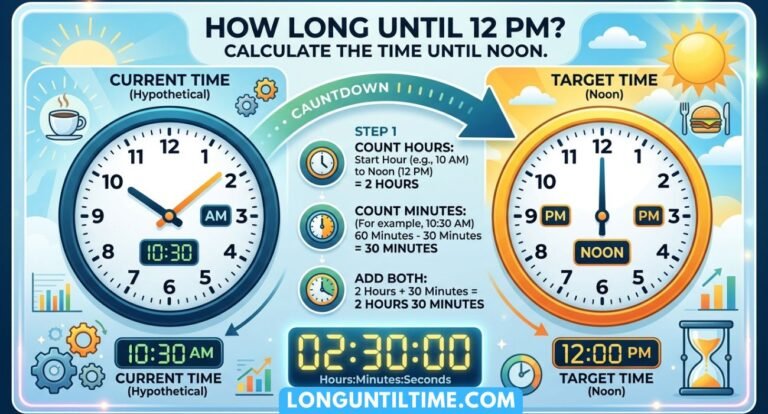
Two methods cover every situation. For a quick estimate, count forward in chunks: whole hours first, then the leftover minutes. For an exact answer, convert both times into minutes since midnight and subtract. That subtraction is the whole secret: the time difference between now and 2:20 PM is all the question is really asking for. Here are four worked examples, one for each situation you are likely to meet.
Example 1: An Ordinary Morning (9:45 AM)
Count forward in two chunks. From 9:45 AM to 12:45 PM is 3 hours, and from 12:45 PM to 2:20 PM is another 1 hour 35 minutes. Added together, that gives 4 hours 35 minutes until 2:20 PM.
Example 2: Inside the Final Hour (1:57 PM)
Once you are inside the last hour, minutes do all the work. From 1:57 PM, three minutes carry you to 2:00 PM and twenty more reach the target, so 23 minutes remain until 2:20 PM.
Example 3: After the Target, Rolling to Tomorrow (4:50 PM)
At 4:50 PM, today’s 2:20 PM passed two and a half hours ago, so the target becomes tomorrow’s, and the count crosses midnight and a date change on the way. From 4:50 PM to midnight is 7 hours 10 minutes, and from midnight to 2:20 PM the next day is 14 hours 20 minutes. Together that makes 21 hours 30 minutes until the next 2:20 PM.
Example 4: The Minutes Method (11:38 AM)
This is exactly how an online time calculator does it, and it works for any current time. First convert the target: 2:20 PM is 14:20 in 24-hour time, and 14 × 60 + 20 = 860 minutes after midnight. Then convert the current time: 11:38 AM is 11 × 60 + 38 = 698 minutes. Subtract: 860 − 698 = 162 minutes, and 162 minutes is 2 hours with 42 minutes left over, so there are 2 hours 42 minutes until 2:20 PM.
The Final Stretch: Minutes and Seconds Before 2:20 PM
In the last few minutes, hours and whole minutes stop telling the whole story, and seconds take over. At 2:15 PM, exactly 5 minutes — 300 seconds — remain. At 2:19:30 PM, only 30 seconds are left, which is why countdown displays switch to a minutes-and-seconds readout near the end. If an appointment or a classroom door waits at 2:20 PM, treat those final 300 seconds as working time rather than a cushion; they vanish faster than they look on paper.
Why Your Time Zone Can Move the Answer
2:20 PM is a local moment, not a worldwide one, because the world is divided into time zones. A video call booked for 2:20 PM in Chicago takes place at 3:20 PM on a clock in New York, 1:20 PM in Denver, and 12:20 PM in Los Angeles. If an event lives in another zone, convert its start into your local time first and count down to the converted time; counting toward the unconverted 2:20 is a quiet way to arrive an hour or two off.
Planning Around a 2:20 PM Target
A 2:20 target sits in the middle of the afternoon’s working block. Classes are in their second half, appointments cluster between the restart and the half-hour mark, with the day’s last act still to run. Work backward from the target rather than forward from now: decide what “ready” looks like at 2:20 PM — seated in the meeting room, at the clinic desk, or through the classroom door — then subtract your travel or preparation time to find your real deadline, which is often 10 or 15 minutes earlier than the target itself.
Setting two timers, one for the target and one for that earlier real deadline, turns a vague mid-afternoon worry into two clear checkpoints. The same backward habit works for the target ten minutes later: our guide to how long until 2:30 PM covers the half-hour mark this one is running toward.
Frequently Asked Questions
How long until 2:20 PM from noon?
There are 2 hours 20 minutes from 12:00 PM until 2:20 PM. Noon is a friendly starting point here, because the answer simply repeats the target’s own hours and minutes.
How many minutes are left at 2:15 PM?
Exactly 5 minutes remain between 2:15 PM and 2:20 PM. Both times sit inside the same hour, so the count is a single fixed gap.
It is 3:05 PM now. How long until 2:20 PM?
There are 23 hours 15 minutes until the next 2:20 PM. Because today’s 2:20 PM has already passed, the count runs through tonight and into tomorrow afternoon.
What is 2:20 PM in 24-hour time?
2:20 PM is 14:20 in 24-hour time. Add 12 to the hour for any time after noon, and the AM/PM label disappears entirely.
How many minutes after midnight is 2:20 PM?
2:20 PM falls 860 minutes after midnight. That single number powers the minutes method: subtract your own minutes since midnight from 860 to get the time remaining.
How long until 2:20 PM from 9:00 AM?
There are 5 hours 20 minutes from 9:00 AM until 2:20 PM. Morning starts like this one produce the longest same-day counts most people will ever need for this target.
Is 2:20 PM the same as twenty past two?
Yes, 2:20 PM is twenty past two, falling twenty minutes after 2:00 PM. The phrase counts forward from the hour that has just passed, which is exactly why it gets confused with twenty to two, its 40-minute-away mirror image.
Why does my countdown suddenly show almost a full day?
Because today’s 2:20 PM has already passed, so the countdown has rolled over to tomorrow’s 2:20 PM. The jump from a few minutes to nearly 24 hours happens the moment the clock moves past the target.
Conclusion
Working out how long until 2:20 pm comes down to one habit: compare your current time with 14:20, the 24-hour form of 2:20 PM. Count forward in chunks for a quick estimate, or subtract your minutes since midnight from 860 for an exact answer, and if the target has already passed, aim at tomorrow’s 2:20 PM instead. When the time arrives by word of mouth, the twenty-past check — twenty minutes after two, never twenty minutes before it — keeps the spoken version honest.
For anything that matters — an appointment, a classroom door, the last afternoon errand — do the small calculation once, set a timer, and let the clock-watching go. Anyone shaping a day around fixed marks like this one is really working from a timetable, and the encyclopedia entry traces how those grids came to organize school, travel, and work.
2 Comments