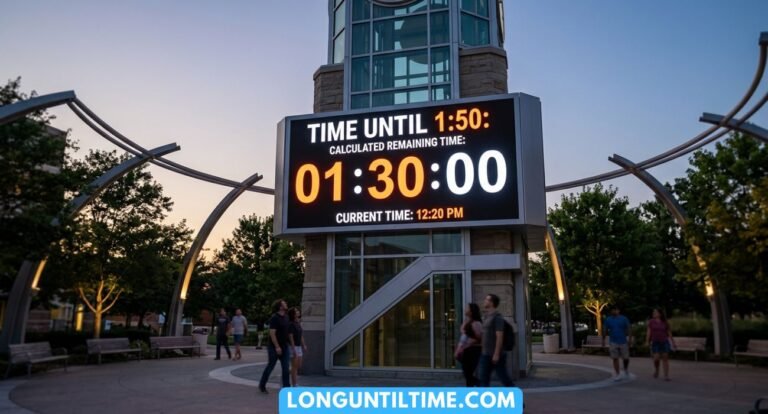
How Long Until 4:30 PM? Easy Time Calculator & Guide
The answer to How Long Until 4:30 PM depends on your current local time. If it is 3:00 PM, you have 1 hour and 30 minutes left. If it is 4:00 PM, you have 30 minutes remaining. If the clock already shows 4:30 PM, there is no time left to wait for that day’s target.
You can calculate the time remaining by subtracting the current time from 4:30 PM. A live countdown timer can also show the remaining hours, minutes, and seconds automatically.
This guide explains how to calculate the time until 4:30 PM, understand AM and PM, handle situations when the target time has passed, and use a countdown to plan appointments, school activities, work, travel, and everyday tasks.
Meaning / Definition
The phrase “How Long Until 4:30 PM?” asks how much time remains before the clock reaches 4:30 in the afternoon. The answer is a time difference between the current local time and the target time.
For example, if the current time is 2:00 PM, the difference between 2:00 PM and 4:30 PM is 2 hours and 30 minutes. If the current time is 3:45 PM, only 45 minutes remain.
This calculation changes as time passes. At 4:00 PM, there are 30 minutes left. At 4:29 PM, there is just one minute left. At exactly 4:30 PM, the countdown reaches zero.
The result also depends on the date. If it is already 5:00 PM, today’s 4:30 PM has passed. Someone asking about the next 4:30 PM would need to count forward to the following afternoon.
A time difference calculator can help determine the duration between two clock times. For a live countdown, the calculator must also use the correct date and time zone.
Meaning in Simple Words
In simple words, “How Long Until 4:30 PM?” means asking how much longer you must wait until it is half past four in the afternoon.
Imagine looking at your phone at 3:30 PM. You know that 4:30 PM is one hour away. If you check again at 4:15 PM, you have only 15 minutes left.
The same method works at any time of day. You compare the current time with the target, then find the difference. You can express that difference in hours and minutes or convert it into seconds when you need a more precise countdown.
Quick Answer
How long until 4:30 PM? The exact answer depends on your current local time. Use the following table to find common examples quickly.
| Current local time | Time remaining until 4:30 PM |
|---|---|
| 12:00 PM | 4 hours 30 minutes |
| 1:00 PM | 3 hours 30 minutes |
| 2:00 PM | 2 hours 30 minutes |
| 2:30 PM | 2 hours |
| 3:00 PM | 1 hour 30 minutes |
| 3:15 PM | 1 hour 15 minutes |
| 3:30 PM | 1 hour |
| 3:45 PM | 45 minutes |
| 4:00 PM | 30 minutes |
| 4:15 PM | 15 minutes |
| 4:25 PM | 5 minutes |
| 4:29 PM | 1 minute |
| 4:30 PM | 0 minutes |
These examples assume the current time and 4:30 PM refer to the same day and time zone.
If you want the answer in seconds, multiply the remaining minutes by 60. For instance, 15 minutes equals 900 seconds. A countdown timer can update this value automatically as each second passes.
Real-Life Examples
Knowing how long until 4:30 PM can help you organize daily activities and avoid rushing at the last minute. The following examples show how to apply the calculation in familiar situations.
Example 1: Planning an Appointment
Suppose you have a doctor’s appointment at 4:30 PM and check your phone at 2:45 PM. You need to determine how much time remains before the appointment begins.
From 2:45 PM to 3:45 PM is one hour. From 3:45 PM to 4:30 PM is another 45 minutes. Therefore, 1 hour and 45 minutes remain.
You can use this time to gather documents, prepare questions, and plan your trip. However, the countdown only measures the time until the appointment. It does not tell you how long the journey will take.
If you need 25 minutes to reach the office, you should plan your departure around that travel time and allow an extra margin for traffic or delays.
Example 2: Waiting for School to End
A student knows that school finishes at 4:30 PM. At 3:15 PM, the student checks the clock to see how much longer the school day will last.
The calculation is straightforward:
4:30 PM − 3:15 PM = 1 hour and 15 minutes.
There are 75 minutes remaining before the scheduled dismissal time. A parent checking the same countdown can use it to plan pickup or arrange transportation.
Actual school dismissal times vary, so always use the schedule provided by the school. If an after-school activity changes the expected departure time, update the target accordingly.
Example 3: Preparing for Work
Imagine an employee wants to complete a report before 4:30 PM. The current time is 2:30 PM, leaving exactly two hours.
The employee can divide the available time between finishing the main report, checking the details, and submitting the final version. A timer can help track progress and signal when it is time to move to the next task.
The main benefit is a clear deadline. Instead of guessing how much time remains, the employee can make a realistic plan based on the remaining minutes.
If the report requires more than two hours, the countdown can also help identify the need to adjust priorities or communicate about the deadline.
Example 4: Cooking Dinner
Suppose dinner is planned for 4:30 PM, and the current time is 3:40 PM. The time remaining is 50 minutes.
From 3:40 PM to 4:00 PM is 20 minutes. From 4:00 PM to 4:30 PM is another 30 minutes. Together, that makes 50 minutes.
This information helps you plan when to prepare ingredients, start cooking, and set the table. You can also use separate timers for dishes that require different cooking times.
Remember that the countdown to dinner is not a substitute for following a recipe’s cooking instructions or checking that food has reached a safe internal temperature.
Example 5: Catching a Bus
A bus is scheduled to leave at 4:30 PM, and you check the clock at 4:05 PM. You have 25 minutes until the scheduled departure.
That might be enough time to walk to the bus stop, purchase a ticket, or check the route information. Whether it is enough depends on your location and the distance to the stop.
For example, if the walk takes 20 minutes, leaving immediately would give you only five minutes to spare. A delay could cause you to miss the bus.
Use the remaining-time calculation together with the expected travel time. A countdown tells you when the bus is scheduled to leave, not when you must begin your journey.
Example 6: Online Meeting
Suppose a video meeting starts at 4:30 PM, and the current time is 4:10 PM. You have 20 minutes to prepare.
You can review your notes, open the meeting link, test your microphone, and check your internet connection before the meeting starts.
A calendar reminder can alert you when preparation should begin, while a digital clock or countdown timer shows the exact time remaining.
If you are working with people in different locations, confirm the meeting time in the correct time zone. A meeting scheduled for 4:30 PM Eastern Time does not necessarily begin at 4:30 PM Pacific Time.
Example 7: When 4:30 PM Has Passed
Suppose it is currently 5:00 PM and you ask, “How long until 4:30 PM?”
Today’s 4:30 PM has already passed by 30 minutes. The answer depends on what you mean by the question.
If you want to know how long ago 4:30 PM occurred, the answer is 30 minutes ago. If you want to know how long until the next 4:30 PM, the answer is 23 hours and 30 minutes, assuming the next target is tomorrow and no unusual time-zone change affects the elapsed duration.
This distinction matters when setting reminders or using an online time calculator. Some calculators display a negative time difference for a past target, while countdown timers often switch to the next occurrence only when configured to do so.
Synonyms and Related Terms
People use several different phrases when searching for the time remaining until 4:30 PM. These expressions usually describe the same basic calculation, although the intended date or level of detail may differ.
For example, “How much time until 4:30 PM?” asks for the remaining duration. “How many minutes until 4:30 PM?” asks for the answer in minutes. “Countdown to 4:30 PM” often refers to a timer that updates automatically.
Other useful variations include “time left until 4:30 PM,” “hours until half past four,” “4:30 PM time calculator,” and “how long until 4:30 today.”
A time calculator can calculate the difference between two times, while an online countdown is designed to track the approach of a future target. Both can be useful, but a live countdown requires a reliable clock and the correct target date.
AM vs. PM
AM and PM help distinguish morning times from afternoon and evening times in the 12-hour clock system.
AM covers the period from midnight to just before noon. PM covers the period from noon to just before midnight. Therefore, 4:30 AM means half past four in the morning, while 4:30 PM means half past four in the afternoon.
| Clock time | Meaning | 24-hour format |
|---|---|---|
| 4:30 AM | Half past four in the morning | 04:30 |
| 12:00 PM | Noon | 12:00 |
| 4:30 PM | Half past four in the afternoon | 16:30 |
| 12:00 AM | Midnight | 00:00 |
The difference between 4:30 AM and 4:30 PM is 12 hours. Choosing the wrong period can make a countdown incorrect by many hours.
Pay special attention to noon and midnight because they are common sources of confusion. Noon is 12:00 PM, and midnight is 12:00 AM.
When to Use
A countdown to 4:30 PM can be useful whenever an activity has a clear deadline or scheduled start time. It helps you understand the available time and make better decisions about what you can finish before the target.
The calculation is simple, but its practical value comes from using the result to plan what happens next.
Use It for Appointments
Use the time remaining until 4:30 PM to prepare for medical appointments, business meetings, interviews, or personal commitments.
If you have an appointment in 90 minutes, you can work backward from the scheduled time to decide when to get ready and leave. Include travel time and a reasonable buffer so that you do not confuse the time remaining with the time available to travel.
Use It for Work
A countdown can help you track the time left before a deadline, shift change, or scheduled break.
For example, if it is 1:30 PM, you have three hours before 4:30 PM. You can use that period to complete important tasks, review your work, and prepare anything that must be submitted before the deadline.
A timer can also help you notice when a task is taking longer than expected. This gives you a chance to adjust your plan before time runs out.
Use It for School
Students and parents can use a 4:30 PM countdown to plan school pickup, homework, tutoring, and extracurricular activities.
If school ends at 4:30 PM, knowing that only 30 minutes remain at 4:00 PM can help a parent prepare to leave. Students can also use the same method to organize study sessions before an evening activity.
Always check the actual school timetable because dismissal times may vary by grade, day, or activity.
Use It for Travel
A countdown is useful when tracking the time before a scheduled bus, train, flight-related activity, or planned departure.
For example, if a bus leaves at 4:30 PM and it is 3:50 PM, you have 40 minutes until departure. You can compare that duration with the estimated journey to the station or stop.
For travel across the United States, check whether the schedule uses local time. A departure time listed in the destination’s time zone may differ from the clock where you are currently located.
Use It for Reminders
A reminder helps you remember an upcoming event, while a countdown shows how much time remains before it happens.
If you need to submit a form by 4:30 PM, you can set a calendar alert before the deadline and use a timer to monitor the remaining time. This combination can be more useful than relying on memory alone.
Make sure the reminder uses the correct date and time zone. Otherwise, an alert may arrive earlier or later than expected.
Use It for Countdowns
A live countdown timer is helpful when you want to see the remaining time without repeating the calculation manually.
Depending on the tool, the display may show hours, minutes, and seconds. Some tools count down to a fixed date and time, while others let you set a repeating daily target.
For an accurate countdown, choose the correct local time, verify AM or PM, and check whether the target refers to today or tomorrow.
Use It for Daily Planning
The time until 4:30 PM can help you organize errands, meal preparation, work tasks, and personal activities.
Suppose it is 1:00 PM and you have three hours before a scheduled commitment. You can estimate how much time each task requires and decide which activities should come first.
Leave room for unexpected delays. A plan that uses every available minute may become difficult to follow if a meeting runs late or a journey takes longer than expected.
How to Calculate the Time Until 4:30 PM
You can calculate the remaining time manually by comparing the current time with 4:30 PM. The main rules are simple: one hour contains 60 minutes, and one minute contains 60 seconds.
For example, if the current time is 2:15 PM, the difference between 2:15 PM and 4:30 PM is 2 hours and 15 minutes.
For times that are easier to calculate in minutes, convert both clock times into minutes after midnight. Subtract the current total from the target total. This method works well when the two times occur on the same day.
The target time of 4:30 PM is 16:30 in the 24-hour clock, which equals 990 minutes after midnight. If it is 2:15 PM, or 14:15, the current time is 855 minutes after midnight. The difference is 990 − 855 = 135 minutes, or 2 hours and 15 minutes.
If the Current Time Is Before 4:30 PM
When the current time is earlier than 4:30 PM on the same day, subtract the current time from the target time.
For example, suppose it is 1:45 PM.
From 1:45 PM to 2:45 PM is one hour. From 2:45 PM to 4:30 PM is another hour and 45 minutes. The total is 2 hours and 45 minutes.
Here are a few additional examples:
| Current time | Calculation | Remaining time |
|---|---|---|
| 1:30 PM | 16:30 − 13:30 | 3 hours |
| 2:10 PM | 16:30 − 14:10 | 2 hours 20 minutes |
| 2:45 PM | 16:30 − 14:45 | 1 hour 45 minutes |
| 3:20 PM | 16:30 − 15:20 | 1 hour 10 minutes |
| 4:10 PM | 16:30 − 16:10 | 20 minutes |
When the minutes in the current time are greater than the target minutes, you may need to borrow one hour during subtraction. For example, 4:10 PM to 4:30 PM is 20 minutes, not a negative 20 minutes.
If the Current Time Is After 4:30 PM
If the current time is later than 4:30 PM, today’s target has passed.
You must first decide whether you want to calculate how long ago 4:30 PM occurred or how long until it happens again.
For example, if the current time is 6:00 PM, today’s 4:30 PM was 1 hour and 30 minutes ago.
If you want the next occurrence tomorrow, the remaining time is 22 hours and 30 minutes, assuming an ordinary 24-hour interval between the two local clock times.
The distinction is important because a standard time-difference calculation may return a negative value when the target is in the past. A repeating countdown may instead be configured to target the next day’s 4:30 PM.
If the Current Time Is Exactly 4:30 PM
If the clock shows exactly 4:30 PM, the time remaining until that day’s target is zero.
The event is due now, and the countdown has reached its target. If you are tracking an appointment or departure, you should treat the scheduled time as the start or deadline rather than assume that additional preparation time remains.
If you mean the next occurrence of 4:30 PM, the next target is normally tomorrow. The exact elapsed interval may differ if the local time zone changes its clock between the two dates.
When NOT to Use
A countdown to 4:30 PM is helpful, but it does not answer every time-related question. You should avoid relying on a calculation when the target is unclear, the date is wrong, or the relevant time zone has not been confirmed.
Understanding these limits helps prevent mistakes when planning important events.
Do Not Ignore the Date
The time 4:30 PM appears every day. A calculator needs the correct date if you want to know the duration until a specific appointment, deadline, or departure.
For example, if it is 5:00 PM on Monday and your event is at 4:30 PM on Tuesday, the remaining time is 23 hours and 30 minutes under an ordinary 24-hour interval. If the event was scheduled for Monday, it has already passed.
Always confirm whether the target is today, tomorrow, or another date.
Do Not Confuse AM and PM
A target of 4:30 AM is very different from a target of 4:30 PM.
If you intend to attend an afternoon meeting but accidentally enter 4:30 AM into a calculator, the result will not match your schedule. Check the AM/PM label before calculating.
For tools that use a 24-hour clock, enter 16:30 for 4:30 PM and 04:30 for 4:30 AM.
Do Not Ignore Time Zones
The current local time depends on the location. The United States spans several time zones, including Eastern, Central, Mountain, and Pacific Time, along with other regional zones.
If you are in New York and an online event is scheduled for 4:30 PM Eastern Time, you should calculate the countdown using Eastern Time. Someone in California joining the same event would normally see it scheduled for 1:30 PM Pacific Time.
Time-zone rules can also change with Daylight Saving Time. For events across locations, use the event’s specified time zone rather than assuming every location shares the same clock.
Do Not Assume the Answer Stays the Same
The answer to “How Long Until 4:30 PM?” changes as the current time moves forward.
If you check at 3:00 PM, you have 90 minutes left. At 3:30 PM, you have 60 minutes. At 4:00 PM, only 30 minutes remain.
A result copied from an earlier calculation may become outdated. If you need the current answer, recalculate it or use a live timer.
Do Not Use a Fixed Answer for a Live Countdown
A fixed statement such as “30 minutes until 4:30 PM” is accurate only when the current time is 4:00 PM and the target is still ahead on the same day.
A live countdown needs a clock that continues to update. It should also use the right date and time zone so the timer does not keep counting toward an incorrect target.
For deadlines, travel, or meetings, verify the displayed target before relying on the countdown.
Common Mistakes
Time subtraction is simple once the target and current time are clear. Most errors happen when someone subtracts the hours incorrectly, forgets to account for the minutes, or overlooks the date.
Mistake 1: Subtracting the Wrong Hour
A common error is subtracting only the hour numbers without considering the minutes.
For example, someone may see 2:45 PM and 4:30 PM and subtract 2 from 4 to get two hours. However, the actual difference is 1 hour and 45 minutes.
The easiest way to check the answer is to count forward: from 2:45 PM to 3:45 PM is one hour, then another 45 minutes takes you to 4:30 PM.
Mistake 2: Forgetting the Minutes
Minutes can change the result even when the hour numbers look simple.
If it is 3:50 PM, the time remaining until 4:30 PM is 40 minutes, not one hour. The clock only needs to advance from minute 50 to the next hour, then from 4:00 PM to 4:30 PM.
Count the minutes carefully instead of rounding to the nearest hour.
Mistake 3: Treating 4:30 PM as 4:30 AM
AM and PM identify different times of day. Confusing them can create an incorrect answer even when the subtraction itself is correct.
Remember that 4:30 AM is in the morning, while 4:30 PM is in the afternoon. In 24-hour format, they are 04:30 and 16:30, respectively.
Mistake 4: Forgetting Tomorrow
When the current time is later than 4:30 PM, today’s target has passed. A countdown to the next 4:30 PM usually needs to cross midnight.
For example, at 8:00 PM, the wait until tomorrow’s 4:30 PM is 20 hours and 30 minutes, assuming a normal 24-hour day.
If the event is today, report that the target has passed rather than silently switching the date.
Mistake 5: Using the Wrong Time Zone
A time difference can be wrong if the target and current times belong to different time zones.
For example, 4:30 PM in New York and 4:30 PM in Los Angeles do not represent the same moment. When a meeting or event uses a specific zone, convert the target to the time zone relevant to your location before calculating the remaining duration.
Mistake 6: Rounding the Answer
Rounding can make a countdown less useful, particularly when you have a close deadline.
If it is 4:17 PM, there are 13 minutes until 4:30 PM. Calling that “about 15 minutes” may be acceptable for a rough estimate, but it is not the exact answer.
Use hours and minutes for ordinary planning and seconds when precise timing is necessary.
Mistake 7: Confusing Elapsed Time With Remaining Time
Elapsed time describes how much time has passed since an event. Remaining time describes how much time is left before a future event.
If the clock shows 5:00 PM, 30 minutes have elapsed since 4:30 PM. But the next occurrence of 4:30 PM is 23 hours and 30 minutes away under an ordinary 24-hour interval.
Always identify whether the question concerns a past event or an upcoming one.
Comparison With Similar Terms
The phrase “How Long Until 4:30 PM?” is related to other time-calculation questions, but the wording can affect the answer you need.
“How many minutes until 4:30 PM?” requests a duration in minutes. “What time is it in 30 minutes?” asks for a future clock time. “How long ago was 4:30 PM?” asks about elapsed time rather than a future countdown.
These questions use similar arithmetic, but they have different starting points or goals.
For example, if the current time is 4:00 PM, there are 30 minutes until 4:30 PM. If you add 30 minutes to 4:00 PM, the answer is 4:30 PM. If it is 5:00 PM, 4:30 PM occurred 30 minutes ago.
4:30 PM in Different Formats
The same moment can be written in different time formats without changing its meaning.
| Format | Representation |
|---|---|
| 12-hour clock | 4:30 PM |
| 24-hour clock | 16:30 |
| Spoken English | Half past four in the afternoon |
| Hours and minutes after midnight | 16 hours, 30 minutes |
| Total minutes after midnight | 990 minutes |
The 24-hour clock is common in transportation schedules, international settings, and some digital systems. It avoids the need to specify AM or PM.
To convert 4:30 PM into 24-hour time, add 12 to the hour because the time is in the afternoon: 4 + 12 = 16. The result is 16:30.
For 4:30 AM, keep the hour as 04:30. Do not add 12 to morning times between 1:00 AM and 11:59 AM.
Understanding the Calculation With More Examples
The best way to become comfortable with time subtraction is to try examples from different parts of the day. These examples also show what happens when the current time matches, follows, or sits far away from the target.
What If It Is 4:31 PM?
If the current time is 4:31 PM, today’s 4:30 PM has passed by one minute.
If you are asking about the next occurrence tomorrow, the remaining time is 23 hours and 59 minutes under an ordinary 24-hour interval.
This is a useful example because it shows why a countdown needs to know whether to stop when the target passes or repeat the target the following day.
What If It Is Midnight?
Midnight is 12:00 AM, or 00:00 in 24-hour time.
From midnight to 4:30 PM on the same day is 16 hours and 30 minutes. In minutes, that equals 990 minutes.
The calculation works because 4:30 PM is 16 hours and 30 minutes after midnight. If it is midnight and you are counting down to that afternoon’s target, there is no need to cross into another date.
What If It Is Noon?
Noon is 12:00 PM. From noon to 4:30 PM is 4 hours and 30 minutes.
You can calculate this by counting four full hours from noon to 4:00 PM, then another 30 minutes to reach 4:30 PM.
This example also shows why noon should not be confused with midnight. At noon, the afternoon target is only 4 hours and 30 minutes away. At midnight, it is 16 hours and 30 minutes away.
Why Live Countdown Timers Are Helpful
The same countdown method also works for the next hour – see how long until 5 pm.
A live countdown timer removes the need to repeat the same subtraction throughout the day. Instead of checking the clock, calculating the difference, and recalculating it later, you can watch the remaining time update automatically.
For example, a timer set to 4:30 PM might show 45 minutes remaining at 3:45 PM, 15 minutes at 4:15 PM, and one minute at 4:29 PM. These values change as the clock advances.
A countdown is especially useful when you are preparing for a meeting, waiting for transportation, managing a work deadline, or organizing a daily routine. It gives you a clear view of the time left and can help you decide when to begin the next task.
However, the timer must be configured correctly. Check that the target is 4:30 PM rather than 4:30 AM, confirm the intended date, and use the right time zone. If you are counting down to an event in another city, use the event’s scheduled local time or convert it carefully.
Some timers count down to a fixed date and stop when they reach zero. Others support repeating daily countdowns. Choose the behavior that matches your purpose, especially if you want a timer to move automatically to tomorrow’s 4:30 PM after today’s target passes.
For the most reliable result, use a device with an accurate clock and keep the target date and time zone consistent. A timer is a convenient planning tool, but it cannot guarantee that a bus will arrive on schedule or that a meeting will begin on time.
Frequently Asked Questions
How long until 4:30 PM today?
The answer depends on the current local time. At 3:00 PM, there are 1 hour and 30 minutes left. At 4:00 PM, there are 30 minutes left. If it is already later than 4:30 PM, today’s target has passed.
How many minutes are there until 4:30 PM?
The number of minutes depends on the current time. At 4:00 PM, there are 30 minutes until 4:30 PM. At 3:30 PM, there are 60 minutes remaining, and at 2:30 PM, there are 120 minutes remaining.
How many seconds are there until 4:30 PM?
Multiply the remaining minutes by 60 to convert them into seconds. For example, 10 minutes equals 600 seconds, while 30 minutes equals 1,800 seconds. A live countdown can display the seconds automatically.
What time is 30 minutes before 4:30 PM?
Thirty minutes before 4:30 PM is 4:00 PM. Subtracting 30 minutes from the target gives the starting time.
What if it is already past 4:30 PM?
Today’s 4:30 PM has passed. You can calculate how long ago it occurred or count forward to tomorrow’s 4:30 PM. At 5:00 PM, for example, the target was 30 minutes ago, and the next occurrence is normally 23 hours and 30 minutes away.
Is 4:30 PM the same as 16:30?
Yes. Both represent the same time of day. The 12-hour format uses 4:30 PM, while the 24-hour format uses 16:30.
Does the time zone affect the countdown to 4:30 PM?
Yes. The countdown depends on which location’s 4:30 PM you mean. If an event is scheduled for 4:30 PM Eastern Time, someone in Pacific Time should use the equivalent local time when planning to join.
Can I use a countdown timer for 4:30 PM every day?
Yes, if the timer supports a repeating daily target. Set it to 4:30 PM and verify that it uses the correct local time zone. A repeating timer should be distinguished from one set to a single date and time.
Conclusion
The answer to How Long Until 4:30 PM depends on the current local time and the date you want to reach. If it is 3:00 PM, you have 1 hour and 30 minutes remaining. If it is 4:00 PM, you have 30 minutes. If it is already past 4:30 PM, decide whether you want to know how long ago it occurred or how long until the next afternoon.
You can calculate the difference manually or use a live countdown timer to track the remaining hours, minutes, and seconds. Always check AM or PM, the target date, and the relevant time zone. With these details correct, you can use the countdown to plan your appointments, work, school activities, travel, and daily schedule more confidently.
Readers can also browse the encyclopedia entry on afternoon for more on how the day is divided.