
How Long Until 4:00 PM? Calculate the Exact Time Remaining Today
Wondering how long until 4:00 PM? The answer depends on your current local time. If it is 1:00 PM, you have 3 hours left. If it is 2:30 PM, you have 1 hour and 30 minutes remaining. At 3:45 PM, only 15 minutes remain until 4:00 PM.
You can calculate the time remaining by subtracting your current time from 4:00 PM or use a live countdown timer to track the hours, minutes, and seconds. This is useful when you are waiting to finish work, picking up a child, preparing for a meeting, or planning an afternoon activity.
In this guide, you will learn how to calculate the time until 4:00 PM, understand different time formats, use countdown tools, and make better use of the time before your target hour.
Why Do So Many People Search “How Long Until 4:00 PM”?
People search for the time remaining until 4:00 PM because it is a useful point for planning their afternoon. Some people want to know when they can leave work, while others need to prepare for an appointment, collect their children, or start an activity.
For example, an employee whose shift ends at 4:00 PM may check the clock at 1:30 PM to see how much work time remains. A parent may check the time before leaving home for school pickup. Someone with an online meeting at 4:00 PM may want to know when to begin preparing.
The search can also reflect a simple need for a quick calculation. Instead of working out the difference between two times mentally, users can find the answer with a calculator or countdown tool.
Common related searches include how much longer until 4 PM, time left until 4:00 PM, how many minutes until 4 PM, and 4 PM countdown. Although these searches use different wording, they generally share the same purpose: finding the exact time remaining before 4:00 PM.
How Long Until 4:00 PM Depends on Your Current Time
The time remaining until 4:00 PM changes throughout the day. To find the answer, compare the current local time with the target time of 4:00 PM.
If the current time is earlier than 4:00 PM, subtract it from the target time. The result gives you the remaining hours and minutes.
Here are some examples of how much time remains at different points in the afternoon.
| Current time | Time remaining until 4:00 PM |
|---|---|
| 12:00 PM | 4 hours |
| 12:30 PM | 3 hours 30 minutes |
| 1:00 PM | 3 hours |
| 1:15 PM | 2 hours 45 minutes |
| 1:30 PM | 2 hours 30 minutes |
| 2:00 PM | 2 hours |
| 2:15 PM | 1 hour 45 minutes |
| 2:30 PM | 1 hour 30 minutes |
| 3:00 PM | 1 hour |
| 3:15 PM | 45 minutes |
| 3:30 PM | 30 minutes |
| 3:45 PM | 15 minutes |
| 3:55 PM | 5 minutes |
| 4:00 PM | 0 minutes |
These examples assume that the current time and the target time fall on the same day. Your actual countdown will depend on the time shown by your local clock.
How to Calculate the Time Until 4:00 PM Manually
You do not need a special tool to calculate the remaining time. A simple subtraction method works for most situations.
Suppose the current time is 1:40 PM. First, count from 1:40 PM to 2:00 PM. That takes 20 minutes. Then count from 2:00 PM to 4:00 PM. That takes 2 hours.
Add the two amounts together, and the answer is 2 hours and 20 minutes.
For another example, imagine that it is 3:20 PM. You can subtract 3:20 from 4:00 to get 40 minutes. This means you have 40 minutes left before 4:00 PM.
The same method works when the current time includes seconds. If your clock reads 3:59:30 PM, only 30 seconds remain until 4:00 PM.
What If It Is Already Past 4:00 PM?
If it is already 4:30 PM, today’s 4:00 PM has passed by 30 minutes. If you want to know how long until the next 4:00 PM, you must calculate the time until tomorrow’s target.
For example, at 5:00 PM, the next 4:00 PM is 23 hours away. At 8:00 PM, it is 20 hours away. At 11:00 PM, it is 17 hours away.
This distinction matters when using an online countdown. A timer must know whether you mean today’s 4:00 PM or the next occurrence of 4:00 PM.
How Long Until 4:00 PM Using a Live Countdown
A live countdown provides a continuously updated view of the time remaining until a specific target. Instead of calculating the difference manually, you can use a countdown timer set to 4:00 PM.
A typical countdown displays the remaining time in hours, minutes, and seconds. For example, if it is 2:15 PM, the timer should show 1 hour and 45 minutes remaining. As time passes, the seconds decrease until the target time arrives.
A countdown is especially helpful when you need to monitor the time while completing another task. You can keep the timer open in a browser tab or use a clock application on your phone or computer.
For an accurate result, make sure the countdown uses your intended time zone and the correct date. A timer set to 4:00 PM in another location may show a different result because local times vary across the United States.
It is also worth checking whether a countdown updates automatically. Some timers display a live result, while others calculate the duration only when you open or refresh the page.
Understanding Time Formats Before Calculating 4:00 PM
Time calculations become easier when you understand how clocks represent hours. The two common systems are the 12-hour clock and the 24-hour clock.
The 12-hour clock uses AM and PM to distinguish morning from afternoon and evening. The 24-hour clock assigns each hour of the day a number from 00 to 23.
In the United States, the 12-hour format is common in everyday conversation. However, digital systems, travel schedules, and some workplace tools may use the 24-hour format.
| 12-hour clock | 24-hour clock |
|---|---|
| 12:00 PM | 12:00 |
| 1:00 PM | 13:00 |
| 2:00 PM | 14:00 |
| 3:00 PM | 15:00 |
| 4:00 PM | 16:00 |
| 5:00 PM | 17:00 |
| 8:00 PM | 20:00 |
In the 24-hour system, 4:00 PM is written as 16:00. To convert an afternoon time from 1:00 PM through 11:00 PM, add 12 to the hour. For example, 3:00 PM becomes 15:00, and 7:00 PM becomes 19:00.
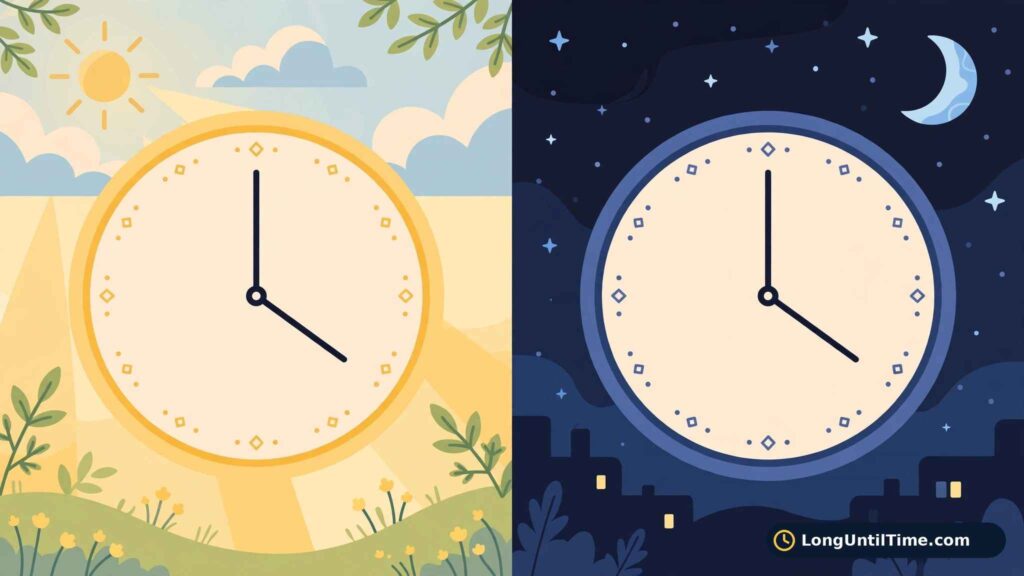
Remember that 4:00 AM and 4:00 PM are different times. Four in the morning is written as 04:00 in the 24-hour system, while four in the afternoon is 16:00.
AM refers to the period before noon, while PM refers to the period from noon until before midnight. Noon is 12:00 PM, and midnight is 12:00 AM. Understanding this difference helps prevent mistakes when setting alarms, scheduling meetings, or calculating the time remaining until an event.
Everyday Moments When 4:00 PM Really Matters
Four o’clock in the afternoon can serve as a useful planning point for work, family responsibilities, and personal activities. Knowing the time remaining helps people decide what to do next and how much time they can reasonably spend on each task.
The importance of 4:00 PM depends on your daily schedule. For one person, it may mark the end of a shift. For another, it may be the time to leave for an appointment or begin exercising.
End of the Workday
Some workplaces finish the day at 4:00 PM, while others use different schedules. If your shift ends at four, knowing how much time remains can help you organize your final tasks.
For example, if it is 2:30 PM, you have 90 minutes before the target time. You might use the first hour to finish important work and the remaining 30 minutes to review messages, organize files, and prepare for tomorrow.
A countdown can also help you avoid starting a task that requires more time than you have available. Instead of watching the clock repeatedly, you can set a reminder for your final review or closing routine.
School Pickup
Parents and caregivers may use a 4:00 PM countdown when planning school pickup or after-school transportation. Knowing the remaining time makes it easier to estimate when to leave and whether there is enough time to finish another task first.
Suppose pickup is scheduled for 4:00 PM and the current time is 3:15 PM. You have 45 minutes before pickup. If the journey usually takes 20 minutes, leaving enough time for traffic and parking can help you arrive without rushing.
Always follow the school’s actual pickup schedule and consider local traffic conditions. Four o’clock is not a universal dismissal time, so confirm the relevant school’s arrangements.
Online Meetings
A meeting scheduled for 4:00 PM gives you a clear deadline for preparation. You can use the countdown to decide when to review documents, open the meeting link, and check your microphone or camera.
If it is 3:30 PM, you have 30 minutes to prepare. That may be enough time to review the agenda, collect the information you need, and find a quiet place to join.
For meetings with people in other states or countries, confirm the time zone before setting your reminder. A meeting listed as 4:00 PM Eastern Time does not necessarily begin at 4:00 PM in every other US time zone.
Afternoon Workout
If you plan to exercise at 4:00 PM, tracking the remaining time can help you prepare your clothes, water, equipment, or workout space.
For instance, if it is 3:00 PM, you have an hour before your planned session. You could finish a work task, eat a suitable snack if needed, and get ready without feeling rushed.
A countdown can also support a consistent routine. When you choose a regular start time, you can plan your other activities around it instead of repeatedly delaying your workout.
Family Gatherings
Family activities, appointments, and afternoon visits may also revolve around 4:00 PM. Knowing how much time remains can help you prepare food, gather supplies, or coordinate transportation.
If guests are expected at 4:00 PM and it is now 2:00 PM, you have two hours to prepare. You can divide that period between essential tasks and leave a little extra time for anything unexpected.
The key is to treat the countdown as a planning aid rather than a guarantee that everything will be ready at the exact target time.
Tools That Help You Track the Countdown
Several simple tools can help you calculate or monitor the time remaining until 4:00 PM. The best choice depends on whether you need a quick answer, a continuously updating display, or a reminder.
An online time calculator is useful when you want to compare two times. Enter your current time and the target time, and the calculator determines the difference. This is particularly helpful when the minutes do not divide evenly into whole hours.
A countdown timer is better when you want to watch the time decrease. Set the target to 4:00 PM and check that the timer uses the right date and time zone. Some tools offer seconds, while others display only hours and minutes.
A digital clock provides a quick reference without requiring a separate calculation. Most phones and computers display the current time automatically, provided their clock settings are correct.
Calendar applications and reminder tools are useful when the target time represents an event. Rather than checking the countdown throughout the day, you can schedule a notification before 4:00 PM.
Each tool serves a slightly different purpose. A calculator answers how much time remains, a countdown tracks the passing time, and a reminder helps you act when the target approaches.
The Psychology Behind Waiting for 4:00 PM
Waiting for a particular time can make the afternoon feel longer, especially when you are eager to finish a task or begin an activity. Looking at the clock repeatedly may keep your attention focused on the remaining minutes instead of what you are doing.
A countdown can make the waiting period easier to understand because it turns an uncertain stretch of time into a clear duration. Knowing that you have 45 minutes left, for example, gives you a defined period in which to finish a small task.
However, watching the seconds continuously may become distracting. If you keep checking how much time remains, you may interrupt your work and find it harder to stay focused.
A better approach is to check the countdown at useful intervals. You might review it when beginning a task, halfway through the remaining time, and shortly before the target. This keeps you aware of the schedule without making the clock the center of your attention.
The goal is not to make time pass faster. It is to use the available time with less uncertainty and fewer unnecessary interruptions.
Productivity Tips While Waiting for 4:00 PM
The time before 4:00 PM can be useful when you match your tasks to the time available. Instead of treating the remaining period as time to wait, consider what you can realistically complete before the target arrives.
If you have two hours left, you may have time for a substantial task. If you have only 20 minutes, choose something smaller, such as answering an important email or organizing your workspace.
For example, someone checking the clock at 3:00 PM could reserve 40 minutes for focused work, 10 minutes to review the result, and 10 minutes to prepare for the next activity. This creates a simple plan for the hour without requiring a complicated schedule.
It also helps to choose a clear stopping point. If a task cannot be completed before 4:00 PM, decide which part you can finish and what should wait until later. This reduces the chance of rushing through important work.
A productivity timer can support this process by dividing the available time into manageable work periods. The exact length depends on the task and your preferences; there is no single interval that works for everyone.
Most importantly, leave room for unexpected delays. A plan that fills every remaining minute may be difficult to follow when a call takes longer than expected or another responsibility appears.
Planning Your Afternoon Around 4 PM
Four o’clock can serve as an anchor for organizing your afternoon. An anchor is a fixed time around which you arrange other activities. Once you know the target, you can work backward to determine when preparation should begin.
Imagine that you need to attend an appointment at 4:00 PM. If travel takes 25 minutes and you want 10 minutes to get ready before leaving, you should begin preparing at least 35 minutes before the appointment. That means starting at 3:25 PM, assuming the travel estimate is reliable and you do not need extra time.
The same method works for other plans. If you need to finish a work task before leaving at 4:00 PM, estimate how long the task will take and compare that duration with the time available.
For instance, if a task requires 50 minutes and the current time is 2:45 PM, you have 75 minutes before four. Completing the task should leave approximately 25 minutes for checking your work or handling a delay.
This type of planning is more useful than focusing only on the countdown. The countdown tells you how much time remains, while backward planning helps you decide how to spend it. The same approach also works for a nearby target, such as how long until 4:15 pm.
How Local Time and Time Zones Affect Your Countdown
The answer to “How long until 4:00 PM?” depends on which location’s 4:00 PM you mean. Local time differs across the United States, so a target of 4:00 PM in one state may occur at a different moment in another.
The contiguous United States generally uses four main time zones: Eastern, Central, Mountain, and Pacific. Alaska and Hawaii have their own time-zone arrangements, and some US territories use additional zones.
For example, when it is 4:00 PM Eastern Standard Time, it is 3:00 PM Central Standard Time, 2:00 PM Mountain Standard Time, and 1:00 PM Pacific Standard Time. These examples apply when the relevant locations are observing those standard-time offsets.
During daylight saving time, many locations move their clocks forward by one hour. This changes the relationship between local clock times and UTC, the international reference time used to coordinate clocks around the world.
Not every location observes daylight saving time. Hawaii and most of Arizona do not follow the same seasonal clock changes as most of the contiguous United States, although specific local rules and exceptions can apply.
If you are counting down to a local appointment, use the time zone of the place where the appointment will occur. If you are attending a remote meeting, check whether the invitation uses your time zone or the organizer’s.
For the most reliable result, use a device or countdown tool with automatic time-zone settings enabled. This is especially important when traveling or scheduling events across state lines.
Digital Devices That Keep You on Schedule
Phones, computers, tablets, and smartwatches make it easy to check the time remaining until 4:00 PM. Most modern devices can display the current local time, create reminders, and run timers.
A smartphone is convenient when you are moving between locations. You can set an alarm or calendar notification for a few minutes before 4:00 PM, giving yourself time to prepare for an event.
A computer may be more useful during work because the clock stays visible while you complete tasks. You can also keep an online countdown open in a browser tab if you want to see the remaining time.
Smartwatches provide quick access to the time without requiring you to reach for your phone. Depending on the device and its settings, they may also display upcoming events or send reminders.
However, digital devices are only as reliable as their time settings and software. If the clock is incorrect, a countdown may also be incorrect. Automatic date, time, and time-zone settings can reduce this risk when the device has a reliable connection and supports the relevant location.
Choose a tool that matches your needs. A simple clock may be enough for casual planning, while a calendar alert is more appropriate when missing an appointment would cause problems.
Related Time Searches People Also Make
People searching for the time remaining until 4:00 PM often want to calculate the difference between other times or understand how much time has passed.
These related searches share the same basic principle: compare a starting time with a target time, taking the date and time zone into account when necessary.
| Related search | What it helps you calculate |
|---|---|
| How long until 3:00 PM? | The time remaining before 3:00 PM |
| How long until 3:30 PM? | The time remaining before 3:30 PM |
| How long until 3:45 PM? | The time remaining before 3:45 PM |
| How long until 5:00 PM? | The time remaining before 5:00 PM |
| How long until 6:00 PM? | The time remaining before 6:00 PM |
| What time is it in 30 minutes? | The future time after 30 minutes |
| What time was it one hour ago? | The time one hour before now |
| How many minutes are in two hours? | The conversion from hours to minutes |
For example, if it is 3:15 PM, 45 minutes remain until 4:00 PM. If you want to know what time it will be 45 minutes from 3:15 PM, the answer is 4:00 PM.
These questions may sound similar, but they ask for different results. A countdown question asks for a duration, while a future-time question asks for a clock reading. Understanding the difference helps you choose the right calculation.
Making the Most of the Time Before 4:00 PM
The best way to use the time before 4:00 PM is to decide what matters most and match your plans to the minutes available. You do not need a detailed schedule for every afternoon. A clear priority and a realistic estimate are often enough.
If you have an hour left, choose a task that fits within that period. If you have 15 minutes, focus on one small action rather than beginning something that will require much longer.
You can also use the countdown to prepare for transitions. Give yourself enough time to save your work, gather your belongings, travel, or join a scheduled meeting. These small preparations can make the move from one activity to another easier.
Avoid checking the clock every few seconds unless the timing is especially important. Set a reminder when necessary, then focus on the task in front of you.
Finally, remember that the time remaining is only one part of planning. Your priorities, travel time, deadlines, and unexpected interruptions all affect what you can accomplish before four.
Frequently Asked Questions
How long until 4:00 PM today?
The exact time depends on your current local time. At 1:00 PM, three hours remain; at 2:00 PM, two hours remain; and at 3:30 PM, only 30 minutes remain.
How many minutes are left until 4:00 PM?
The number of minutes depends on the current time. For example, 60 minutes remain at 3:00 PM, 30 minutes at 3:30 PM, and 15 minutes at 3:45 PM.
How do I calculate how long until 4 PM?
Subtract the current time from 4:00 PM. If it is 2:20 PM, the remaining time is 1 hour and 40 minutes. If the target time has already passed, decide whether you mean the time since today’s 4:00 PM or the time until tomorrow’s 4:00 PM.
What is 4:00 PM in 24-hour time?
4:00 PM is written as 16:00 in the 24-hour clock system. The 24-hour format removes the need for AM and PM because each hour has its own number.
Is 4:00 PM afternoon or evening?
4:00 PM is generally considered afternoon. The exact point when people describe the time as evening varies by personal usage, season, and location.
Does the countdown to 4:00 PM change by location?
Yes. Local time zones affect when 4:00 PM occurs. A countdown to 4:00 PM in New York may differ from a countdown to 4:00 PM in Los Angeles because the cities use different time zones.
What happens if it is already after 4:00 PM?
If it is after 4:00 PM, today’s target has passed. If you want to know how long until the next 4:00 PM, calculate the time remaining until four o’clock the following day.
Can I use my phone to track the time until 4 PM?
Yes. You can use your phone’s clock, timer, alarm, or calendar application. For a continuously updating countdown, choose a tool that supports a specific target time and uses the correct local time zone.
Conclusion
Knowing how long until 4:00 PM helps you plan work, appointments, school pickup, exercise, and other afternoon activities. The exact answer depends on your current local time: if it is 1:00 PM, you have three hours left; if it is 3:30 PM, you have 30 minutes remaining.
You can calculate the difference manually, use a live countdown timer, or set a reminder on your phone. If 4:00 PM has already passed, remember to distinguish between the time since today’s target and the time until the next day’s 4:00 PM.
Readers can also browse the encyclopedia entry on the school run for more on the busy end-of-school hour.